
2SaveEnergy
Strong tomato crop with less gas in 2SaveEnergy greenhouse
In a Cappricia crop in the 2SaveEnergy Greenhouse, we are seeing how far we can go with limited ventilation. Among other things, an average 24-hour temperature of 21.4ºC was achieved in April.
The crop tolerated this for quite a while, but in early May we had to start providing more ventilation. But venting more during the day means that less CO2 and moisture are retained in the greenhouse. In the 2SaveEnergy greenhouse, we have also been trying to save as much energy as possible without affecting the strength of the crop. That has worked well so far. Up to April, we were using 5 m3/m2 (planting date: 5 January) plus 10 kWh electricity for the heat pump.
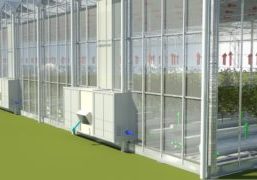
This greenhouse has a double glass roof with an F-clean film and is also equipped with a double aluminium screen and a transparent (Luxous) screen. To limit outgoing radiation, the screen is closed quite early at the end of the day, at around sunset. In winter and spring we don’t generally vent off heat towards the evening. During dehumidification, we recover both the sensible and latent heat from the air and we also use the heat from the heat pump for heating the greenhouse air.
Related



Good cucumber yields in innovative Winterlight greenhouse
Last year the focus in the Dutch 2SaveEnergy greenhouse was on high-wire cucumbers. Over two production cycles, Wageningen University & Research investigated whether it was possible to grow a crop that could intercept and use winter light to the full. This trial was a preliminary study in advance of upcoming trials in the Winterlight greenhouse, a design that lets in 10% more light in the winter.
The crop in the innovative greenhouse was very successful, say crop researchers Jan Janse and Frank Kempkes. It was cleared at the end of November and the total yield is estimated at 110 kg, with 260 cucumbers. “And all with minimal energy input,” Janse says. “We used around 17.5 m3 of gas over the entire year. That once again puts us well below the average for the sector.” Yet again, this new greenhouse proves what it is capable of. The concept clearly demonstrates that Next Generation Growing can be made even more energy-efficient without affecting production or quality.
Steering the crop
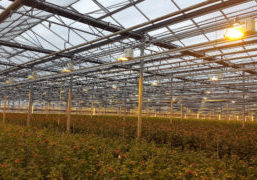
This high-insulating greenhouse at the Energy Innovation and Demonstration Centre in Bleiswijk features clear glass and a permanent, high light transmitting, diffuse layer of plastic film parallel to the glass. The greenhouse is fitted with a dehumidifier unit with outdoor air entering via ducts under the gutter.
The researchers planted the cucumber variety Hi-Jack in the greenhouse on 29 December 2015. The crop was steered by varying the row width and plant density and by thinning out the fruits, the optimum having been modelled in advance. Over two production cycles the team intensively monitored light interception, cultivation (crop, production and quality) and energy consumption.
Different row widths
Janse: “We decided to start with a plant density of 1.67 plants/m and three different row widths: 1.4, 1.6 and 1.8 m. Among other things, we wanted the trial to tell us which row width would produce the best crop, would be best for light utilisation and would be easiest to work in. After all, you have to be able to move through the cucumbers on the high-wire trolley without damaging the plants too much. Each setup consisted of three ‘carousels’ (growing gutters). Regular crop observations were carried out on one carousel in each setup.”
To record the observations, Kempkes took photographs from a fixed position above the crop at the same time once a week. Using an image processing program, the researchers were then able to track the development of the crop and the projected leaf surface area to get an idea of the amount of light being intercepted. Kempkes: “If you can see a lot of the floor or the gutter on the photos, light interception is not as good as it could be.”
45% less gas
At the end of January last year, the plants were doubled by pinching out. “At one point we had a crop with highly generative growth and small leaves, but we still harvested a lot of cucumbers from it. Over six weeks (weeks 15-20) the crop produced as many as ten cucumbers per week, or 4.5 kg/m2. So clearly the plants were using their assimilates very efficiently.”
According to Janse, even the two growers on the supervisory committee were looking enviously at the crop. “The plants were strong and production was high – better than in a commercial greenhouse, in fact. We still have some work to do to find out the exact reasons for this. It may be partly down to good crop care. What was also striking was the temperature achieved: it averaged 1ºC higher than in a commercial greenhouse. This meant that the cucumbers got going very quickly. Over the entire period, the development time was around 14 days at an average greenhouse temperature of 21.4ºC. The row widths of 1.4 and 1.8 m yielded the highest production. In addition, gas and pure CO2consumption worked out at 12.7 m3and 4.5 kg/m2 respectively. This represents savings on gas consumption of around 45% compared with commercial greenhouses.”
Later second planting
The team set up a new crop in mid-July. This time they used Hi-Power with a plant density of 2.25 plants/m2, again with the same three row widths. In the period with the most light, there was therefore a gap of three weeks between the end of the first crop and the start of the second one. “We deliberately planted it slightly later because we wanted to test the crop in the dark period as far as possible. After all, this was a preliminary trial for the Winterlight greenhouse. By the end of October we had already harvested almost 100 cucumbers from this second crop, with an average fruit weight of around 420 grams. The crop finished off well and we achieved excellent overall production of good quality cucumbers.”
This time too, the row widths of 1.4 and 1.8 m yielded the best results. So the objective was fulfilled. An excellent crop can indeed be achieved with a relatively small leaf surface area, in other words small leaves, a characteristic of the variety. Because the rows were oriented east-west and care had been taken to distribute the wires evenly, the crop clearly intercepted enough light and a good proportion of the assimilates went to the fruits. There was barely any fruit abortion. Smaller leaves also mean less transpiration, which saves energy in cold periods.
Winterlight greenhouse
The research into an efficient Winterlight crop was brought to a successful conclusion. On to phase two: in late December 2016 a new high-wire crop was planted in the Winterlight greenhouse, this time with a row width of 1.8 m. Kempkes: “Both 1.4 and 1.8 produced good results but there was more plant damage with 1.4 m spacing.” The scientist, who also manages the Winterlight greenhouse project, is expecting a lot from the follow-on trial. “The Winterlight greenhouse was handed over recently and is really very nice.”
The entire structure is painted with a white powder coating with an increased reflection factor of 90%. The glass used is SmartGlass, a new type of diffuse glass in panes measuring 300 x 167 cm. Light transmission remains constant even if the glass is wet or covered in condensation. The integrated ISO++ screen system is fitted in a W shape for optimum light transmission when the screen is closed. In addition, the greenhouse is fitted with a new, highly transparent screen cloth with even better light transmission.
The greenhouse is equipped with an Air in Control climate system. The expectation was that the greenhouse would let in at least 10% more light. “Initial measurements have indicated that this light gain has in fact been achieved. The next crop will prove whether we can achieve a 10% rise in production too.”
Cutting energy consumption
In the meantime, the 2SaveEnergy greenhouse has been adapted for a new research project entitled “A strong crop with little gas”. The assumption is that it should be possible to go yet another step further in reducing energy consumption. Janse: “We will be trying this out with a dehydration system that recovers heat using a heat pump. This will enable us to not only recover tangible but also latent heat. There will also be three movable screens in the greenhouse and some adjustments will be made to the control strategy for the tomato crop.”
Both the 2SaveEnergy greenhouse and the Winterlight greenhouse are financed by the Greenhouse as a Source of Energy programme, the innovation and action programme of LTO Glaskracht Nederland and the Dutch Ministry of Economic Affairs.
Summary
A high-wire cucumber crop was grown in the high-insulating 2SaveEnergy greenhouse last year. The aim of the project was to optimise a vegetable crop by making use of the available scarce winter light. Over two cycles the researchers intensively monitored light interception, cultivation (crop, production and quality) and energy consumption. The crop performed well and the trial clearly demonstrates that both energy savings and higher production are achievable.
Text: Jojanneke Rodenburg. Images: Studio G.J. Vlekke.
Related


IPM Innovation Award 2017 for 2SaveEnergy Consortium
On the occasion of the opening ceremony of the 35th IPM 2017 in Essen INDEGA presented the IPM Innovation Award to the 2SaveEnergy Consortium for the 2SaveEnergy greenhouse system. The award was handed over by Frank Lock, President of the Representation of interests of the German horticulture industry (INDEGA).
This year, attention focused on innovations and new technical features relating to all aspects of products for the regional and supraregional production of vegetables. The prerequisites for participation were that the products offer economic and ecological benefits, are marketable and are being presented at the fair.
Best Innovations of International Plant Breeders
Messe Essen and the Central Horticultural Association honoured the most impressive innovations at the fair for the tenth time. Corina Krause, Flower Fairy 2017, and Eva Kähler-Theuerkauf, Chairwoman of the Advisory Board for the IPM ESSEN Fair and President of the North Rhine-Westphalia State Horticultural Association, congratulated the winners:
• The Pelargonium zonale 'Brocade Fire Night' presented by Dümmen Orange from Rheinberg was distinguished as the "IPM Innovation 2017" in the "Bedding and Balcony Plant" category.
• The Mandevilla sanderi (Hemsl.) Woodson 'Mini Scarlet' received the title in the "Tub Plants" category.
• The Hibiscus rosa sinensis 'Petit™Orange' presented by Graff Breeding from Denmark received the mark of distinction in the "Flowering House Plant" category.
• An alstroemeria presented by Könst Alstroemeria from the Netherlands, i.e. the 'White Pearls', was once again distinguished in the "Cut Flowers" category.
• The Expert Commission decided in favour of the Picea abies 'Little Santa' presented by Baumschule Artmeyer from Hörstel in the "Woody Plants" category.
• The jury has distinguished the Helleborus Gold Collection ®Ice N'Roses® (Helleborusxglandorfii) presented by Heuger Gartenbaubetriebe from Glandorf in the "Shrubs" category.
• The Rosa polyantha 'Smeralda Green Show' presented by Twelve Energy Societa Agricola SRL from Italy emerged as the Special Prize winner this year.
Source: IPM Essen. Photo: Mario Bentvelsen.
Related

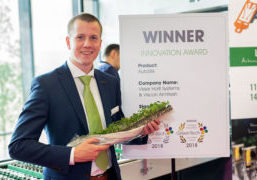

GreenTech Innovation Award 2016 nominees announced
A shortlist of nominees, all but two of them Dutch, has been announced for the GreenTech Innovation Award 2016. An international jury has selected a shortlist of 15 nominees from 73 entries in three categories: Production, Equipment and Automation Solutions. One of these three winners will be chosen as the overall winner on June 14, during the opening event of GreenTech Amsterdam.
“As jury, we are very pleased with both number and quality of the applications for the GreenTech Innovation Award 2016. It shows the high level of innovation in the greenhouse horticulture sector”, said jury chairman Aalt Dijkhuizen, former president of Wageningen UR and appointed by the Dutch Minister of Economic Affairs as figurehead of the Topsector Agri & Food in the Netherlands.
Shortlisted in the Production category are:
- RootmaXX by Saint-Gobain Cultilene - a new stone wool cube which claims to give a 5-25 per cent higher root mass thanks to a newly patented fibre.
- ISO Cutting and Planting robot 1800 by ISO Group - which automatically analyses the geometry of a stem, cut the stem to the right length and plants it in a pot.
- ISO Plantsampler by ISO Group - which automates the gathering of DNA material from the leaves of trial seedlings.
- GrowCoon by Maan BioBased Products - a biodegradable plug casing which help keeps the root ball together.
- Biospreader by Royal Brinkman - which provides a uniform distribution of predatory mites in the crop.
Shortlisted in the Equipment category are:
- 2SaveEnergy covering by 2SaveEnergy - a twin-skinned glasshouse covering claimed to combine high insulation and light transmission with an affordable.
- Triton Bioreactor by Van der Ende Groep - a biological treatment which yields clean irrigation water rich in oxygen and microbial biodiversity.
- AntiReflect by Mardenkro - a glass treatment which can be applied to existing greenhouses.
- NUF water recycling by NUFiltration (Israel) - which enables purification of irrigation water without use of chemicals, thermal or biological treatments.
- ValkScreenVision by Van der Valk Horti Systems - a quick, clean and safe system for inserting glasshous screens.
- Priva Deleafing Robot by Priva - a robot which removes leaves from tomato plants completely independently and in an economically profitable manner.
Shortlisted in the Automation Solutions category:
(with one remaining undisclosed)
- Paskal Growth Analyser by Paskal Technologies (Israel) - a wireless weighing system to continuously monitor plant growth in the glasshouse.
- C.H.I.M.P (Crop Health & Information Monitoring Platform) by Phenokey - which measures control and plant health parameters for remote monitroing and decision support.
- HortiMaX-Go! by Ridder Hortimax Group - a user-friendly and affordable horticultural computer for controlling both greenhouse climate and irrigation.
All nominated products will be on display at GreenTech's InnovationLAB.
Source: GreenTech. Photo: Mario Bentvelsen.