algorithm
Big data poised to navigate growers to their targets
With cultivation so closely intertwined with the Internet and with the advent of crop and climate sensors, big data is becoming available to the greenhouse horticulture sector. Big data consists of huge collections of information that growers can use to optimise operational aspects such as crop growth and energy consumption. A consortium of companies and organisations is working on the calculation models and algorithms that should make a comprehensive management program possible. “Think of it like a satellite navigation system (satnav): the grower enters a target and the program guides them there.”
“Imagine you’re a tomato grower. Wouldn’t it be great if you could manage your yields, quality and harvesting times even more accurately than you do at present. What buttons should you press to achieve that? That’s what we’re working towards,” says Simon van Mourik, Assistant Professor at the Farm Technology Group at Wageningen University & Research in the Netherlands, where he works on intelligent agri-systems based on precision technology and data streams.
Alternative route
Van Mourik has teamed up with energy specialists AgroEnergy to lay the foundation for a joint research project. The university, the energy partner for greenhouse horticulture and a number of companies and organisations were recently awarded funding for this project, which is entitled “Energy saving in greenhouse crop production by flexible management” and goes by the working title “FlexCrop”. The research project will start in a crop of artificially lit tomatoes next summer. The consortium also includes the Dutch growers’ organisation LTO Glaskracht and the companies B-Mex, LetsGrow.com and Delphy.
Developing a management program based on big data is no small matter. A period of four years has therefore been allowed for FlexCrop. There are a lot of requirements to be met. First of all, the program must be able to adjust for temporary fluctuations, just as a satnav recommends an alternative route for the driver if there is congestion ahead. “This dynamic must be built in. So the program must steer dynamically. In terms of climate and energy consumption, for example, that can be done by adjusting the settings hour by hour based on the most recent data,” says van Mourik.
Analyse and interpret
All the relevant cultivation factors must be built in. For example, B-Mex is looking at forecasts from changed settings. Take the CO2 dosage. What happens if the grower increases the concentration of CO2? What would that cost? And what would it deliver in terms of crop growth or extra kilograms of product? Based on the measurements and calculations, the program must be able to recommend the best and most cost-effective CO2 dose for the crop.
Van Mourik: “Next Generation Growing has already taught us that a crop is very flexible. With even more information about this, we can develop an algorithm that optimises the settings accordingly. That calls for models that predict the consequences of a particular action or situation. These models do already exist but they are not yet perfect. The challenge is to analyse and interpret the enormous volume of data in the right way.”
Two PhD students are helping with the research. One is working on knowledge of crop physiology and the other is working on an algorithm that utilises the flexibility of the crop. “In this project, the trick will be to make the best use of all the partners’ expertise,” the Dutch scientist says.
For growers, the datasets on which the management information system is based are invisible. Will they have the courage to trust the advice? Van Mourik thinks so. “Look at the satnav. You don’t know how it works but you still follow the instructions and you do what the screen on the dashboard tells you to. ‘After 300 metres, turn left’ – and you really do turn left after 300 metres. And that gets you where you need to go.”
Intertwined with business aspects
One example of where big data can take us is BiedOptimaal from AgroEnergy. This program calculates the optimum APX bid for the next day based on extensive data sets and prediction models. More than 130 growers are already using it every day. There’s a lot to be got out of the energy market for the grower, AgroEnergy product developer Peter Goudswaard explains. “Energy is an important part of the cost price and energy prices can fluctuate strongly on the APS and the intraday market. With the right APX bid and by adjusting for intraday, you can use the program to make significant savings in energy costs and time.”
At the moment the company is working on a series of additional solutions designed to help growers with everyday issues. There’s no shortage of examples. Goudswaard: “Is it worth switching on the lights or would it be better to leave them switched off? What would it cost you in the first scenario, and what would you save in the second? And what does the crop do when the lights are on or off? What extra yields could you get, and what costs would be involved? The program doesn’t approach the cost factor of energy in isolation and is becoming more and more closely intertwined with many areas of production, climate and day-to-day operational aspects. We are working with a number of partners on this.”
Support for decision-making
Goudswaard’s colleague Bram van Rens is a data scientist at the Delft-based energy specialists: “The yield has to come from cultivation, whereas climate is a cost factor. It takes time if the cultivation manager and the energy manager keep having to meet because the cultivation manager wants to switch on the lights to boost growth and yields while the energy manager wants to feed energy back into the grid because prices are good at that point. Their objectives differ, but cultivation and energy are both factors in the company’s bottom line: they have to go hand-in-hand.”
Big data makes it possible to provide advice that will highlight the optimum, van Rens believes. “With systems that support decision-making we can make things easier for the grower. As sensors and the Internet of Things produce more and more information and data, there is an increasing need for this.”
Less to the daily market, higher mid price
The Dutch company HortiKey is working on other applications based on big data. The company’s latest innovation is the Plantalyzer, which has been developed for tomatoes to begin with.
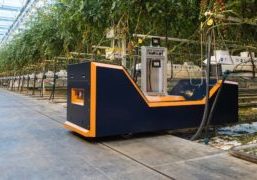
The autonomous measuring system photographs the colour of the tomatoes on a scale from 1 to 12. The measurements are then used to produce a forecast of the harvest in kilograms two weeks in advance. This is very handy. After all, if the grower knows that in two weeks’ time he will be producing more than he is contracted to deliver to the customer, his sales staff can start looking for alternative outlets. General Manager Andreas Hofland: “Otherwise they have to get rid of the surplus on the daily market, where prices almost always put pressure on their mid price. With this system, you can reduce the normal margin of error in production planning by around ten percent.”
When all is said and done, the measuring system is a sales tool, Hofland says. But it is a little more than that, because it also highlights production differences and can detect colour variations. “If some trusses are ripening differently from the others, this tells the crop manager that there has been a problem there. If he is able to find out exactly what that is, that mistake can be avoided in the future – even if it was only a leaking window. This is a way for inquisitive growers to get their hands on a wealth of new information.” The company mainly specialises in applications for large fruiting vegetable nurseries. That’s a strategic choice, because these nurseries are becoming larger and larger the world over, and yet it is becoming harder to find good crop managers and the risks (in other words, errors in cultivation or production) still have to be eliminated.
Summary
The trick with big data is to recognise patterns in the enormous streams of data and convert them into information that can be applied to the grower’s day-to-day practice. Various parties in the greenhouse horticulture sector are working hard on this. A consortium is developing a management information system based on big data, for example, and one company is focusing on yield forecasts that helps growers manage production and sales even more precisely.
Text and images: Jos Bezemer.
Related



Crux Agribotics develops cucumber robot with machine learning
Brabant start-up Crux Agribotics has developed the world's first fully automated cucumber harvesting robot. The robot is unique because it also harvests cucumbers deeply hidden between the leaves of cucumber plants. The robot uses a machine learning algorithm, which allows it to independently determine which cucumbers are ripe for cultivation, and which cucumbers are diseased.
The harvesting robot consists of a trolley with rotating cameras and a flexible grab arm. The cameras make 3D images of the crop from a variety of angles, after which the robot uses special software to build up a complete picture of where cucumbers are located. The robot then sends the coordinates of each cucumber to the grab arm, which clamps the cucumber by the stem.
Hidden cucumbers
Since the robot visualises the crop from different angles, it also sees cucumbers hidden deep between foliage. Special software converts various images into a whole, and controls the grab arm. According to Richard Vialle, co-founder and director of Crux Agribotics, the robot picks 96 percent of all ripe cucumbers. A limited number of employees follow the robot to pick any cucumbers which are missed.
Smart robot
Vialle says that the data collected by the robot is very important. The robot uses a machine learning algorithm, allowing it to assess more accurately which cucumbers are ripe for picking. The grower is partly responsible for this learning process. According to Vialle, "The robot sends the grower a picture when in doubt, and asks what it should do with the cucumber in question." The robot also learns to recognise diseased cucumbers in this way.
Harvesting, sorting and packing
A major advantage of the machine learning algorithm used by Crux Agribotics is that a robot can also sort and pack cucumbers. However, the advantages of the algorithm do not stop there. Vialle says, “The learning algorithm means that the robot can also make predictions, such as how the cucumber will grow, or how many days before a cucumber is ripe."
On the market
Crux Agribotics has tested the fully automated cucumber robot with a number of growers, and is currently working on developing an industrial product that can be used anywhere in the world. “We need another two years for this, and are we looking for strategic investors," says Vialle. Crux Agribotics is also developing similar robots for pepper and tomato crops.
Text: Leo Hoekstra. Photo: Crux Agribotics.