
assimilation lighting
Slowing down crop transpiration cuts energy consumption
The focus of energy savings usually lies in technology. But the crop itself offers numerous opportunities to economise on energy consumption. Many research results are still waiting to be translated into practice.
Significant differences in energy consumption per square metre or per kilo of product regularly exist between nurseries with similar greenhouses and the same crop. These can be attributed to different views on production among the growers. One grower likes to play it safe, the other looks more into the possibilities of the plant. Within the scope of The Next Generation Growing other ways to deal with the characteristics of the crop is gaining more attention. Previous research results form the basis for this.
Transpiration
Transpiration is the driving force behind essential processes such as mineral uptake, transport in the plant, maintaining cell tension and development of fruits. But the plant exaggerates: In the greenhouse it often transpires much too much. This 'luxury' transpiration brings an excess of moisture into the air, which then needs to be removed. And draining off moisture always costs energy. It would be very advantageous to be able to slow down transpiration. Various studies have shown that it can be reduced by 30 to 35% in tomatoes without any cost to production.
Less minimum heat
Yet in practise, growers are still reluctant to slow down the transpiration. They want an ‘active crop’ and are afraid that root growth will lag behind. But ‘active’ means that the crop fully assimilates; this can also be done with less transpiration. And you can stimulate root growth better with a lower greenhouse temperature.
Over the last few years commercial growers have been assessing much more critically the use of the minimum heating pipe to reduce air humidity. Actually, raising the temperature encourages the crop to transpire even more. And then the windows have to be opened to lower the air humidity.
One step further than economical use of the minimum pipe is dehumidification with external air in combination with more screening. Then you control the air humidity independently of the window position. But this of course requires extra technology.
Picking leaves
A very effective means to drastically reduce crop transpiration is to pick leaves on a major scale. With a leaf area index (LAI = m2 leaf surface area per m2 ground) of 3 to 4 you already have sufficient light interception. Any number above that means you have a superfluous amount of leaf in the greenhouse.
It’s normal to pick the leaves of tomato plants but it would also be a good idea for sweet peppers too. The lower leaves only transpire and don’t contribute any more to photosynthesis. Picking could also be an option for different ornamental crops. Of course you need to consider whether the extra labour outweighs the energy savings.
Temperature
In practise there are many fixed views about the necessary temperature gradient during the day. Tomato production is definitely a crop that is very dependent on the temperature strategy. But some of these opinions lead to very high energy consumption. If you heat before sunrise, when the outside temperature is at its lowest point, it costs a lot of gas. If you want to achieve a sharp drop in temperature at the end of the day, and therefore open the windows, all the heat that you’ve just put in is simply lost.
Retain the heat
The question therefore is whether the temperature gradient during the day needs to be so precise. To find out, a study compared three regimes: Heat up quickly in the morning and cool down quickly in the evening; heat up and cool down slowly; and a middle road in which the house was heated slowly and cooled down quickly. The researchers followed the crop for an entire season, critically observed by a growers group. What happened? Looking at the crop you couldn’t tell which treatment had taken place and yield hardly differed. However, the steady strategy did save energy.
For the growers group it was a question of ‘seeing is believing’. They applied the regime to their own nurseries. Seen from a plant perspective the results were not surprising: The plant responds sooner to the mean 24-hour temperature than to a specific gradient during the day. So as a grower of fruit vegetables you can easily heat the house adapted to the amount of light and keep the heat in at the end of the day. You achieve the same 24-hour temperature with less energy.
Cooling
Another point is that at the end of the day leaves and fruit cool off at different speeds. The leaf temperature follows the greenhouse temperature; the fruit temperature lingers behind. The effect of this could be that the fruit attracts more assimilates. The differences are so small, that it’s hardly noticeable. Research has shown no differences in fruit weight between the different cooling strategies.
In pot plants, where the shape of the total crop is important, phenomena like DIF (the difference between day and night temperatures) and DROP (a sudden drop in temperature) can indeed affect the elongation or the compactness. Then it’s worth having a temperature regime during the day.
Light and lighting
If you look at light from an energy point of view, you arrive at two questions: How do you best utilise the natural light and when does it pay to use assimilation lighting? The answer to the first question was always: Ensure that the greenhouse has the highest light transmittance possible. Based on the research over recent years we can now add: Diffuse light almost always pays off. This light penetrates much deeper into the crop, the horizontal distribution of light is more uniform and both result in more assimilation.
The answer to the second question requires some more explanation. With respect to temperature, the plant responds to the average over the day, or over a few days. The latter forms the basis for temperature integration. With light however, there is an immediate response. At the same time, there are reasons why the plant, despite a lot of light, assimilates very little, for example, because the stomata are closed for one reason or another. It is therefore very useful to know the reason why. Then you know when the assimilation lights have an effect.
Photosynthesis
A grower can already determine the photosynthetic activity himself with instruments such as the Plantivity, but these measure just a very small piece of leaf. New methods are being developed that measure the photosynthesis (actually the fluorescence) of a square metre of leaf surface area.
A better understanding of photosynthesis can save energy because then the grower can adjust the lighting and CO2-dosing according to the activity of the crop.
Summary
A different growing strategy is a potential key to saving energy. An important part of this is to slow down transpiration. Furthermore, the precise temperature gradient over the course of the day is often not that important. The plant responds more to the average for the day (or several days). This response also offers a basis for saving energy. Finally, better utilisation of natural and assimilation light is possible.
Text and images: Ep Heuvelink (Wageningen University), Anja Dieleman (Wageningen UR Greenhouse Horticulture) and Tijs Kierkels.
Related

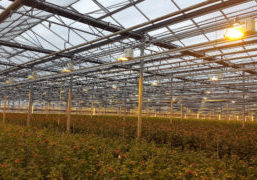


Combining two vertical fans makes for more even climate
Assimilation lights give off a lot of heat which stays at the top of the greenhouse when you would rather have it down near the crop. And closed screens also bump up the temperature too much. Fresh Valley in the south-east of the Netherlands has solved both these problems with a combination of two vertical fans. After a successful trial, tomato grower Bert van den Brand has also installed the system at his second site where it is enabling him to limit light emissions with no side-effects.
When Bert van den Brand increased the assimilation lighting in his nursery in Uden from 8,000 to 13,000 lux in late 2014, he encountered a problem. “We are right next door to a residential area there so we have to use screens to prevent light emissions. But with such high light levels the night-time temperature rises so high that it affects your 24-hour temperature. So you end up with thin, puny plants, poor fruit setting and the risk of scorching on the shoot apex”, he says. He wanted to find a relatively simple solution to the problem.
As it happened, an energy efficiency trial involving a combination of two fans had been running at his Maasbree site since the beginning of that year, run by Wageningen University & Research in collaboration with Dutch suppliers Vostermans Ventilation and Hint Installatietechniek. The results were so good that the grower decided to try out the system at his site in Uden as well.
Own brand
Fresh Valley has two sites: 2.7 hectares in Uden and 6.3 hectares in Siberië, Maasbree. The nursery mainly grows Juanita, a small, sweet truss tomato sold under their own brand name, L’Amuse. It also supplies Kumato, a golden-brown tomato grown by other growers. Half the area in Maasbree is lit with 10,000 lux and the other half with 13,000 lux. Half the power needed for this system comes from the nursery’s own CHP unit and the rest is bought in. They opted for this arrangement to avoid generating a lot of excess heat.
The combination of fans was left in place after the trial (3,000 m2). “The bottom fan, a Multifan V-FloFan, draws the cold air upwards from below and distributes it horizontally so that it passes along the lights and warms up. When the lights are on, this fan is always running,” van den Brand says. It’s the same at the Uden site.
Better temperature distribution
The top (axial) fan draws cold, dry air downwards through the closed screen. This air bounces off a plate and is then distributed by the bottom fan. The top fan is only used if it gets too hot or too humid under the screen,” says Guus Vostermans, sales engineer at the company of the same name.
The result achieved with the combination, named Ventilation Jet, is better mixing of the greenhouse air and therefore fewer horizontal and vertical temperature fluctuations. Van den Brand: “Before the trial I had not expected it to work as well as it did. But not only did Wageningen University & Research’s measurements indicate better temperature distribution, the crop is also more even.”
There are 50 fan combinations per hectare in Maasbree and 11 per hectare in Uden. Because the top fans there are double capacity, that works out at the equivalent of 22 per hectare. So that is still quite a lot fewer. “In Uden we have an Obscura blackout screen that is 95% closed. So you actually always have a small gap of five percent. That’s why we could get by with fewer there,” he says. They also have ducts with fans hanging under the gutters, which also help improve air circulation. “If we didn’t have those, we would need more fan combinations.”
Preventing light emissions
Van den Brand has not yet decided to kit out the whole greenhouse in Maasbree with the system. That will probably only happen when the screens need replacing. At the time of the trial, which focused on energy saving, two highly insulating screens were installed in the section with the fans. Because of the low post height (4.5 m), they run across the same wire bed so they can’t both be closed at the same time. There is a blackout screen (XLS 10 Revolux) and a transparent screen (XLS SL 99 Revolux W/W).
But saving energy is not van den Brand’s main objective. “Our primary concern at Uden is to prevent light emissions. The Ventilation Jet is the only way we can keep the air cool enough in our situation. The second argument in its favour is a more even climate.”
Energy savings
The system does in fact deliver energy savings. Van den Brand puts the savings in the section in Maasbree (3,000 m2) at around 10-15% in winter, thanks to a lower minimum pipe temperature, fewer gaps and less venting. “The minimum pipe temperature is about 4°C lower, so 36°C instead of 40°C, for example. But the plant always comes first. If it needs 40°C, it gets 40°C.”
The transparent screen stays closed for the first eight weeks of cultivation. “This also benefits the plant. With the darker screen we don’t need to leave gaps at night up to an outside temperature of 12°C, and you hardly ever get that in winter”, he says.
Without the fans he would have to vent more when the screen is closed. “That’s not ideal, of course: you’re getting rid of heat and wasting energy”, he says.
Mixed feelings about NGG
So there is evidence that this system does save energy. But as already mentioned, that is not van den Brand’s primary concern. He mainly tends to sidestep Next Generation Growing (NGG): “With an unlit greenhouse, NGG can save you a lot of energy, but we have lighting everywhere. There are definitely good things in the NGG approach, but I can also see accidents happening. You take big risks to save a few cubic metres of gas, but that can be at the expense of quality and flavour, as flavour can deteriorate if you inhibit transpiration. We can’t allow that to happen with our own brand. So we have very mixed feelings about NGG. It depends a lot on whether you are production- and cost-oriented or market-oriented, as we are. We would rather not risk it.”
Fresh Valley was one of the first nurseries to use vertical fans. The concept has been refined since then. Vostermans says that following customer feedback they reduced the noise level: “People found it particularly annoying at harvest time and while working on the crop. The current generation is quieter and also a lot more energy-efficient.”
Summary
Fresh Valley uses a combination of two vertical fans. The bottom fan is always running when the assimilation lights are on. It draws cold air upwards from below and mixes it with the warm air at the top of the greenhouse. The second fan draws cold, dry air downwards through the closed screen. Together they create a better greenhouse climate with fewer temperature fluctuations and save energy as well. At one site, the main reason for installing the fan system was to prevent light emissions without causing problems.
Text: Tijs Kierkels. Images: Wilma Slegers.
Related



Dutch aubergines now also available in winter
Purple Pride will be offering aubergines grown under assimilation lighting starting this week. It is expected that over 100,000 kg of aubergines will be harvested this winter at Purple Pride’s cultivation site in Dinteloord, where a total surface area of 7000 m2 is dedicated to growing aubergines under assimilation lighting. Until recently, the only aubergines available during the winter season in the Netherlands were imported from Spain.
After three years of testing, Purple Pride now believes that the time is ripe to officially bring aubergines grown under assimilation lighting to the market. The fact that this took three years demonstrates that the growers’ collective did a lot of research before coming to this decision. Grower Peter de Jong: “We noticed that more and more of our clients were asking for Purple Pride aubergines outside of the regular season. There is a demand for locally grown products. However, the Spanish alternative is not always reliable in terms of availability and quality.”
Sustainably grown
Normally speaking, the aubergine season in the Netherlands runs from late February to mid-November. To respond to the production hiatus, aubergines are imported from Spain. De Jong: “We are convinced that there is sufficient demand for a product that distinguishes itself from the conventional variety in addition to the volume obtained from Spain. In addition to quality, our customers attach considerable value to sustainable production methods. We limit our water consumption to the absolute minimum, for example, and use biological crop protection methods.”
Aubergine brand
Purple Pride has been dedicated to growing high-quality aubergines on Dutch soil since 1996. With a harvest of over 20 million kilos of aubergines each year, grown at five cultivation sites, the growers’ collective has grown into north-western Europe’s largest aubergine brand. Purple Pride therefore makes every effort to increase the consumption of aubergines and to turn this fruit into one of the most highly valued culinary ingredients available. The sale and marketing of Purple Pride aubergines is in the hands of DOOR Partners BV.
Source/photo: Purple Pride/DOOR Partners BV.
Related


Much to gain with improved control over lighting installations
Assimilation lighting has a big impact on the greenhouse climate and - when the electricity is generated on site - on the efficiency of the energy generator. Optimising the control of the lighting installation leads to a gain in both areas. Two growers and their suppliers explain how they achieved it.
If you want to read this content you need a subscription, or log in when you already have a subscription.
Houweling's smart solutions to save energy and water
Houweling's Tomatoes in Camarillo, California has been showered with awards for its sustainable approach. Many of the techniques for saving water and energy are new to the American horticulture industry and a source of inspiration for fellow companies.
"Going green" can be a successful economic strategy that leads to sustainable growth, the jury said at the presentation of one of those awards. That accurately sums up the vision of Casey Houweling, owner of Houweling's Tomatoes. "What sustainability is to us is a combination of caring for our planet - which we will leave to our children - and commercially viable solutions for growing healthy, delicious tomatoes," says the grower.
In this family, the innovative entrepreneurial spirit is passed from generation to generation. His father, a Dutch immigrant, built a horticultural company in British Columbia with years of hard work. Son Casey continued where his father left off and now has locations in Canada and the USA. While the company may now be significantly larger, one thing has not changed: the ambition to be in the vanguard of sustainability and produce top quality tomatoes.
Semi-closed Ultra Clima greenhouse
The location in Camarillo has 125 acres of greenhouses, with around 40 acres' worth of the semi-closed type that have few windows that open and instead have air handling units to regulate the greenhouse climate. "This type of system makes use of many fans which requires considerable additional electricity," says Richard Vanderburg, energy and water conservation manager. "That is why we installed five acres of solar panels over the water basins in 2008. This was attractive because the State of California provides a 50% subsidy."
"What sustainability is to us is a combination of caring for our planet - which we will leave to our children - and commercially viable solutions for growing healthy, delicious tomatoes."
Until then, the heat required for the greenhouses had been provided by gas boilers, but that is not the most efficient use of energy. "With a combined heat and power (CHP) system, because it simultaneously produces heat, electricity and CO2, you can utilize practically 100% of the energy. There is no longer any waste. We have Casey Houweling's enthusiasm to thank for the fact that we now have three 4.4 MW CHP units."
The cogeneration technique is still not all that common in the USA. The technique has been used for the combustion of gas extracted from garbage dumps and waste-water treatment, but it is virtually unheard of in horticulture.
Selling back to the grid
Purchasing the CHP system was the easy part. "Much harder were the negotiations to sell the generated electricity back to the grid. The regulatory environment was difficult. It took us three years to win that battle," says Vanderburg.
Another challenge was the interplay of boiler, combined heat and power units, solar panels, heat storage and assimilation lighting. "At certain times, exporting to the grid has a strong commercial position - in the summer the peak rate period is between noon and six in the evening - so we run the CHPs at their maximum and we can make good use of the produced CO2 at that time. Export is therefore given priority over our own use, for lighting as an example. The heat is stored in the buffer. The buffer charging must be done in such a way that the CHPs can run at full capacity during the lucrative hours. If, on the other hand, the heat demand cannot be met entirely with the CHPs, the boiler has to kick in," he says.
"We harvest rainwater from the roof, and we collect the condensation water from the CHPs. We don't waste a drop here."
Designing a system to control all this is very complicated, and therefore Houweling's called in world-class specialist Priva. The choice was made for a very user-friendly solution. Everything is presented graphically on the computer screen; this insulates the operator from most of the complex process coordination taking place in the background. "There is very little that has to be done manually," the manager realizes. "And the system stores all the data, which is useful because we not only need it for our own analyses but also for the energy subsidy. Working with Priva has been a pleasure. Project engineer Richard Zeeuw found smart solutions to meet all of our needs and made it very easy to operate." To integrate all the new technologies, John van der Wilk of Priva Business Solutions was closely involved in discussions with the local power company and the contractor.
Water scarcity
Houweling's is not only very progressive in its approach to energy but also in how it handles water. "Water scarcity is a major and ever-growing problem in California. We do have our own well, but we are only allowed to extract a limited amount of groundwater," says the manager. "Therefore we capture as much water as possible. We harvest rainwater from the roof, and we collect the condensation water from the CHPs. We don't waste a drop here."
The plants get the water they need: with the Priva computer we can dose the water based on the measured evaporation, enabling us to provide the exact amount of water needed. The evaporation is measured through continuous monitoring of the weight of the substrate mats. The drain water is recirculated to the extent possible, and potential contamination issues are ruled out by disinfecting the return water before reuse.
This efficient use of water has also played a role in the sustainability awards the company has received. "We do everything possible in the current situation," tells Vanderburg. "But we are already pursuing a new initiative: obtaining purple water from the treatment plant three miles away. That water is currently being discharged to the ocean after treatment, but we could put it to good use. With reverse osmosis we can make it suitable for cultivation. In time, this could completely offset the water we currently extract from the well."
Source/photo: Priva.
LEDs for energy savings of 50%
LED lighting allows energy consumption to be reduced in the cultivation of tomatoes with assimilation lighting. Even better: energy consumption can be cut in half. Eight PhD candidates and three post-graduate researchers are conducting research as part of the ‘Led it be 50%’ project to achieve this.
‘Switching from high-pressure sodium (SON-T) lamps to LED lighting will result in energy savings of 25% with regard to the conversion of electricity into light. In a few years that will even be 30%, since LEDs are becoming increasingly effective. A more even distribution of light across foliage by suspending LEDs at the right position dispersed throughout the crop will enhance light absorption by 15%.
‘Another variable is the application of different colours of light, which will enable you to control the intensity of the light throughout the day. This should lead to a photosynthesis intensification of 10%. We also want to investigate the possibility of sending relatively more assimilates to the fruit to enable 5% more fruit to be formed with the same photosynthesis level. A total amount of 60% in electricity can be saved on lighting.’
As LEDs produce little heat, will greenhouses require more heating?
‘Net energy savings of 50% are realistic. I don’t think that growers will need to raise their heating quotas, because my theory is based on the idea of crops being cultivated under higher humidity conditions. The humidity can be higher particularly during the night-time, so that less moisture will evaporate from the plants. Vaporisation costs energy, which is why we are seeking ways to cut back on vaporisation and to achieve cultivation under slightly more humid conditions.
‘A low evaporation rate and high humidity conditions allow you to save on heat. That has to compensate for the lack of heat otherwise produced by SON-T lamps.
‘Cultivation under higher humidity conditions, however, increases plants’ susceptibility to mildew and fungi. We hope to enhance the resistance in plants being grown under LED lighting through such measures as the controlled application of red light during the night.
‘We aim to achieve a production increase of 30% with the same amount of light - or the same production levels with 30% less light. But will professional growers opt for these possibilities?’ Marcelis has to smile. This question is reminding him of the introduction of a tomato variety 35 years ago. This variety could be grown at a lower temperature, but when exposed to normal temperature conditions the crop yielded decidedly more fruit. Growers unanimously preferred the latter option. ‘We examine the relationship between the amount of light used and the plant’s response to this. An entrepreneur will decide for himself where his priorities are.’
Is interlighting the answer to a more efficient use of light?
‘Light needs to be absorbed by a plant in order for it to contribute to its growth. Of all the light that shines on a plant from above, 5 to 7% is refracted. This is what you see when you fly over a greenhouse at night with the lighting on. It is not true that a portion of the light is refracted upwards on its own accord. The lamps direct their beams downwards. Another portion of the light is lost because it hits the ground. This is around 5 to 10%. In conclusion, another small portion of light is lost through transmission. This is the light that shines straight through a leaf.
‘The challenge lies in being able to reduce light loss, and to distribute light as evenly as possible. When placed directly beneath the lamps, a plant may receive an excess of light, and placed lower down, it may receive too little. In this case it’s better to consider not only vertical but also horizontal distribution. Interlighting, however, doesn’t solve this problem entirely, but it can cut back this loss considerably. You lose less light to the open sky and the ground.’
Interlighting doesn’t enable light to be projected at a big distance.
‘There is not a lot of light behind a leaf. There must be a way to improve that. Perhaps distribution could be improved with a different shape of leaf. Or you could reduce the size of the lead and experiment with adding colours to the light. I’m certain that much more can be achieved, but this will require a great deal more research.
‘SON-t lamps do not emit their light in a uniformly distributed manner across the crop; most of the light is absorbed by the topmost leaves. With a diffuse distribution improvements of 5% could be achieved.
‘Seventy per cent of all assimilates are absorbed into the fruit. This means that 30% remain inside the plant, but does the plant need this much? Suppose that you can get 75% to the plant through more efficient light control. This is an interesting aspect to take consideration.
‘Placing a diffuse sheet of glass under an SON-T lamp will take away too much light. And even if you make that light diffuse, the reflection remains and you still have less light at the bottom. The question for the industry is: this is what we can do with the sun, now what can you do with the lamp? There are still numerous possibilities with LEDS by placing lenses in front of the light source.
‘Five years from now growers will probably be using a combination of SON-T on top and interlighting in between the crop. But in the end, they will be using LEDs exclusively. I’m not clairvoyant. Perhaps SON-T lighting will make giant strides forward, but there are more development possibilities for LEDs.’
Do plants derive other substances when exposed to LED lighting in comparison to SON-T light?
‘LED lighting directed at the bunch in tomato plants will double the Vitamin C content. This immediately raises new questions for further research: how does that work? What colour light would you need to achieve this? Research on this is currently in full sway. Perhaps this will show us that we can increase other beneficial substances as well. It is doubtful that professional growers will soon be positioning their lighting directly around every bunch of tomatoes, but we do want to discover the principle behind this. Perhaps this will offer growers new possibilities. Everyone can grow tomatoes under diffuse glazing, but if you can grow tomatoes that have a beneficial effect on health, you can distinguish yourself on the market. Specific types of LED lighting could also increase these substances in other crops, such as herbs.’
Plant growth can be influenced by the colour of LED lighting. Marcelis refers to a test conducted on tomatoes in the Wageningen UR test greenhouses incorporating varicoloured LED lighting. Conventional lighting with red and blue light resulted in plants at chest height, while the plants in the test area that were exposed to far-red lighting grew above Marcelis’ head.
‘The research we are conducting should teach us which light combinations will result in optimum production. We are, for instance, also examining the results of applying far-red lighting for short periods during the night. Of all the spectral colours, red is the most efficient. Our knowledge of plant response to LED lighting is, however, still in its infancy.’
The research is funded by the STW technology foundation, LED lamp manufacturer Philips, three seed producing firms (Rijk Zwaan, Nunhems and Bejo), two automation firms (HortiMax and B-Mex), two plant nurseries (Van der Lugt and Westlandse Plantenkwekerij) and Wageningen UR University and Research Centre.
Leo F.M. Marcelis (Elst Gld, 1963) studied horticulture at Wageningen University, where he obtained his PhD in 1994. He was a professor by special appointment of Crop Production in Low-Energy Greenhouses at Wageningen University until 2013 and team leader at Wageningen UR Greenhouse Horticulture. On 1 December 2013 Prof. Dr Leo Marcelis was appointed Professor of Horticulture and Product Physiology at Wageningen University.
Download the complete interview with prof. dr. ir. Leo Marcelis about diffuse glass, LED-lighting, urban farming, de-leafing and the effects on plants, energy consumption and cultivation strategy (login required).
Source/photo: Tuinbouwteksten.nl/Theo Brakeboer.