Bayer Crop Science
First cucumbers harvested in Winter Light Greenhouse
Recently, harvesting of cucumbers started in the new Winter Light Greenhouse at the Greenhouse Horticultural Department of Wageningen University and Research Centre in Bleiswijk.
The High-Power (Nunhems/Bayer) cucumber variety was planted on 19 September. Thanks to the good weather, the crop matured rapidly in this light greenhouse, so the first examples could already be harvested on 11 October. These first fruits were remarkably long; at the start of the harvest, fruits tend to be short. The growers who visited this test site every two weeks noticed that the plants were strong, with good ovaries and large leaves at the base. Although the greenhouse transmits more than 10% extra light in comparison with a standard greenhouse, light is still a limiting factor in this period. With the acquired knowledge, a second crop was planted immediately after Christmas.
Greenhouse concept
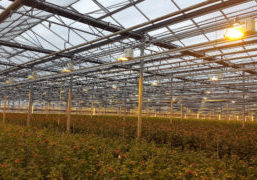
The Winter Light Greenhouse is a new greenhouse concept which, in combination with a new type of screen system, new screen cloth and light-diffusing glass, improves light transmission by more than 10%. The entire newly-designed greenhouse structure is provided with a white powder coating, which offers an increased reflection factor of 90%. The greenhouse is glazed with SmartGlass, a new type of diffusion glass with large panels. Even if the glass is wet or covered in condensation, light transmission remains constant. The integrated Iso++ screen system is mounted in a W-shape for optimal light transmission when the screen is closed, and features a new Ludvig Svensson screen with even better light transmission. The new greenhouse design is also fitted with an Air in Control climate system.
The Winter Light Greenhouse was developed by a consortium of BOM Group, Ludvig Svensson, Bayer Crop Science and Glascom Tuinbouw, in collaboration with Wageningen UR. The project was also assisted by the Greenhouse as Energy Source (Kas als Energiebron) programme, LTO Glaskracht’s innovation and action programme, and the Dutch Ministry of Economic Affairs.
Source/Photos: BOM Group.
Winter light greenhouse at research centre ready for cucumber trial
The winter light greenhouse aims to enhance light transmission by more than 10% during the European winter. In September a trial greenhouse of 500 m2 was prepared at a site at Wageningen University & Research in Bleiswijk, the Netherlands. Among other things it includes a special light transmitting cloth and diffuse, hydrophilic glass. “We’ve pinched a few per cent from everywhere. Our goal is to maximise the amount of light in the greenhouse between October and March.”
Even on a grey July day you had to squint your eyes when walking into the trial greenhouse during the construction work. In that respect it seems mission is accomplished. “Even the people working here say it is very light,” says project leader Frank Kempkes, researcher at Wageningen University & Research. He's been working on this project since 2014.
Cooperation
Kempkes organised the building together with a consortium of companies: Glascom Tuinbouw and DA Glass provided the glass; Ludvig Svensson the screen material; Bayer CropScience the most suitable cucumber variety; and Bom Group was responsible for the greenhouse and screen construction. The latter company was a logical part of the project, says its CEO Mike Vermeij. “Our company is always focused on innovation. We work closely with Wageningen University & Research on several projects. In this project too, we wanted to test our practical capability with their theoretical knowledge. Together we achieve more.”
Kempkes explains the reason for this project: “Nearly everywhere in the world natural light is the limiting factor for growth and production for part of the year. In the winter the prices are at their best. Therefore, we are searching for the ideal winter light greenhouse and a greenhouse that is also more energy efficient, because it uses more, free, solar energy."
Calculations in preliminary phase
In order to design the right greenhouse, in 2014 and 2015 researchers in Bleiswijk first looked at all the parameters. In consultation with the greenhouse designer and suppliers nine designs finally emerged. Further calculations were made using an optical simulation model created by researcher Gert-Jan Swinkels. This resulted in a greenhouse design that on paper provided 12% extra light. How? It was achieved by a combination of factors: The greenhouse construction and equipment; the glass; the screen; the screen installation; and the variety.
Larger glass panes
Starting with the greenhouse construction, it is situated east-west. This is better than a north-south position during the winter. “That is slightly less favourable in the summer but then the light is not a limiting factor. In the end you gain that back in the winter,” says the project leader.
The roof is still the ‘normal’ symmetrical Venlo roof, 5.60 m wide with extra large glass panes of 3.00 x 1.67 m. The researcher explains how this evolved. “Based purely on theory an asymmetrical saw tooth roof seemed better for the winter light greenhouse. But in practise there were disadvantages. Therefore we still went for a symmetrical roof.”
The large glass panes also caused headaches. “The disadvantage of larger glass is that it bends more. Then you need wider rods, but they intercept the light. Therefore we chose thicker glass of 5 mm instead of 4 mm. That absorbs slightly more light, but the effect is less great than wider rods."
Regarding the greenhouse construction, the upright Twinlight columns are not solid, but have a smarter, leaner, yet sturdy construction. In addition, all gutters, rods, trusses and columns are covered in a white powder coating with a reflection factor of 90%, a big improvement on out-dated aluminium that has a factor of less than 60%. “That results in just a few tenths of a percentage, but we do everything we can to achieve more light," says the researcher.
Diffuse and hydrophilic glass
The biggest gain comes from the light transmission through the diffuse glass. Compared with clear float glass – the current standard-horticultural glass – the SmartGlass used yields more than 7% extra light. A whole process was involved in its selection. First of all, researchers established that after taking measurements diffuse glass was a better choice for the crop than clear glass, even in winter. The hemispheric transmission – a weighted average of incident light taken from all angles – of this glass is more than 90% (perpendicular 96%), while that of standard glass is 84% (perpendicular 91%).
Usually diffuse glass is structured glass. In this case it is etched glass, the speciality of glass manufacturer DA Glass. Measurements showed that both types of glass performed well, as long as the glass is hydrophilic (water attractant). “Condensation always occurs on the glass in winter. If droplets form it is at the expense of light transmission. When a water film forms the transmission remains virtually the same or even increases. The type of glass produced by this supplier causes a water film to form and there is hardly any loss in light transmission,” explains the project leader.
Actually, Kempkes expects to see many more innovations in glass. “Solar panels are covered with glass. This market is growing fast so there’s a demand for improvements and therefore it continues to develop. The horticulture sector could piggyback on this.”
Better basic material for cloth
In addition to the clever construction and SmartGlass, the winter light greenhouse prototype is fitted with screens by Ludvig Svensson. These lead to at least a 4% gain in light compared with the manufacturer’s 'standard' energy screen. The greatest gain is achieved by having a better starting material. “The screen is more transparent. After testing many samples we eventually ended up with this material,” says Kempkes. Because the H2NO-technique has been applied to this energy screen the screen remains transparent even when wet from adherent condensation.
In addition to this alternative material the fitting is also special; it’s not horizontal, but forms a W-shape. “This was the screen supplier’s idea. Just like the W-shape is better for optimum light transmission through the roof, it’s the same for the screen.”
Another novelty is the Iso++ screen installation, in which two screens are about 6 cm apart. The cavity space is therefore small, so the air virtually stands still and as a result forms a good insulating layer. This is not so important for the light transmission, but it is important for the energy efficiency of the greenhouse. That also applies to the innovative dehumidifier with heat recovery, the Air in Control system by Bom Group. “We have also further optimised the forced ventilation in the greenhouse by using this system,” says Mike Vermeij.
Variety with small leaves
According to theory all these components add up to 12% extra light. The researchers are now going to accurately measure if this extra light transmission is realised in practise. The first autumn crop of cucumbers was planted at the beginning of September and will be tested. Similarly, the first winter crop of cucumbers - what the trial is really about - will be planted at the end of December.
“Together with Bayer we decided to plant Hi-Jack, a variety for a high wire winter crop. It produces smaller leaves, so that the light can better penetrate the crop. We've also tested which planting distance is best for light penetration. In this greenhouse we choose 1.86 metres in one trellis and 1.77 m in the other," says Kempkes. How the crop develops in the winter light greenhouse will be closely followed.
Summary
A winter light greenhouse has been built at the Innovation- and Demo Centre for Energy in Bleiswijk, the Netherlands. The greenhouse and screen construction, the equipment, glass and screen have been designed to optimise light transmission in the winter. The researchers, together with the participating companies, are striving for 10% extra light between October and March. A winter crop of cucumbers will be planted at the end of December. The autumn crop has already been planted.
Text: Karin van Hoogstraten
Images: Leo Duijvestijn
Bom Group introduces Winterlight Greenhouse concept: 10% more light
BOM Group will present a completely new greenhouse concept at the Greentech: the Winterlight Greenhouse. This concept, in combination with a new type of screen system by Svensson and light-diffusing glass, yields 10% more light.
The Winterlight Greenhouse, with all its installations, systems and products is currently built on the site of Wageningen UR Greenhouse Horticulture in Bleiswijk and will measure 500 m2. This coming winter the greenhouse concept will be tested with a new cultivation method for a cucumber crop, focusing on the winter period. Crop trials are conducted with the cucumber variety Hi-Jack. This variety is especially suitable for winter cultivation because of its leaf shape and direction.
Reflection factor
The newly designed greenhouse structure is fully powder coated in white with an increased reflection factor of 90%. The greenhouse is glazed with SmartGlass, a new type of diffuse glass, sized 300 x 167 cm. Even if the glass is wet or condensed, the light transmittance does not decrease. The integrated Iso++ screen system is installed in a W-shape for optimal light transmission in closed position and is equipped with a new high transparent screen fabric of Ludvig Svensson with an even better light transmission. The new greenhouse concept is also equipped with an Air in Control climate system (overpressure air).
Consortium
The Winterlight Greenhouse was developed in collaboration with Wageningen UR, Svensson, Bayer Crop Science and Glascom Horticulture. The project has been made possible by the program Kas als Energiebron, the innovation and action program of LTO Glaskracht and the Ministry of Economic Affairs.
BOM Group will present the new greenhouse concept at the GreenTech, hall 8, stand 108.