
climate management
Strengthening the Lebanese horticulture sector
We are working with Lebanese researchers to build mono tunnels that will improve vegetable production and simultaneously reduce water consumption.
Yields of tomatoes and cucumbers in traditional tunnels are limited by a lack of ventilation and, consequently, too high temperatures. By using a calculation model to analyse the local climate, we can calculate which modifications to the tunnel will boost production most effectively. We are also looking at rainwater collection. Along the coast, where a lot of Lebanon’s horticulture takes place, there is up to 600 mm of rainfall (800 mm in the Netherlands), most of which goes unused. Growers tend to use river water, which is of much poorer quality, and sometimes groundwater.
The use of rainwater also opens up opportunities for simple substrate cultivation, allowing much more efficient water usage and avoiding soil-borne diseases. At present, it looks as if it will be possible to increase production by 30%. The tunnels will be built in autumn 2017 and the first trials get under way in early spring 2018.
Related



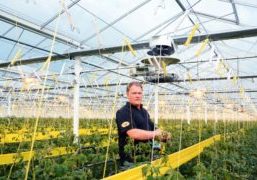
Strong tomato crop with less gas in 2SaveEnergy greenhouse
In a Cappricia crop in the 2SaveEnergy Greenhouse, we are seeing how far we can go with limited ventilation. Among other things, an average 24-hour temperature of 21.4ºC was achieved in April.
The crop tolerated this for quite a while, but in early May we had to start providing more ventilation. But venting more during the day means that less CO2 and moisture are retained in the greenhouse. In the 2SaveEnergy greenhouse, we have also been trying to save as much energy as possible without affecting the strength of the crop. That has worked well so far. Up to April, we were using 5 m3/m2 (planting date: 5 January) plus 10 kWh electricity for the heat pump.
This greenhouse has a double glass roof with an F-clean film and is also equipped with a double aluminium screen and a transparent (Luxous) screen. To limit outgoing radiation, the screen is closed quite early at the end of the day, at around sunset. In winter and spring we don’t generally vent off heat towards the evening. During dehumidification, we recover both the sensible and latent heat from the air and we also use the heat from the heat pump for heating the greenhouse air.
Related



More homogenous climate requires different look at equipment and controls
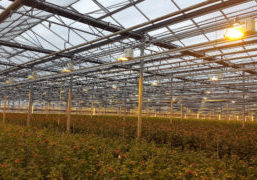
You’d think that the climate in modern, well insulated greenhouses would be a lot more homogeneous than in days gone by. Nothing could be further from the truth, says climate specialist Bas Knoll, of TNO, the Netherlands. In a project taking several years he is assessing the causes and solutions and is working on a climate model that should offer growers and system developers more understanding.
Greenhouses have by definition a heterogeneous climate, both horizontally and vertically. That also applies to modern, well insulated greenhouses. “The temperature differences increase as the heating becomes more intensive and horizontally this can reach more than 5ºC,” says climate researcher Bas Knoll. “As a consequence the RH can also vary from place to place by 15%. That has implications for the heating system. Actually the differences are the largest in highly insulated, large greenhouses."
Calculated risks
To reduce the internal differences growers need to make very local adjustments. That rarely happens. Firstly because equipment such as air vents and heating groups are not sufficiently geared up for that. And secondly because the majority of nurseries have too few data collection points to accurately measure and follow the climate differences.
“This is the direction we need to go in the long term and most growers recognise that,” according to Knoll. “In addition there’s a sharp rise in Next Generation Growing. Here you can take more calculated risks and thereby get more from the crop and at the same time save energy. The condition is that you have the maximum grip on the climate. That is only possible if the differences in temperature and RH inside a greenhouse or area remain small."
Monitor and model
Initiatives to bring the homogenisation of the greenhouse climate to a higher level have resulted in some progress but the whole picture about what works and what doesn’t is far from clear. This was a reason for the Dutch ‘Greenhouse as Energy Source’ project to invite TNO to make a critical evaluation and to develop a simulation model. Its aim is to give growers and suppliers more grip on climate control and the systems involved in that.
Researcher Knoll: “Many whole and half truths are doing the rounds and everyone is struggling with the question what can we do? To clarify that we have to take measurements over a long period in greenhouses to discover when and to what degree climate differences occur, to make the connections and determine the influencing factors. Because it is very difficult for growers at any given moment to see through the interaction of factors there was an urgent need for a simulation model that offered the desired insight and understanding. In addition, there had to be an overview of available and yet to be developed solutions to be able to solve the most important bottlenecks."
These steps are now in motion according to the report ‘More homogenous climate in greenhouses' that TNO published recently. The last step that still needs to be made is the verification and tightening up of the simulation model, as part of a design platform that has gained the abbreviation SIOM (System integration and Optimization Model). Preparations are in full swing.
Cause of temperature differences
Various causes can be the basis for the increasing horizontal temperature differences. Firstly the heating units installed in well insulated greenhouses often have narrower dimensions so are slower and there is a suggestion of higher temperature gradients in parts of low-value heating networks. Also, during the refurbishment of greenhouses the wall heating often remains unchanged.
The second factor is the wind and window vents (see figure 1). Wind that blows over a greenhouse with (partly) open windows always results - due to local over and under pressure - in uneven natural ventilation. Relatively cold outside air comes into the greenhouse furthest away from the windward side (see supply), while nearby on the sheltered, leeward side, warm greenhouse air is removed (see outlet). In addition, the temperature gradient on the roof is barely taken into account.
An equally underestimated point is, according to Knoll, the accuracy of wind and wind direction meters. Often the meters are too low, so that the measurements are influenced by nearby objects, such as high buildings or chimneys. “And an inaccurate measurement leads to inaccurate control of the air vents," says the researcher.
Cold dump
Thirdly, screens and their use make a small contribution. Notorious is the cold dump that occurs by making a gap in the screen but also when the screen is fully closed often a structural localised cold dump occurs through small gaps in the screen. This forms the motor behind internal airflow and temperature gradients. “In addition there is often an imbalance because horizontal screens work dynamically, while the wall screen is permanently insulating,” adds Knoll.
The list of possible causes is easy to expand when other, often crop- or nursery-specific factors are included. Examples are artificial lighting, which are often switched on and off in groups, variations in crops, limitations of the greenhouse and (other) installations, design flaws and so on. In addition, the change to a new cultivation strategy and the installation of new equipment can disturb the precarious climate balance.
Cures
To effectively reduce climate differences within a greenhouse or an area two things are essential, argues the TNO researcher. First of all, more data collection points are needed to indeed be able to measure those differences. “I know a gerbera grower who intensively installed sensors but otherwise hasn’t invested anything,” says Knoll. “By better following the internal climate differences and eliminating them as much as possible with minimum means, he says he’s been able to save tens of thousands of euros annually.”
The researcher also says it’s advisable not just to control the greenhouse or even a section but to narrow that down further. “For example, consider varying the window openings in small sections and be more focused on the internal air circulation,” he suggests.
Simulation model
There are many aspects and possible interactions therefore that need to be fathomed out. This comes together in a new simulation model that helps to find the right combinations. When such a climate model is in place and has proved reliable, it offers several advantages, says the researcher: "You can use it to develop improvements and innovations in order to optimise necessary systems in terms of capacity, lay-out and energy-efficiency. You can also use the output of the model as input for improved control and management of the climate.”
This climate model is part of the design platform SIOM. This is certainly not intended to reinvent the wheel on every terrain, but to bring the multitude of existing computing and design models made by different parties under one umbrella and to serve as a platform for their integration. It also uses new information structures and decision support technologies.
“The climate model is currently only used for research. It has been tested in various forms and cases and enthusiasm for it is steadily growing,” according to Knoll. “The next step is to involve external parties in more practical exercises. It is still ‘work in progress’. To see the real benefits of the model we now want to collaborate with greenhouse and equipment designers who want to be out in front.”
Summary
A project spanning several years is assessing the causes and possible solutions for climate differences in greenhouses. The results have been taken into account during the development of a design platform, in which many existing design and calculation models have been integrated. This should give both growers as well as builders of greenhouses and equipment more understanding about how to achieve a more homogeneous climate.
Text and images: Jan van Staalduinen
Pioneering with the Next Generation Growing
Marius Mans of Mans Flowers is one of the first growers in the Dutch ornamental plant cultivation sector to firmly adhere to the guidelines of the Next Generation Growing. "You become more conscious of your energy usage and that leads to savings. But optimizing growth remains the primary objective."
Modern growers are increasingly becoming entrepreneurs who must know all about the many aspects of a modern greenhouse cultivation company. "Nowadays, regulation and control by a climate computer play an essential role in any of the larger companies", says Mans. However, despite that fact, he believes that having green fingers is still very important. "Certainly in the case of the Next Generation Growing, it is about making the right observations and using this information to choose the correct settings at the right time."
"Insight into every detail of the plant's growing process leads to many other opportunities."
In the last few years, Mans Flowers has developed the Next Generation Growing even further. He became more aware of his energy consumption, which was the first step towards making savings. However, the biggest added value is the optimal growth that he has experienced. "An optimal greenhouse climate greatly improves quality. I can now also deliver top quality products during the more difficult growing periods in the year. Insight into every detail of the plant's growing process leads to many other opportunities."
Balanced greenhouse climate
Mans has recently switched to Priva for his climate control needs. "I have made that choice because it gives me more options to achieve the ideal, balanced greenhouse climate. I get calculations in advance based upon a variety of parameters. And that helps me to take the right decision at the right time in order to achieve my goal."
"A lot of knowledge has been gained about biological control in the Netherlands, which has given us an advantage over growers from other parts of the world."
Fighting diseases and pests also has a very high priority, says Mans. "The gerbera is a bushy plant with a lot of leaves close to each other, which makes it difficult to treat diseases and fight pests. For that reason and also because we want to demonstrate corporate social responsibility, biological control is extremely important. It has to do with having the right balance and an integrated approach. A lot of knowledge has been gained about biological control in the Netherlands, which has given us an advantage over growers from other parts of the world. That helps us to be able to hold and improve our strong position in the future."
Source/photo: Priva.
‘A good growing climate produces healthier plants.’
Royal Pride is one of the few companies in Holland that is allowed to display the Milieukeurmerk (Dutch quality mark), so the bar on food safety has been set high in Middenmeer. 'The first step in striving for the lowest possible amount of crop protection agents is to prevent diseases in the crop. A good climate computer system is essential here', says tomato grower Frank van Kleef.
Royal Pride recently switched to a different climate system and a different supplier. Co-owner Frank van Kleef explains the motivation for teaming up with Priva. 'In terms of development the Connext from Priva is much more advanced than other systems. It allows us to grow crops more energy efficiently and make advances in terms of production. This allows you to successfully recoup this type of investment. The new system also has an advantage in the field of food safety, as a good growing climate produces healthier plants with higher resistance.'
'It is, and remains, the green-fingered grower who can best decide whether or not the plant is happy.'
It is an essential aspect of the operational safety Royal Pride continuously strives for. 'We've come a long way in that field. With the current size of tomato companies like ours, that safety is very important. When we switched to the new climate system we had good reason to include a loop so that the necessary back-up was available at all times.'
3500 sensors
Technical developments provide added value, but Frank van Kleef does not believe that automation will make expertise superfluous in the future. 'The grower's judgement will always be very important.' At the company in Middenmeer 3500 sensors have been installed to measure all kinds of things. 'But it is, and remains, the green-fingered grower who can best decide whether or not the plant is happy.'
'A development such as Next Generation Greenhouse Cultivation is promising but keeps shifting because technology keeps changing.'
However, due in part to the technological developments, that grower has regularly changed the way they work over the past 20 years. 'A development such as Next Generation Greenhouse Cultivation is promising but keeps shifting because technology keeps changing. We need to continue improving. While 20 years ago we grew 40 kg of tomatoes with 60 cubic metres of gas, today we grow 70 kg with just 35 cubic metres.'
Watch the video of Frank van Kleef about climate management.
Source/photo: Priva/The Grower Files.