emission-free
Emission-free growing on unbuffered coco with good results
A consortium of companies is trialling and demonstrating a concept for emission-free growing at the Water Innovation and Demonstration Centre in Bleiswijk, the Netherlands. After trials on rockwool (2014 to 2016) and buffered coco substrate (2016), it was the turn of unbuffered coco in 2017. “The results are better than expected,” say researchers Erik van Os and Jan Janse. “We had actually predicted a big increase in sodium levels, but luckily this didn’t happen. And yields were certainly no lower than on buffered substrate.”
Every Dutch nursery has to make the decision. Do you recirculate your water flows or treat the wastewater? The fact is that growers in the Netherlands must be emission-free by 2027. “That will definitely happen,” says van Os, like his colleague Janse a researcher in Wageningen University & Research’s Greenhouse Horticulture business unit. “We are seeing increased awareness among growers. Their understanding of the water flows in the nursery is growing rapidly. And from a research perspective, we are providing more and more knowledge about potential pitfalls and solutions.”
At any rate, this won’t be affected by the type of substrate a grower uses. Four years of research have revealed that emission-free growing is most definitely achievable on both rockwool and coconut fibre. The crops (sweet pepper and cucumber) were grown without any real problems and there was no loss of production or quality.
Cation exchange complex
The research project started off with rockwool. This is inert, so it is relatively predictable. Emission-free growing on this growing medium therefore proved not to be a problem. Coconut fibre (coco), on the other hand, is a more difficult substrate. Janse: “Coco has to be pre-treated before it can be used for growing. It has a cation exchange complex consisting of a negative charge. The complex is naturally saturated with potassium and also contains large amounts of sodium. Cations with a larger positive charge bind more strongly to this complex and will initially be replaced with potassium and sodium. Calcium is bound and sodium is released and can accumulate in the system.”
To prevent the release of sodium during growing, coco is, in practice, always buffered with calcium nitrate first. The rinsing water is drained off. But this has two downsides. Firstly, the rinsing water removes some of the nitrogen that plays such an important role further along in the cultivation process. Secondly, a grower has to contend with “high” emission figures even before cultivation begins. So it was logical for WUR to be curious about the possibilities of unbuffered coco. In 2017, therefore, the researchers compared an emission-free cucumber crop in two sections, one with buffered and one with unbuffered coco.
Buffered versus unbuffered
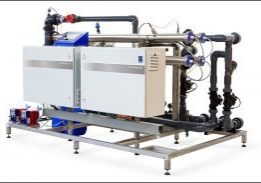
Between the two 144 m2 sections was the machine room, which contained a ring main, an ozone disinfector and a flat-bed filter. The buffered and unbuffered coco each had their own dosing system. “We monitored the drippers and drain water closely using uptake analyses. The weekly figures enabled us to respond promptly and effectively to discrepancies in the ion uptake pattern. For the unbuffered substrate, we factored in a surplus of sodium and a calcium deficiency. But these didn’t happen. The Na content in the drain was no more than 2 mmol/litre. We don’t have a clear explanation for this. Most likely, the starting substrate from the supplier Dutch Plantin was of such good quality that there were no extreme levels.”
Janse also points to the fact that many of the concerns growers currently have are based on outdated assumptions. “For example, growing media are of much better quality nowadays and threshold values for things like sodium can be more broadly interpreted than was previously assumed. That’s what our trials have shown up to now. We can therefore state quite categorically that it’s perfectly possible to grow vegetables emission-free on rockwool and coco, both buffered and unbuffered.
Recirculation at start
Other points that emerged from the research include the importance of getting the crop off to a good start, having an end-of-cultivation strategy and having emergency storage. Van Os: “Growers are still reluctant to recirculate the water in the first few weeks of cultivation. They would rather play it safe and discharge it. It’s such a waste of nutrients and is absolutely unnecessary. No substances are released that are harmful to a plant. Higher sodium figures are possible. The 6 mmol/litre limit for cucumber, for example, is a ‘political’ limit that was created years ago: ‘You can discharge above this’. Higher values were possible even then, and we are not seeing a drop in performance at higher values now either.”
End-of-cultivation strategy
During the four-year trial, the researchers paid extra attention to the end-of-cultivation strategy. Their aim was to significantly reduce the amount of residual water and the concentrations of nitrogen and phosphorus. To achieve this, a regime involving less watering at a lower pH was introduced six weeks before the end of the crop.
Van Os: “We also replaced nitrate with chlorine. By doing so we were able to reduce the water content in the slabs to 20%, and then there is hardly any free water left in them. This way you don’t have to discharge so much water and nutrients. What’s more, the lighter slabs work much better at crop changeover time.”
Emergency storage
The disadvantage of practical and semi-practical research is that unexpected situations can arise. The emission-free growing trial didn’t always run smoothly either, Janse and Van Os report. Janse: “We are now translating those sticking points into advice for growers. For instance, always have emergency storage for ‘dirty’ water. A faulty disinfector meant that we had to discharge water into the sewers, which increased our emissions unexpectedly. So it’s a good idea to have a place to collect this water temporarily until the problem is solved.”
Another point to watch out for is the quality of the irrigation water. Often there is insufficient storage capacity to store enough rainwater for the entire crop. The grower then needs access to an alternative source of low-sodium water, such as groundwater, either treated with reverse osmosis or not.
Actual emission limits
The research into emission-free growing was finally completed at the end of 2017. The researchers were pleased with the results. Naturally, they noticed loose ends here and there which they would like to tie up in subsequent research. Janse: “The actual emission limits of certain nutrients, for instance. We have launched a study on sodium in sweet pepper to clear this up. At what values do yields drop in practice or do physiogenic disorders happen?”
In particular, van Os hopes to gain a better understanding of water discharges at crop changeover time. “That always used to be accepted as a part of the process. I would like to see how much water ‘disappears’ and where. What kinds of substances does it contain, and how can we reduce these discharges?”
Summary
Research into the potential for emission-free growing on different types of substrate was carried out between 2014 and 2017. The project demonstrates that recirculation of water flows in both rockwool and buffered and unbuffered coco is possible without loss of production or product quality. Important points to watch out for are a well executed end-of-cultivation strategy, low-sodium starting water, sufficient emergency storage, frequent uptake analyses and choosing suitable equipment.
Text: Jojanneke Rodenburg.
Images: Studio G.J. Vlekke.
Related



Finishing up leftovers – a model for zero-emission growing
Greenhouse horticulture will have to be virtually emission-free in ten years’ time. By 2027, European growers must ensure that their drainage water is completely free from residues of fertilisers and crop protection products. Researchers are currently working on a cultivation method that involves the plant finishing up all the nitrate and phosphate in the substrate slab. But a lot depends on achieving the right balances.
A layperson may think it’s easy to grow crops with zero emissions. Just stop fertilising a few weeks before the end of the growing period so that the plants use up the last of the fertiliser – and voilà: the slab is clear, the water is clean and the greenhouse is producing emission-free.
Of course, that’s not what actually happens in capital-intensive greenhouse horticulture. The crop has to continue to produce, preferably right up until the very last day – the day before the crop is cleared. So it needs a good supply of nutrients right up until then.
The right level
“The main aim of an end-of-cultivation strategy is to end the growing and production season emission-free, i.e. with no nitrate and phosphate left in the slab. But the plant needs to continue to receive enough nutrients and water right up until the penultimate week of cultivation,” says researcher Chris Blok of Wageningen University & Research in the Netherlands. “You can quite safely stop providing nutrients in the very last week and leave the plant to fend for itself after that. But in the four or five weeks leading up to that, it’s important to maintain feeding and water levels. That way you will keep production and quality at the right level right up until the end.”
Targets and settings
Blok and his colleagues Romain Leyh and Marco Bustamante are working on a method that entails gradually reducing the supply of nutrients, but in such a way that the plant doesn’t run short of anything. Their research, which is being done on sweet peppers, is being funded via the Dutch Foundation for Water Board Research. A number of companies, including substrate specialists Grodan, are involved in it.
To begin with, the researchers set target values for week -5, week -3 and week -1. The negative week number indicates the number of weeks before the end of cultivation. To achieve the target values, the researchers chose settings for the nutrient supply. An example based on nitrogen supply: 1) The target value for week -5 is 15 mmol N/litre. 2) This should have fallen to 10 mmol/litre by week -3. 3) By week -1, the slab should only contain 5 mmol/litre. 4) So in week 0, when cultivation ends, the slab will contain no more N at all.
To achieve this, the set N supply must decrease: 1) from 15 mmol N per litre in week -5, 2) to 5 mmol/litre in week -3, 3) and finally to 1 mmol/litre in week -1. The researchers have developed similar schemes for phosphate (P), EC and water content in the slab.
Results needed fast
Can it work? Will it mean the grower ends up with a nutrient-free slab? The answer is yes, but the method requires the grower to be very vigilant. Blok: “You will have to take measurements in the slab regularly to keep an eye on how things are going. For example, you might choose a target value that is too ambitious, which would mean that you are supplying too few nutrients. The plant would then run short and production would suffer. If that happens, you would need to be able to make adjustments quickly: you can’t wait a week for the results of the measurement to arrive, you would need them within a couple of days. In the trial department we work with electronic meters which give us the water and EC results we need fast.”
Too much versus too little
As stated, all elements the plant needs must be present in sufficient – but never excessive – quantities until just before the end of production. Researchers Leyh and Bustamante: “To check that, we measure the nutrient levels in the slab twice a week. We focus mainly on whether N and P are being used up because these elements are banned from being discharged in the drain water. If the measured value differs from the target value by more than 25% – up or down – it is important to adjust the settings. Because if the measured value is too high, you won’t get the slab clear in time. If the value is too low, the crop will run short of nutrients.”
Souring the slab
In a departure from general nursery practice, the researchers are using chloride as an anion in their trials. They have to do this because as the amount of nitrate supplied drops, the supply of cations, particularly potassium, needs to remain slightly higher. So instead of providing nitrate, they supply chloride as an anion.
Another strategy that helps to clear the slab is to play around with the pH value. If you keep the pH value deliberately low with acid and ammonia, the slab turns acidic. This releases the last residues of precipitated phosphate, causing the plant to use up this nutrient as well. Blok: “This way you can get the plant to finish up all the leftovers, as it were.”
Precisely the right balance
Researcher Ruud Kaarsemaker of Groen Agro Control was involved in the research. He calculates the plant’s nutrient uptake and advises the researchers so that they can input this information alongside the target values and settings. Kaarsemaker points out that nutrient uptake should remain stable for as long as possible. “The plant should continue to grow and produce. But as the amount of food and water the plant receives decreases, the system and therefore the plant become more and more susceptible to disruptions. So it’s a question of looking for precisely the right balance.”
This method is not yet ready for use in practice. However, what is clear is that the nutrient and water supply needs to be adjusted in such a way that the slab is actually empty by the time cultivation finishes. Aspects such as weather influences also have to be taken on board in the targets and settings.
According to Blok, the method should also be highly automated, otherwise it will be too much work for the grower. “An attractive aspect of this method of working is that it doesn’t require any investment on the part of the grower. The result is achieved entirely from controlling the nutrient flow. We are essentially telling the plants: ‘It’s time to start clearing your plate’.”
Summary
Researchers at Wageningen University & Research and Groen Agro Control in the Netherlands are working on a nutritional regime in which the amount of feed and water given to the plants gradually decreases towards the end of cultivation. This forces the plant to finish up everything in the slab, thus making cultivation completely emission-free. The trick is to adjust the amount of nutrients given to ensure that production and product quality remain at the required level.
Text and images: Jos Bezemer and Studio GJ Vlekke.