
energy management
Strong tomato crop with less gas in 2SaveEnergy greenhouse
In a Cappricia crop in the 2SaveEnergy Greenhouse, we are seeing how far we can go with limited ventilation. Among other things, an average 24-hour temperature of 21.4ºC was achieved in April.
The crop tolerated this for quite a while, but in early May we had to start providing more ventilation. But venting more during the day means that less CO2 and moisture are retained in the greenhouse. In the 2SaveEnergy greenhouse, we have also been trying to save as much energy as possible without affecting the strength of the crop. That has worked well so far. Up to April, we were using 5 m3/m2 (planting date: 5 January) plus 10 kWh electricity for the heat pump.
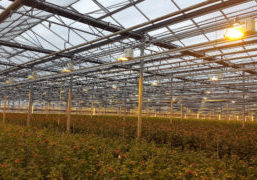
This greenhouse has a double glass roof with an F-clean film and is also equipped with a double aluminium screen and a transparent (Luxous) screen. To limit outgoing radiation, the screen is closed quite early at the end of the day, at around sunset. In winter and spring we don’t generally vent off heat towards the evening. During dehumidification, we recover both the sensible and latent heat from the air and we also use the heat from the heat pump for heating the greenhouse air.
Related



EnergiekEvent 2016 looks back and forward
'We should not depreciate the closed greenhouse', 'Greenhouse growers should rely less on feelings and more on knowledge' and 'In the greenhouse sector of 2050 gas is no longer relevant'. These were some of the remarkable statements that were made at the well-attended EnergiekEvent 2016 in Bleiswijk, where the 10th anniversary of Kas als Energiebron was also celebrated.
Looking back, Kas als Energiebron (Greenhouse as a Source of Energy), the innovation and action programme for energy efficiency and sustainability in the greenhouse horticulture sector, was found to be successful. The energy efficiency of the Dutch greenhouse growers has increased significantly, while the energy sources are becoming more sustainable. Especially thanks to geothermal and residual heat, wind energy, (semi-)closed greenhouses, diffuse glass, LED lighting and - the manual is in need of a reprint - Next Generation Cultivation.
Micro-controller
The best news of the EnergiekEvent was that the increased energy efficiency does not affect the quality or production. But it does require more data, knowledge and insight of the growers. "Before, there used to be one measuring unit on each hectare. In the future we want to change this to smaller units. Maybe even to micro-controllers for every plant, not only for the production, but also for the quality. For example, think of LED lighting to enhance certain plant components," says Sjaak Bakker, manager of Wageningen UR Greenhouse Horticulture.
Bakker outlined a future in which electricity will play a leading role. "We are rapidly moving towards an all-electric situation. Just look at electric cars, batteries and what's happening in LED lighting. They are already thinking about lighting through foils or glass cells."
Our CO2 supply should also be different in 2030 or 2050, Bakker said. "If we no longer burn gas in the future, where would we get our CO2 from? An example might be extracting CO2 from the air."
Closed greenhouses
Next Generation Cultivation is being succesfully applied in various crops, including tomato and gerbera. An estimated 15 to 20% of the Dutch growers is using this method. A lot of knowledge has been gained in closed greenhouses and during previous research, Bakker said. "In Next Generation Cultivation many things that were already developed have been put together: think of temperature integration, research on screens, air movement, etc."
The closed greenhouse is disappearing, it seems. But Wilco Wisse, chairman of Kas als Energiebron and staffmember of Lans Tomaten, thinks that closed greenhouses should not be depreciated. "We ourselves also have an Optima greenhouse of 1.5 hectares and we know better than anyone how difficult it is to make profits with it. It is actually a huge solar collector though, it stores excess heat of the summer and supplies it in the winter. Therefore, we should not depreciate the closed greenhouse.”
Sustainable future
Leo Oprel, currently working as a policy advisor at the Ministry of Economic Affairs - who is considered as the founder of Next Generation Cultivation at Wageningen UR - outlined a sustainable vision of Dutch horticulture, in which:
- new greenhouses will look very similar to existing greenhouses
- gas has been replaced by sustainable electricity and heat
- virtually no chemical pesticides are used
- the use of CO2 for growth is limited
- knowledge is crucial
- climate control will include energy and ventilation management
- heat exchangers will become commonplace to transfer energy from the moist greenhouse air to the incoming drier air
- cultivation is done with more humidity, with a very homogenuous greenhouse climate
- light is the key for temperature control
- the diffuse greenhouse roof transmits more light and there are more screens hanging above each other
- super translucent greenhouses will determine the production - and the existence - in the winter
- light will be flexibly captured above a certain level in the summer and will be available for energy storage
- excess radiation is immediately absorbed without the greenhouse air heating up too much
- assimilation lighting is used on the basis of the requirements of the plant
- the artificial light is also dimmable because it works with direct current
- the heat requirement is reduced to 10 cubic meters of gas per m2
- geothermal energy and heat pumps with heat/cold storage supply the residual heat
- the backup will consist of batteries
- offices and industrial buildings supply additional electricity with roof-integrated solar panels
- windmills are a regular appearance in horticultural areas
- proud entrepreneurs have created a sustainable future!
Kas als Energiebron, the innovation and action plan for energy efficiency and sustainability in greenhouse horticulture of LTO Glaskracht Nederland and the Ministry of Economic Affairs, will continue until the end of next year. Both the greenhouse horticulture industry and the government want to continue with the program. The ministry of Economic Affairs wants to maintain the 50/50 cost sharing – but is still negotiating with LTO.
At the end, the participants visited the workshops and greenhouses at Wageningen UR/Delphy Improvement Centre, where they were informed of the latest research.
Text/photos: Mario Bentvelsen.
'The interests of the whole should be given priority over the interests of the individual.'
Tomato grower Frank van Kleef of Royal Pride believes a lot can still be done regarding cooperation between the horticultural and industrial sectors in the field of energy management. 'There are a lot of opportunities, particularly in places where the sectors are located close to each other, such as Westland and the Rotterdam harbour.'
According to the entrepreneur, the same is also true for the development of geothermal energy. 'It is still in its infancy. However, for the greenhouse horticultural sector, it is essential to be economical with the available energy and to make optimal use of the alternatives to fossil fuels.'
'In my opinion, the best way to help each other is to return energy to the grid at exactly the right time.'
Van Kleef is critical of developments such as heating residential areas with waste heat from greenhouse horticulture. 'It is expensive to move heat from one place to another and I am, therefore, not in favour of it.' He also does not think that bringing both segments physically closer is a viable option. 'In other areas, horticulture and home owners get in each other's way. In my opinion, the best way to help each other is to return energy to the grid at exactly the right time.'
Microsoft data centre
Royal Pride is located at Agriport A7, where the entrepreneurs cooperate as much as possible where energy is concerned. Microsoft recently built a large data centre there and, according to Frank van Kleef, that offers excellent opportunities for sustainable, mutual cooperation.
He is convinced that a lot can be gained by working together, particularly in the field of energy management. 'The greenhouse horticultural sector should stop putting itself first all the time. The interests of the whole should be given priority over the interests of the individual.'
'In order to achieve the international environmental and energy objectives, the greenhouse horticultural sector must look for worldwide solutions.'
During the journeys that he regularly makes, Van Kleef has noticed that foreign countries do not take advantage of the lessons that have been learnt in the Netherlands. 'Abroad, horticultural companies too often choose to be located far away from their fellow horticultural companies. I would rather have my competitors as my neighbours than have no neighbours at all.'
In his opinion, in order to achieve the international environmental and energy objectives, the greenhouse horticultural sector must look for worldwide solutions. 'With the same investment, greater advances can be made abroad than in the Netherlands, where great progress has already been made over the last couple of years.'
Watch the video with Frank van Kleef about energy management.
Source/photo: Priva/The Grower Files.
Mobilising all efforts on the imbalance market
Now that the rates for the return of electricity have dropped lower than ever before, growers will have to make all possible efforts to achieve a profit on the imbalance market from their CHP. AgroEnergy is launching a new service that will allow growers to place bids directly on the control power market, which will enable them to trade actively through TenneT. This initiative would also allow growers to collectively offer emergency power.
Cogen Nederland, the Dutch association for the promotion of CHP, anticipates that the current capacity generated by CHP units will be reduced by fifty per cent in the next decade to come. With a rate of 3.6 cents per kWh and a peak rate of 4.8 cents for the next three years to come, the energy market is suffering tremendously. The peak price will barely cover the variable costs of a CHP unit. Nevertheless, Arjan van der Spek of Enova is convinced that the fifty per cent referred to above will probably not be achieved, taking into account that half of all growers deploy their CHP units for assimilation lighting for their own crops anyway. CHP is here to stay. With regard to the fifty per cent that would remain unused, growers will have to rely on returning electricity to the grid at the right moment. ‘They will have to actively make use of this option.’ There is, however ray of hope as opportunities on the imbalance market are likely to improve. The increasing number of wind turbines and solar panels has heightened the risk of imbalance problems in the supply of electricity. After all, no electricity will be generated when the sun doesn’t shine or there is no wind.
Power control under contract
‘Based on the by-the-minute forecast price, growers can adjust their CHP production upwards or downwards through the imbalance control platform’, explains Willem Bijlsma of Tenergy Services. ‘This will allow them to benefit from the higher rates arising from a shortage in electricity at a particular point in time. TenneT, however, determines its quarterly rates in retrospect; you can never forecast precisely how much you will earn. This is a drawback in passive participation on the imbalance market. Additionally, this supply option is gradually phasing out because TenneT prefers to regulate the supply of energy through contracts.’
TenneT contracts extra control power capacity for a sufficient supply of energy on the imbalance market. As TenneT concludes these contracts with large energy companies, and not with greenhouse growers (these parties being simply too small), AgroEnergy is developing a service that will let growers offer their CHP as control power capacity. This service will be launched on 1 October 2015. The collective power will than be offered to TenneT by means of a bid, provided that the capacity will amount to at least 5 MW. ‘Every grower can subscribe and decide for himself whether or not to participate’, explains Fieke Rijkers of AgroEnergy. ‘In the event that we are unable to supply the required 5 MW, Eneco will make up for the deficit. The biggest advantage for growers is that they will get the rate that has been fixed at that particular moment.’
Rijkers believes that growers will benefit in terms of security by collectively offering control power capacity rather than responding to the imbalance market without a contract. ‘This will provide growers a realistic alternative to earn some extra money on top of the long-term spark spread and trading on the Amsterdam Power Exchange (APX). As soon as TenneT gives the sign for delivery, participants will have thirty seconds to respond with an upwards or downwards revision. This will require some adjustments with regard to the necessary software.’
Making use of all the available options
Robert Willemsen of Powerhouse – a subsidiary of RWE – is wondering why a grower would allow his CHP unit to contribute to a pool, ‘particularly if a fine applies when you fail to respond in time.’ This is, however, not the case with regard to the product offered by AgroEnergy, taking into account that this concerns voluntarily offered control power capacity instead of a fixed contract with TenneT. His solution: ‘Make sure that you get the most out of your CHP unit and that you are using good software. For an optimum yield you have to make use of all the available options: the imbalance market, the APX and keeping a vigilant eye on the highs and lows: selling when the price is up and buying when the price is down. Not everyone will be able to do this equally well; it requires a lot of time and attention.’
Stijn Schlattman of Energy Matters argues for adequate compensation for flexible power supply to compensate for the fluctuations in the supply of wind and solar energy. ‘It is important that gas-fuelled engines are able to contribute to this. This will improve the case for gas engines and people may even begin to invest in new gas engines. Following on another two meagre years with a weak market and a low spark spread new opportunities are arising fro flexible CPHs. Until then owners of CHP units will simply have to muddle through.’
Contract for emergency power supply
TenneT contracts emergency power supplies to compensate for possible failures at power plants. This counters the considerable imbalance on the electricity grid. Back-up generators or CHP units that would otherwise be on stand-by could be used for this. The power generated by these, which is used once a month on average, must be continually available. Companies can register on an annual basis for a scalable emergency power supply of 350 MW, to be made available within ten minutes. This could be financially worthwhile, says Hendrik Koetsier of Energie365. Energie356 collects flexible power from companies for emergency power supply for TenneT. This flexible power supply is provided by companies with back-up generators. Koetsier has noted interesting opportunities for CHP units in this. However, the power generated by multiple growers would have to be offered collectively, because TenneT applies a 20 MW minimum. This would enable infrequently deployed CHP units to nevertheless bring up some cash. TenneT pays an annual availability compensation of over ten thousand euros per MW, plus a variable compensation for the electricity actually supplied. ‘Supplying emergency power could be interesting particularly in cases where a CHP unit generally doesn’t produce anything normally, while entering the imbalance and control power markets is a more obvious alternative for CHP units that are deployed on a regular basis. Emergency power is a better option for CHP units that are not deployed as frequently.’ The drawback is that the emergency power reserved for TenneT has to be continually available; a grower will neither be able to offer it on the imbalance market or the APX nor make use it for his own crops in peak periods.
Supplying emergency power is not a viable alternative for growers who make use of assimilation lighting, says Remco Wiegmink of NIFE-energieadvies. Chances are high that the emergency power will be demanded from the grower when he needs the electricity for his own crop. Besides this, the power may need to be delivered at times when there is no demand for heat. It is doubtful whether the yield for emergency power contributed by a CHP unit that would otherwise not be producing will be sufficient to cover such fixed cost items as gas power and transport. Growers switching to geothermal heat hardly ever offer the power generated by their CHP units on the imbalance market for this reason alone. Robert Willemsen of Powerhouse even considers participating in pools like this a ‘very dangerous’ option. ‘It is better to participate in the control power or imbalance markets by gearing the sale of your power to the opportunities that come your way.’
Careful deployment
CHP yields only minimal returns in the horticulture industry. A new CHP unit is not profitable unless it is used for assimilation lighting for your own crops. Based on variable costs, if you already own a CHP unit selling power to the grid will barely be profitable. According to Schlattman of Energy Matters operating hours for CHP units are dropping as far as approximately 3200 hours a year. Fieke Rijkers of AgroEnergy understands the difficulties faced every day by growers placing a bid on the APX, in terms of calculation effort as well as time. ‘The automated BiedOptimaal system offered by AgroEnergy will take a load off their shoulders.’
Robert Willemsen of Powerhouse: ‘Growers who own a CHP unit that has not been written off yet will have to deploy their CHP unit very carefully in order for it to be profitable. If it does not operate for at least 4,000 to 4,500 hours it will be very difficult indeed to pay back your investment. On top of that, you can optimise short-term returns through the APX and the imbalance market. The price risk is, however, high. In fourteen years’ time I have never seen rates as low as they are now, with 3.6 cents per kWh and a peak of 4.8 cents for the next three years to come. The peak price is just enough to cover the variable costs of the CHP, so this will only be profitable with an old CHP unit. The problem is that you can’t simply shut down a CHP unit when you have taken out a 3,500-hour maintenance contract. In this case, your best bet is to deploy it as frequently as possible, if only to minimise your losses.’
Source: Tuinbouwteksten.nl/Theo Brakeboer. Photo: Mario Bentvelsen.