
floriculture
Floriworld attraction and experience centre soon to become a reality
The initiators and developers agree: Floriworld, the experience centre of the ornamental plant sector, will be opening its doors in Aalsmeer at the end of 2019. The parties engaged in this initiative since the beginning have announced that they have the support of the entire ornamental plant sector. The centre will provide inspiration to hundreds of thousands of visitors every year.
The initiators (including the Koninklijke VolkerWessels subsidiary KondorWessels Projecten) aim to demonstrate, together with the ornamental plants sector, the effect that flowers and plants can have on everyday life. Through this, they aim to boost the global demand for flowers and plants.
Nurturing that green feeling
Floriworld has been a topic of discussion for several years. Following the initial feasibility studies a great deal of hard work has been done on Floriworld behind the scenes, particularly in the past year. This experience centre is intended to nurture ‘that green feeling’ among the many international tourists visiting the Amsterdam metropolitan region. It is estimated that the number of tourists visiting the Netherlands from abroad will grow by 3% by the year 2025. The Keukenhof flower gardens, for example, once again demonstrated a growth in visitor numbers, with figures reaching 1.4 million this year.
Wide representation
A growing interest in the Netherlands and in flowers provides a positive perspective for the realisation of Floriworld. At the beginning of December 2017 the various parties involved in the project (Koninklijke VolkerWessels subsidiary KondorWessels Projecten, Dutch Experience Group, Royal FloraHolland and Bloemenbureau Holland) took the last step. In a meeting attended by representatives from the entire ornamental plant sector (breeders, growers, traders and promoters) the above parties announced their commitment to the project. It is now certain that Floriworld will be built.
Construction to commence in autumn 2018
Royal FloraHolland is a key partner in the realisation and will be an important shareholder in the Floriworld foundation, together with Bloemenbureau Holland and Dutch Experience Group. They will ensure that the activities in this experience centre will contribute to the growing demand for flowers and plants in concrete terms. Construction is estimated to commence in autumn of 2018 and a pre-opening will take place sometime during the 2019 Trade Fair in Aalsmeer.
Source/photo: VolkerWessels.
Related






‘New era for international floriculture’
The Dutch market share in global exports has fallen behind the combined market share of Colombia, Kenya, Ecuador and Ethiopia for the first time, according to a survey by Rabobank and Royal FloraHolland on international trends and import and export movements. The results were published in the World Floriculture Map 2016.
Ever since Rabobank first published the World Floriculture Map in 2005, the Dutch share of global cut flower exports has been in decline. That share currently stands at 43%, whereas ten years ago it was 50%. In 2015, the combined exports of the four rising stars, namely Colombia, Kenya, Ecuador and Ethiopia, overtook the Netherlands for the first time. Their combined cut flower exports now account for 44% of global exports. Just two years ago, that share was 33%, whereas in 2005 it was only 25%.
Although these four countries’ exports tend to be centred around roses, Colombia does have a fairly wide range of products. It is now the largest exporter of chrysanthemums, and the second largest exporter of carnations. Even so, it remains a challenge for these equatorial countries to grow and export cut flowers, despite their low production costs, favourable climates, large farms and increasing efficiency and quality. There is barely any domestic market, and producers face problems with insufficient air freight capacity, high transport costs, currency instability and tense political and social conditions, according to the authors of the report.
Floriculture in motion
The report also mentions the following recent developments:
• the online sale of ornamental plants is on the rise, while garden centres and florists in Europe are under pressure
• the US floriculture market is recovering, but the global market remains vulnerable
• imports of cut flowers in Russia are decreasing
• The Netherlands will remain a major player in international floriculture, but Colombia, Kenya, Ecuador and Ethiopia are catching up in terms of cut flowers
• Colombia is striding ahead, and has become a leader in the market of cut flowers transported by sea container
The new era will be greatly affected by global geopolitics, because of increasing protectionism and a difficult trading environment. Other influences include rapid digitisation, and the increasing importance of sustainability in floriculture. Floriculture companies can hold on to their positions as market leaders by preparing themselves for the unexpected. They can defend themselves against all the various future scenarios by being strong but flexible. In addition, businesses can seize opportunities in other markets, move their procurement to other countries or regions, expand their marketing to digital channels, and set up their supply chains to be more sustainable.
Read the full report or download the World Floriculture Map 2016 here (infographic).
Source/infographic: Rabobank.
Food safety and quality critical success factors in online sales
Key points for attention in the online sale of fruit and vegetables are quality and food safety. Another factor to take into consideration is packaging. Can standardised packaging guarantee the desired product quality, food safety and customer experience standards?
Although no specific rules apply to online sales - as opposed to traditional sales methods - online sales channels will need to observe the same quality and food safety regulations as other food suppliers. ‘Food safety is a priority issue,’ says Nicolette Quaedvlieg, policy officer for Quality & Food Safety at het GroentenFruit Huis.
'People are less disappointed when they pick up a product at the supermarket with a quality defect than if they had bought the same product with the same quality issues online.'
She also believes that the quality of online products should be better than what is offered by supermarkets. ‘You have to take it one step further. People are less disappointed when they pick up a product at the supermarket with a quality defect than if they had bought the same product with the same quality issues online. That’s simply not acceptable to them.’ Additionally, Quaedvlieg points out that consumers purchasing produce online need information about the product’s country of origin. Online sales platforms are also required - just as shops and restaurants - to provide information about allergens, both on their websites and upon delivery to the customer.
Best quality
Martijn van Andel of JEM-id is also convinced that consumers should get the best possible quality when they order something online. ‘And that’s possible, because you leave out several links in the distribution chain. Going grocery shopping three times a week is actually ridiculous, since 90% of the products you buy are identical. Neither is grocery shopping a particularly interesting experience. There are few people who genuinely enjoy shopping for groceries.’
'Consistency in quality and freshness is only possible through short lines and foolproof chain cooperation with preferably local suppliers.'
Harrij Schmeitz of the Fresh Informationmanagement Center emphasises that the quality of online groceries not only needs to be good; it must also be consistent. ‘The consumer must not be disappointed. If consumers fail to find the quality they seek online, you will lose them and they will purchase their products elsewhere.’ Consistency in quality and freshness is, according to Machiel Reinders, senior researcher at LEI Wageningen University Research Centre, only possible through short lines and foolproof chain cooperation with preferably local suppliers. ‘Good customer service is also of paramount importance.’
Packaging
The range of packaging currently available can only partially guarantee the desired standard of quality and consumer experience, says Reinders. He indicates that there is a demand for better packaging, particularly for more delicate products. ‘Special packaging is also needed for the cooled transport of products. PostNL has conducted several experiments with Vershuys.com, for example, in which they explored the possibility of using special coolers for the shipment of fresh food products.’
'The range of packaging currently available can only partially guarantee the desired standard of quality and consumer experience.'
The researcher also points out that packaging can also enhance consumer experience through the addition of supplementary information, or visual materials, for example. ‘On the other hand, one of the trends in modern society is to desire to curb the amount of packaging waste. To put it briefly, there are still plenty of opportunities for innovation in the field of packaging fir the online market. This is one of the issues on which the Fresh ONLINE Pack project will be focusing in the next few years to come.’
Text: Tuinbouwteksten.nl/Ank van Lier. Photo: HelloFresh.com
Would you like to know the key conclusions and read about appealing examples in e-commerce? Download the complete dossier New Retail (8 pages, pdf).
If you want to download this content you need a subscription, or log in when you already have a subscription.
Related




Online sale of fresh produce promising and challenging
The online market for fresh produce and ornamental plants is growing. However, while the ornamental plant sector is making giant steps forward in this respect, the food market is lagging distinctly behind, particularly with regard to fresh produce. How can this be explained, and what are some of the opportunities and threats facing the online sale of horticulture products? Four parties engaged in this field present their vision on the developments, each based on their own expertise.
The number of consumers preferring to make their purchases online is constantly growing. Not only do they buy their clothes and shoes online; they also buy their food on the internet. The percentage of fresh produce sold online, however, lags far behind that of other product groups.
This can in part be explained partly by the high supermarket density in the Netherlands and partly by a lack of consumer confidence in the quality of fresh fruit and vegetables offered online: they prefer to see - and even touch - these products before buying them. Additionally, they are reluctant to pay additional shipping and delivery costs. On top of that, many suppliers of fresh produce lack a successful business model, particularly due to the logistic complexity associated with online sales. There are still many challenges ahead!
Online groceries
Nevertheless, various people engaged in the online sale of food products believe this to be a highly promising market. A study conducted by LEI Wageningen University Research Centre at the beginning of 2015 showed that approximately 12% of all Dutch consumers order their groceries on the internet from time to time. Another study, conducted by Deloitte in 2015, revealed that 8% of all consumers have, at one time or another, made use of an online ordering service. This service is used once or twice a month and the average amount per online order is approximately 69 euros.
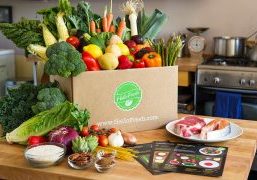
Groceries ordered by respondents (or that they would like to order) online are mainly products with a longer shelf life, dairy products and frozen food. There is, however, also a notable rise in the number of fresh products ordered online. The emergence of meal boxes, of which more and more are being offered by supermarkets and other retailers, plays an important role in this development. This relatively new concept is benefiting from the popularity of regional products, healthy nutrition, organic ingredients and several intensive marketing campaigns launched by leading international players.
Meal box increasing in popularity
The meal box is becoming increasingly popular among Dutch households: A recent survey by Multiscope showed that, as it stands today, 11% have tried out a meal box and one third of them will continue to order them. Two out of ten people in the Netherlands are interested in the concept, but have never ordered a meal box. These are generally households composed on one or two persons. What appeals to them in particular is the convenience, the variety in meals and the inspiration to try new recipes.
HelloFresh is the best-known meal box. Eight out of ten people in the Netherlands has heard of this brand. Users are most satisfied about the originality and good quality of HelloFresh box. However, the price and freedom of choice in the various varieties received a lower score. HelloFresh does not deliver its meal boxes on Monday, which is the preferred delivery date. Allerhande Box, however, delivers on Monday and is second to HelloFresh when it comes to name recognition (49%).
Text: Tuinbouwteksten.nl/Ank van Lier. Photo: Fresh Informationmanagement Center.
Would you like to know the key conclusions and read about appealing examples in e-commerce? Download the complete dossier New Retail (8 pages, pdf).
If you want to download this content you need a subscription, or log in when you already have a subscription.