
herbs
Growing vegetables in an urban environment
Apart from Vertical Farming, there are numerous hybrid cultivation initiatives taking place in and on buildings, also known as Urban Farming and Rooftop Farming. Even restaurants, supermarkets and offices are experimenting with growing fruit and vegetables in cities.
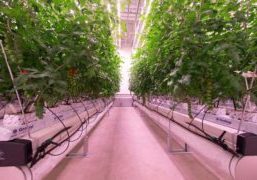
Vertical Farming is, of course, not suitable for crops that grow in an upwards direction, such as tomatoes and cucumbers. This problem was solved in Jackson (Wyoming) with the construction of an impressive building incorporating huge amounts of glass, designed by Larssen Ltd.: a very expensive building costing 3.7 million dollars, partly due to its earthquake-proof construction. Three stories of the building are dedicated to LED-illuminated Vertical Farming, with two stories reserved for herbs and leafy vegetables and the third for tomatoes. The 3,800 m2 surface area is sufficient for a production of 45,000 kg a year. The building is intended to bridge the awareness gap between horticulture and the city’s inhabitants and also provides space for education. The vegetables can be seen growing from behind a glass wall. The project received financial support through crowdfunding and the municipality is the owner of the building.
Restaurants and supermarkets
InFarm is directed at growing vegetables in big cities; in and by restaurants and the retail industry. ‘We are the new farmers and the city is our company.’ In his mind’s eye, the founder of InFarm is seeing supermarkets with multi-tier cultivation for leafy vegetables above the shelves. You simply can’t buy fresher food with fewer food miles than this! InFarm developed the Kräutergarten for the Berlin-based Metro wholesaler, just as Mirai did in Japan: a multi-tier LED-illuminated greenhouse in the supermarket. The crops grown consists primarily of herbs (basil in particular) and leafy vegetables grown on a shallow layer of water (hydroponics).
You simply can’t buy fresher food with fewer food miles than this!
InFarm also operates the UFcontainerfarm in Berlin: a container with a small greenhouse on top. Tilapia fish are bred in the container. The water from the fish is pumped up to the greenhouse, where it is used to water the plants after it has been purified. This concept is also used in London, where it is called a GrowUp Box.
Above and below ground
An outsider in Urban Farming is SkyGreens. This Singapore-based initiative grows vegetables on trays suspended in gutters. These gutters circulate vertically by means of two A-shaped pillars nine metres tall. The circulatory movement enables each plant to obtain the same amount of sunlight. The company has 1,000 of these vertical towers with 20 gutters each and produces 800 kg of vegetables a day, including Chinese cabbage, spinach and other leafy vegetables.
The London-based Farmdrop initiative produces herbs underground, in former bomb shelters.
Another outsider, but of an entirely different calibre, is the Pasona office building in Tokyo, where a myriad of plants and vegetables are grown on and in the building, which also features a dedicated Vertical Farming division. The vegetables grown here are intended for the company restaurant. In conference rooms, workspaces - in fact, all over the building - you will see tomatoes growing all the way up to the ceiling, or sweet peppers and eggplants, broccoli, lemons and even passion fruit. A total of 200 varieties of vegetables, fruit and even rice are grown here! The staff is free to pick whatever they want. The company employs a permanent staff of ten people to keep the vegetables in tip-top condition. Not everything is grown efficiently, but the project was never intended to achieve a high production rate; the concept was developed to engender awareness for food provision.
The London-based Farmdrop initiative produces herbs underground, in former bomb shelters: 30 metres below the surface. It took Farmdrop two years to conquer all the challenges of underground cultivation.
Rooftop greenhouse
Where Vertical Farming appears to be booming, there is less interest among the inhabitants of big cities for rooftop cultivation - in greenhouses, at any rate. Few people practice greenhouse horticulture on rooftops, but when it is, this is mainly in the USA.
According to GothamGreens, urban farming is all about re-establishing the connection between people and the food they eat, educating young people and nurturing the soul.
A firm called GothamGreens operates a series of rooftop greenhouses, in which leafy vegetables are grown in gutters, in New York and Chicago. The first 1400 m2 rooftop greenhouse was built in 2011, and the total surface area of GothamGreens has since risen to 16,000 m2 distributed across four sites. The biggest measures 7,000 m2 and is built on the roof of a bowling alley. According to GothamGreens, urban farming is all about re-establishing the connection between people and the food they eat, about educating young people and nurturing the soul. ‘Urban Farming will never become a primary source of food, but its impact is lasting.’ A head of lettuce grown here costs around $4 at Whole Foods, almost twice as much as conventional lettuce grown in the field and $1 more than organic lettuce.
Bright Farms also aimed to dedicate itself to rooftop cultivation, but it was forced to give up its plans due to the difficulties it encountered with permit applications and the costs, which were 20% higher in comparison to an 8.5 million dollar greenhouse built just outside of the city.
The Hague
The Swiss Urban Farms initiative in Basel built a 250 m2 rooftop greenhouse as a pilot in 2013. Three years later, in May 2016, the UF De Schilde rooftop greenhouse opened its doors in The Hague, the Netherlands. As opposed to the rooftop greenhouses in the USA, which are all on one or two-storey buildings, this greenhouse is situated on top of building six storeys tall. Greenhouse builder Van der Valk Kleijn designed an extra-sturdy greenhouse with double glazing incorporated into the walls and roof. The project’s financiers are SVn (Stimulation Fund for Public Housing) and private investors. The greenhouse collaborates with Rijk Zwaan, Koppert Biological Systems and Priva.
UF hopes to cater to 900 families who can order fresh fish and vegetables via a subscription, as well as to restaurants.
The 1,200 m2 greenhouse is the biggest rooftop greenhouse in Europe. The farm grows lettuce, micro-greens and tomatoes. The floor underneath the greenhouse is rented from the municipality of The Hague to farm fish, whose waste products are subsequently used as nutrients for the plants. Visitors can watch the cultivation process from behind a glass wall. UF hopes to cater to 900 families who can order fresh fish and vegetables via a subscription, as well as to restaurants: 500 tilapia fish a week and 50 tons of vegetables a year. UF expects the venture to be a success, mainly because consumers are enthusiastic about initiatives engaged in the local production of food.
Priva developed the necessary control technology for the project, which required an extraordinary degree of innovation taking into account all the regulations that apply to fish farming (e.g. temperature and oxygen content) and irrigation (including fertilising, temperature and electrical conductivity) for the various greenhouse sections in which lettuce, tomatoes and leafy vegetables are grown. On top of that, Priva also developed the systems for CO2 and climate control.
Canada
Lufa Farms in operates a 3,000 m2 rooftop greenhouse in Montreal (Canada) and one in Laval measuring 4,000 m2. Both were built by the Montoni Group and Kubo. The greenhouses are capable of withstanding large amounts of snow.
Verticrop combines a rooftop greenhouse with Vertical Farming, with cultivation on horizontally circulating plates in twelve tiers in a greenhouse on top of a parking garage in Vancouver (Canada). As the plates rotate slowly, all plants obtain the same amount of light and are watered and harvested at a particular point. However, the company has since gone bankrupt. The investment in both the rooftop greenhouse and a complete new cultivation system was probably too high. Additionally, crops grown using this system tend not to grow as profusely due to the limited amount of daylight they receive.
Horticulture 3.0?
An interesting point for consideration is the extent to which the higher costs of a rooftop greenhouse are balanced against the presumed higher quality, freshness and local distribution. Or will the multi-tier cultivation of fruit, vegetables and fish under fully controlled conditions pave the way for Horticulture 3.0, with its smaller CO2 footprint, retention of local employment and higher diversity in supply as its social driving forces? In the meantime, restaurants, supermarkets and offices are all experimenting with growing their own vegetables, and urban consumers have discovered the art of growing their own food as a meaningful and pleasurable pastime.
Locally grown, super-fresh and demonstrably sustainable could very well become the new standard of reference.
The consequences are, however, very limited for the Dutch horticulture industry, which has traditionally always focused on the export of primarily herbs and leafy vegetables to other European countries. This does not detract from the fact that the industry should consider expanding its focus area to feeding mega-cities rather than ‘shifting around’ products from one location to another, as the CEO of Hoogendoorn, Martin van Gogh, recently suggested during the Greenport Annual Event. Locally grown, super-fresh and demonstrably sustainable could very well become the new standard of reference.
Text: Tuinbouwteksten.nl/Theo Brakeboer. Photo: UrbanFarmers/Martijn Zegwaard.
Download the complete Vertical Farming files, including the pros and cons of vertical farming (16 pages, pdf).
If you want to download this content you need a subscription, or log in when you already have a subscription.
Related



Electronics manufacturers express growing interest in commercial farming
Electronics manufacturers in Japan launched a number of Vertical Farming projects starting in 2008, initially with the aim of producing good LEDs and electronics for control equipment. A few years later they started growing fruit and vegetables commercially as well. Exceptions to this rule are Mirai and Spread, which have evolved into large-scale farms that also supply complete cultivation systems.
Fujitsu claims to have the only vertical farm that offers full-scale protection against all contamination from outside. The company is growing its produce in a vacant computer chip production hall, and where not even a single speck of dust is allowed to float through the air. As Fujitsu grows its lettuce with a low potassium content, it is not bitter to the taste and can also be extremely well tolerated by persons suffering from renal diseases: a growing group of patients in Japan. The company produces 3,000 heads of lettuce a day on 2,000 m2. The product is very popular among consumers and sold at a price of $3.00 apiece, while lettuce normally sells for $1.00 a head.
Toshiba also grows vegetables in a former computer chip factory. The company claims that its cultivation concept produces lettuce that is rich in phenols.
Fujitsu grows its lettuce with a low potassium content, it is not bitter to the taste.
Sharp initiated a study into the feasibility of growing strawberries in a multi-tier configuration in 2013. The company plans to start on the concrete execution of this concept in 2016 with a Vertical Farm in the United Arab Emirates. It aims to expand this with solar panels in the future. The example provided by Sharp is followed by a consortium of three companies in the chemical, wholesale and technology industries. This consortium aims to launch a demonstration company for Vertical Farming in the UAE towards the end of 2016, in which it will be focusing on the cultivation of leafy vegetables. This should lead to the establishment of various Vertical Farms equalling an investment of 47 million dollars over the course of three years.
Panasonic is planning to start a 1,154 m2 farming factory in 2017 to produce 81 tons of leafy vegetables a year. The company currently produces 6 tons of vegetables a year on a surface area of 248 m2.
Japan
In Japan, most Vertical Farming projects are in the hands of electronics companies. Exceptions to this rule are Mirai and Spread: large-scale farms that also supply complete cultivation systems. And - contrary to their Western counterparts - they communicate openly about the costs involved. Spread is planning to open a Vertical Farm in Kyoto in 2017 that will be fully automated, from sowing to harvesting. This ‘Vegetable Factory’ will comprise 4,800 m2 of cultivation space and produce 30,000 heads of lettuce a day: that’s almost 10 million a year. The construction alone required an investment of 14.5 million dollars. The turnover is estimated at 8.1 million dollars. Spread aims to render the vegetable cultivation profitable through this technology, which can be applied no matter where in the world.
Spread aims to render the vegetable cultivation profitable through this technology, which can be applied no matter where in the world.
In comparison to Spread’s Vegetable Factory in Kameoke near Kyoto, which produces 21,000 heads of lettuce a day, the far-reaching automation of this project will reduce labour costs by 50%, energy costs by 30% and construction costs by 25%. To prevent contamination, all staff wear lab clothing and must pass through an air shower before entering the cultivation area. In the automated factory, this will no longer be necessary and any danger of contamination is reduced even farther. The cost price of the new factory is also lower on account of improved technology, such as more efficient LEDs, air treatment and the reuse of water. Spread offers various partnership options to interested entrepreneurs.
The Antarctic
Over the course of several years, Mirai has proven that Vertical Farming is not only possible, but also profitable. After the tsunami in 2011, Shigeharu Shimamura took on the challenge of transforming an empty Sony factory into the biggest Vertical Farm in the world. He harvests 10,000 heads of lettuce every day on a surface area of 7,500 m2 of vertical cultivation space; this is 100 times more than he would be able to produce in the traditional manner. He developed the ultimate LED illumination for his crop in collaboration with General Electric. His business has since expanded to include 14 Vertical Farms.
Mirai has two smaller farms in Mongolia, whose inhabitants would otherwise have to forego all leafy vegetables for several months a year. Shigeharu Shimamura also built a 3 m2 miniature system for the cultivation of fresh vegetables on the South Pole. Consulting goes online.
Mirai has proven that Vertical Farming is not only possible, but also profitable.
Mirai provides a net impact calculation for lettuce production on 1,300 m2, with a harvest of 10,080 heads a day, on fieldrobotics.org. Based in an invested capital of 7.4 million dollars and a lifespan of 7 years for the production system (51% of the investment), 15 years for other facilities (19%) and 20 years for the building (20%), the investment would earn itself back in just 6 years. The annual operating costs are 3.4 million dollars, of which 26% would be spent on wages, 6% on materials, 26% on energy water and suchlike, 2% on transport and 18% on miscellaneous expenses (information, maintenance) and 22% on depreciation. The most crucial aspect for the successful operation of the farm is having the right people with sufficient training and expertise.
Other people take on a more relaxed attitude, such as Ray Kurzweil, director of engineering at Google. ‘The efficient use of resources and space leads to highly profitable year-round production. Customised light recipes and climate regulation create optimum growth conditions. The twenties of this century will be the decade that marks the Vertical Farming revolution.’Mirai: ‘Indoor cultivation will never be the same as industrial production. A non-linear approach is needed to understand the biology involved.’
Fresh, healthy and locally grown
Vertical Farming products don’t make a lot of food miles, because they’re generally grown near or even in the city. They are fresh, healthy, and available all year round. Additionally, they are free of diseases and pesticides and, because their growth is not in any way affected by seasons or weather conditions, their production is constant. The same quantities are sown and harvested every day or - as a film buff would say - ‘in Vertical Farming every day is Groundhog Day!’ This cultivation method uses very little water: 0.11 litres of water per head, according to Spread, which is 95% less than when grown in the open field. Aside from this, Vertical Farming requires much less space in terms of surface area. Plantlab even suggests that ‘only 25% of the entire surface area of the Netherlands would provide ample space to grow enough fruit and vegetables to feed the entire world population.’
'In Vertical Farming every day is Groundhog Day.'
Five years ago, Plantlab also concluded ago that applying pest control to Vertical Farming is entirely unnecessary, because insects are naturally repelled by the blue and red lights of LED lamps under which plants thrive. Nevertheless, Vertical Farmers in Japan refuse to take risks: they use a light filtering system and every staff member must wear a mouth mask. Before entering the cultivation area they take an air shower and a water shower. This stands in shrill contrast to most of the other ‘plant’ factories (120 approximately), where the staff wear normal clothing to work.
Micro-cultivation
Mirai designed an item for furniture for conventional households for micro-growers (consumers). This item was outclassed in terms of design in 2016 by the Foop, a sort of large bread box in which consumers can grow their own vegetables fully automatically, from seed to harvest. The seeds are sown in a growing medium in cups, which are suspended in a layer of nutrients. After a month, the vegetables can be harvested. You can watch them them growing through a plexiglass window. And if you forget your crop? No problem: the Foop will tell you when it’s time to harvest via an app on your smartphone. The Foop costs $360. So, who knows? Perhaps everyone will be growing their own vegetables in the future, making an end to Vertical Farming.
Text: Tuinbouwteksten.nl/Theo Brakeboer. Photo: Panasonic/Japan Times.
Download the complete Vertical Farming files, the pros and cons of vertical farming included (16 pages, pdf).
If you want to download this content you need a subscription, or log in when you already have a subscription.
Related
‘Plants are not just a number, they are very personal’
JD Propagation, of Victoria, Australia, had planned to pay off its first four greenhouses in five years. In fact, the business has grown so fast that within six years it has paid off its 13th house. Attention to detail, including inspecting and handling each individual plant, so customers receive top quality plants sets the company apart.
Dan Patience is passionate about his plants. He admits he has been obsessed with plants since he was 15 years old, so it was natural that he should work in horticulture including for some of Australia’s largest bedding plant and shrub nurseries. In 2009, Dan and his wife Jenny decided to start their own nursery.
They bought a paddock on the Mornington Peninsula, Victoria, a region rich in horticulture and home to some of their biggest customers. The climate is almost perfect, occasionally in winter it drops to minus 2-3 degrees and there is always a gentle sea breeze.
Natural gas
“We started with four greenhouses with money borrowed against their house. Luckily one customer placed orders before we even started!” His business plan was to pay off the first four houses in five years, but with a growing reputation this happened a lot faster. “We’ve grown in line with customer demand and just finished the 13th house in six years.”
JD Propagation began growing herbs and bedding plants, such as calibrachoas, geraniums and verbenas from cuttings, and did some deflasking of tissue culture. Today it produces 3,000 product lines, about 5% of which are unrooted cuttings, 80% vegetative cuttings and rest are seed-produced plugs.
These are raised in ten double skinned poly growing houses, with energy screens and southwest facing window vents, that measure four metres to the gutter. This creates a good environment, says Dan Patience. The houses are heated using natural gas and the main heater in the growing house with lighting also produces carbon dioxide. The nursery also has two mother stock houses and the latest addition was a nucleus greenhouse, all three of which are fully screened against insects.
Insect screening
“Our biggest weakness used to be the absence of insect screening so it was getting harder and harder to guarantee the virus integrity of our stock. We now have two insect screened mother plant houses totaling 1,200 m2,” he says. These were detached from each other but the latest house was built in between and attached to the two. This now accommodates nucleus material.
“We buy virus index material from international breeders overseas once or twice a year. We put this stock directly into the nucleus house and use it purely to take cuttings for the mother stock. Only two staff members are allowed to enter the house and they sterilize their tools after working on each plant.”
Patience recalls that when he worked for the big wholesale nurseries, he often found the quality of plugs and cuttings wasn’t all that great. “We first had to nurture and trim them before we could grow them on. When I started my own business my aim was to supply growers with a perfect plug that was ready to go immediately. We are so focused on quality that all our plants are visually inspected and handled by our growers. The fact that our plants are trimmed by hand, fed by hand and watered by hand sets us apart from other bigger plug producers in Australia. Plants are not just a number, they are very personal.”
Constant improvement
Actually JD Propagation has very little automation, currently just a New Zealand designed climate control system called Autogrow, which is distributed by horticultural technology and innovation company, PowerPlants Australia. It has a touch screen design panel and can be logged into it from anywhere in the world. “We have also ordered an Ellepot machine for the production of paper pots for cuttings so we’ll be installing that later this year.
“We used to make up our own potting mixtures, by sourcing our own peat and blending it with perlite to get it right. Three years ago we ran some trials with Pindstrup substrates as I had used these at a big nursery in the past. The results were so good we switched to using entirely their products and now we import three to four containers per year. We use four mixes: small cell; two general ones; and a mother stock recipe. The mixes are always the same, the quality is excellent and the cutting are really vigorous so it makes life really easy.”
The nursery also recently introduced a new form of bench heating. “Originally we used heated mats on the benches but because the pots were sitting on the mats sanitation was a problem. It was difficult to disinfect properly because of the many pockets in the matting that harbored debris. “The top of the bench is now made from plastic mesh with PVC heating pipes running directly underneath. Water can drain away and we can sanitize really easily. Also, each greenhouse has a concrete floor so it is super clean.”
Hardened off in customer climate
Patience’s main aim is to produce a quality plug that is hardened off and finished properly. Each growing compartment is 512 m2, which consists of two houses of 256 m2; once the cuttings are struck they move through each compartment. Finally they are hardened off in the exact environment as that of the customer. “If they grow outdoors we finish our plants outdoors, if they produce under cold plastic, we finish the plants under cold plastic. By the time the cutting reaches the customer it will have spent 25% of its life matching the customer’s environment so the plants don’t experience any shock when they arrive.” On average the crops are 6-8 weeks old when sold.
Light recipes
The nursery is also using several LED lamp recipes. Traditionally it used HID lighting for crops that were running behind or if plants were needed very fast. Now the interruption of day/night is done with LEDs.
“We use a few spectrums of red, a few spectrums of blue, white light, a little far red and some infrared all of which we blend together. We can produce plants very fast with the lights on at night and the heater running to produce CO2.
“By using the correct spectrum we can achieve the results we want with low energy input. Energy costs are rising so anything we can do to save on these costs is important. If we can keep our energy costs down and speed up our cropping time we can achieve more plants per square meter.”
Experimental
The company ships across Australia to around 80 customers. Having grown nearly 30% every year for several years it is now in a consolidation phase. “We have grown so fast we don’t want to outstrip the skills of our staff and we need to ensure that we keep on top of our quality. We are now focusing on growing skills and making sure everyone really understands what they are doing before we expand any further,” he says. The company employs 25 people including five experienced growers.
Nevertheless, Patience is further experimenting with plug grown camellias and producing them in 24 cc volume plugs. “This is not traditional but because of our liquid feeding regime we can get them to the grower with a lot of vigor. When the grower pots them on they have a better growth rate than those produced in a larger pot or tube. “We work hard on getting the protocols in place and mastering any new cultivation that a customer requests. We enjoy a challenge”
Summary
Australian company, JD Propagation, checks every plug tray and plant by hand to ensure quality is maximised. The cultivation strategy, including attention to substrate, hygiene and LED light recipes, helps create optimum growing conditions for the production of vigorous plants. Each crop is hardened off in the same conditions it will experience at the grower.
Text: Helen Armstrong. Photos: JD Propagation