innovation
Hoogendoorn and Svensson win GreenTech Community Award
On Thursday 16 June Svensson and Hoogendoorn accepted the GreenTech Community Award 2016 for their mutual innovation 'Connected Screening'. The software module casted most public votes.
Hoogendoorn and Svensson introduced 'Connected Screening' during the GreenTech in Amsterdam. The software module calculates the effect of various screens on ventilation, humidity transfer, energy savings and transmission of light and outgoing long wave radiation based on the Svensson screen characteristics and position. With this accurate data growers can achieve more screening hours without risking high humidity levels below fully closed screens. This allows growers to achieve a homogeneous climate, higher crop yields and up to 20% extra energy savings. Data is presented at a glance via a custom-made visualization.
Next Generation Growing
Field research within the Next Generation Growing (NGG) shows that the highest crop yields are achieved under double layer energy screens and completely closed screens (without gaps). However, in practice this is often hard to realize due to a mismatch of screen characteristics or inefficient use of climate control. This leads to an unstable greenhouse climate. The consequence: an increase in pests and diseases that negatively affects crop quality and yields. Hoogendoorn Growth Management and Svensson respond to these needs with the new screening software Connected Screening, specifically developed for the iSii process computer.
In the weeks before the GreenTech the public had the opportunity to cast their vote for their favorite innovation (out of 73 entries). 'Connected Screening' received 46% of the votes, followed by Priva's deleafing robot (36% of the votes) and HortiMax Go! of Ridder HortiMax (9% of the votes).
Source: Hoogendoorn/Svensson. Photo: GreenTech.
Related


Deleafing Robot by Priva wins GreenTech Innovation Award 2016
Priva won the GreenTech Innovation Award 2016 yesterday at the international trade show in Amsterdam. The company was the winner in the category Equipment as well as the overall winner, beating a total of 73 entries. With the robot, christened Kompano at the Priva stand, deleafing tomato plants can be done completely automatically and profitably for the first time.
The prize was awarded during the opening of the GreenTech on 14 June by the chairman of the jury, Aalt Dijkhuizen. In the jury’s opinion, the robot is an innovative solution for tomato growers for the difficult work of deleafing. The robot is able to do it entirely independently. In addition, it is an economically appealing alternative. Because it very accurately removes the leaves from tomato plants, viruses do not get a chance to spread.
Development
The development of the robot took at least 15 years. Priva developed the robot in cooperation with a large number of growers, so the product has received ample field testing. The jury views Priva’s innovation as the start of a large series of robots, which will be developed for horticulture in the coming years to efficiently take care of strenuous work. They therefore identified the Priva deleafing robot as heralding the beginning of a new era for international horticulture.
Thanks to the most up-to-date vision technologies, the robot can work day and night. This allows the robot to work, on average, just as fast as a human. The accuracy of deleafing is about 95%. Three growers from the consortium that developed the robot - Lans, Prominent and Vereijken Kwekerijen - will be the first to start working with the robot. From June of 2017 on, the robot will also be available to growers outside the consortium. Pre-orders may be placed online.
Priva will put the robot on the market as a service, so that growers will be able to benefit from the innovation immediately, without incurring high investment costs. With this first generation of the deleafing robot, 0.75 to 1 hectare of tomatoes can be serviced. For larger growing surfaces several robots will be needed, or it can be combined with manual labour.
Two more winners
In addition to Priva, the international jury also awarded two nominations with a category Award. ISO Group won a prize in the category Production and the HortMax-Go! by Ridder HortiMax Group won in the category Automation Solutions. The ISO Plant sampler is able to independently take samples from leaves and collect the DNA material on a microplate. In the jury’s opinion, the ISO Plant sampler offers a great, automated technique that enables work to be carried out fast and with precision.
According to the jury, the HortiMaX-Go! is a modern, user-friendly, affordable climate control and greenhouse irrigation computer. The modular system uses smart switches that can be installed in a plug-and-play manner. The innovation is intended to be entry level, so that growers all over the world will be able to use this technology.
Photo: Mario Bentvelsen.
Related




Bom Group introduces Winterlight Greenhouse concept: 10% more light
BOM Group will present a completely new greenhouse concept at the Greentech: the Winterlight Greenhouse. This concept, in combination with a new type of screen system by Svensson and light-diffusing glass, yields 10% more light.
The Winterlight Greenhouse, with all its installations, systems and products is currently built on the site of Wageningen UR Greenhouse Horticulture in Bleiswijk and will measure 500 m2. This coming winter the greenhouse concept will be tested with a new cultivation method for a cucumber crop, focusing on the winter period. Crop trials are conducted with the cucumber variety Hi-Jack. This variety is especially suitable for winter cultivation because of its leaf shape and direction.
Reflection factor
The newly designed greenhouse structure is fully powder coated in white with an increased reflection factor of 90%. The greenhouse is glazed with SmartGlass, a new type of diffuse glass, sized 300 x 167 cm. Even if the glass is wet or condensed, the light transmittance does not decrease. The integrated Iso++ screen system is installed in a W-shape for optimal light transmission in closed position and is equipped with a new high transparent screen fabric of Ludvig Svensson with an even better light transmission. The new greenhouse concept is also equipped with an Air in Control climate system (overpressure air).
Consortium
The Winterlight Greenhouse was developed in collaboration with Wageningen UR, Svensson, Bayer Crop Science and Glascom Horticulture. The project has been made possible by the program Kas als Energiebron, the innovation and action program of LTO Glaskracht and the Ministry of Economic Affairs.
BOM Group will present the new greenhouse concept at the GreenTech, hall 8, stand 108.
Related


Priva deleafing robot co-created with growers
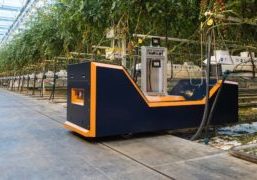
Chances are big that the Priva Deleafing Robot will be the winner of the 2016 GreenTech Innovation Award. It is the first robot in the world today to offer an economically viable alternative for the manual removal of leaves in tomato plants.
Crop handling comprises a significant chunk of the labour costs associated with the cultivation of crops such tomatoes, cucumbers and sweet peppers. Robots offer an interesting perspective to reducing these costs and enhancing the manageability and predictability of business operations. In collaboration with a group of Dutch tomato growers, Priva has developed a robot that removes leaves from tomato plants completely independently and in an economically viable manner. It is always difficult to find workers for this labour-intensive and unpleasant task.
Many demonstration projects have been launched in the past few decades. However, none of these have led to economically viable products. This can generally be attributed to the fact that the performance exhibited by robots was never able to stand up to that of human workers in terms of speed and quality. A great deal of attention has been given to practical applicability in the development of this robot. The close involvement of a large group of growers has proven to be essential: only they can properly assess the usefulness of the robot.
Vision technology
The robot must be able to identify plants and leaves, for which cameras and smart calculation technology (vision technology) are deployed. Because no two plants are identical and the lighting conditions under which the robot operates is subject to constant change, state-of-the-art vision technology was developed. When the robot identifies a leaf, it removes it with a cutting module mounted onto its arm. This cutter must be as compact as possible to allow it to easily move through the plants, and additionally designed to effectively withstand contamination and the damaging effects of the acidic juices exuded by the tomato plant.
‘Thanks to the application of vision technology, the robot can quickly and accurately identify the position of the leaves and its speed of operation is currently at an economically viable level,’ confirms Ronald Zeelen, Manager for Innovation & Research at Priva. Of course, the robot can’t work at the same speed of an experienced human, but compensates this by being able to work 24 hours a day.
The second GreenTech Innovation Award for the most innovative product or solution will be presented during the opening of the GreenTech in Amsterdam on 14 June 2016. Category awards will be presented in three categories: production, equipment and automation solutions. One of these three winners will be chosen overall winner.
Click here for a list of all nominees for the 2016 GreenTech Innovation Award.
Photo: Priva.
GreenTech Innovation Award 2016 nominees announced
A shortlist of nominees, all but two of them Dutch, has been announced for the GreenTech Innovation Award 2016. An international jury has selected a shortlist of 15 nominees from 73 entries in three categories: Production, Equipment and Automation Solutions. One of these three winners will be chosen as the overall winner on June 14, during the opening event of GreenTech Amsterdam.
“As jury, we are very pleased with both number and quality of the applications for the GreenTech Innovation Award 2016. It shows the high level of innovation in the greenhouse horticulture sector”, said jury chairman Aalt Dijkhuizen, former president of Wageningen UR and appointed by the Dutch Minister of Economic Affairs as figurehead of the Topsector Agri & Food in the Netherlands.
Shortlisted in the Production category are:
- RootmaXX by Saint-Gobain Cultilene - a new stone wool cube which claims to give a 5-25 per cent higher root mass thanks to a newly patented fibre.
- ISO Cutting and Planting robot 1800 by ISO Group - which automatically analyses the geometry of a stem, cut the stem to the right length and plants it in a pot.
- ISO Plantsampler by ISO Group - which automates the gathering of DNA material from the leaves of trial seedlings.
- GrowCoon by Maan BioBased Products - a biodegradable plug casing which help keeps the root ball together.
- Biospreader by Royal Brinkman - which provides a uniform distribution of predatory mites in the crop.
Shortlisted in the Equipment category are:
- 2SaveEnergy covering by 2SaveEnergy - a twin-skinned glasshouse covering claimed to combine high insulation and light transmission with an affordable.
- Triton Bioreactor by Van der Ende Groep - a biological treatment which yields clean irrigation water rich in oxygen and microbial biodiversity.
- AntiReflect by Mardenkro - a glass treatment which can be applied to existing greenhouses.
- NUF water recycling by NUFiltration (Israel) - which enables purification of irrigation water without use of chemicals, thermal or biological treatments.
- ValkScreenVision by Van der Valk Horti Systems - a quick, clean and safe system for inserting glasshous screens.
- Priva Deleafing Robot by Priva - a robot which removes leaves from tomato plants completely independently and in an economically profitable manner.
Shortlisted in the Automation Solutions category:
(with one remaining undisclosed)
- Paskal Growth Analyser by Paskal Technologies (Israel) - a wireless weighing system to continuously monitor plant growth in the glasshouse.
- C.H.I.M.P (Crop Health & Information Monitoring Platform) by Phenokey - which measures control and plant health parameters for remote monitroing and decision support.
- HortiMaX-Go! by Ridder Hortimax Group - a user-friendly and affordable horticultural computer for controlling both greenhouse climate and irrigation.
All nominated products will be on display at GreenTech's InnovationLAB.
Source: GreenTech. Photo: Mario Bentvelsen.
Related
‘Algae are the vegetables for the future.’
Although they only started growing fresh algae commercially less than a year ago, Hendrik Staarink and his partner Stefano Canziani are fully confident about the future of their business, which they called Algreen. ‘Algae are the vegetables for the future.’
Starink started his studies in Agricultural Water Management at Wageningen University in 2008 and conducted the research for his final project near the Oosterschelde tidal basin in the province of Zeeland. A few visits to crustacean and seaweed farms further kindled his enthusiasm about algae. After reading several books on the cultivation of algae that summer the ball started rolling rapidly.
"We saw some excellent commercial opportunities, taking into account the high prices paid these days for Spirulina algae."
While he was at university he met Stefano, who was studying biotechnology and shared his fascination for algae. ‘We visited algae farms in France together. These are commercial farms, but they were very open about what they were doing. We studied their cultivation system, which they call raceway ponds. Almost all commercial algae are grown in raceways these days. We saw some excellent commercial opportunities, taking into account the high prices paid these days for Spirulina algae. So, we decided to try our hand at this, too!’
Superfood
‘We first grew Spirulina on an experimental scale in 2014, which marked our first step out of the lab. A great deal of research has been done on the cultivation of Spirulina and we worked with tested techniques and a type of algae that was adapted to the climate in the Netherlands. As a result, we started production on a bigger scale in 2015. We now have an office in Wageningen and grow our algae on a nearby cultivation site.’
"We are directing our sales primarily at the market for healthy juices and good restaurants."
Spirulina is primarily eaten on account of its relatively high protein content. ‘I would like to call it a superfood, but that applies to other vegetables as well. To me, it’s a very special vegetable.’ Spirulina is also chock-full of easily absorbed protein, is an important source of vitamins (e.b. potassium), minerals (particularly iron) and antioxidants (phycocyanine). As a result, it can easily be included in a healthy diet.
Who will be buying your fresh algae?
‘One of our first steps was to conduct market research. We discovered that the market is growing, and that our product is healthy, not too expensive and has numerous uses. You can put it in virtually everything. Many people eat it as a dietary supplement. We are directing our sales primarily at the market for healthy juices and good restaurants. We are a supplier to various small-scale juice bars and shops in Amsterdam. Businesses like that often use powdered Spirulina, and are now replacing this with our product. They tell me that it tastes much better.’
Why do you consider algae to be the vegetable of the future?
‘Because it’s such an easy crop to grow! Harvesting is simple: there’s nothing that needs to be picked or cut. Also, the cultivation of algae can easily be automated and up or downscaled. You don’t need a lot of energy; just a little sunlight. We produce our algae in an unheated greenhouse. Also, we don’t use any crop protection agents. Algae have few requirements with regard to the quality of water (salt content) and don’t emit any greenhouse gases. It’s a very sustainable crop.’
"We distinguish ourselves from the competition by offering a product that is not only fresh, but also sustainably grown."
‘In a conventional greenhouse you need ventilation, which we have no need for. We already apply the principles of Next Generation Cultivation. You see a lot of technology applied to algae that look very interesting on paper, but that are simply not feasible from a commercial perspective. We keep it as simple as possible and make it as complex as necessary. We distinguish ourselves from the competition by offering a product that is not only fresh, but also sustainably grown.’ By offering the algae while they are fresh they not only taste better, but also retain more of their nutrient content, adds Starink. ‘Plus, it cuts costs, because drying the algae requires extra energy.’
Will every grower with access to a tank of salt water be able to grow algae in the future?
‘It’s not quite that simple. Growing algae requires a certain degree of craftsmanship. There’s actually a lot you need to know about: cultivation, certification, biological testing, microscopic testing, harvesting, processing, and so on. We studied the entire process in minute detail. In addition to that, we optimised the cultivation conditions for our algae. We prepare our own nutrient mix. Still, what we do can easily be compared to what other commercial growers of vegetables do.’
"If you operate on a large enough scale you should be able to produce algae profitably in the Netherlands with the variety we developed."
When asked what his production yield is, Starink keeps silent. ‘Even in a cold greenhouse we can earn a little. However, cultivation at this scale takes a lot of labour, relatively speaking. If you operate on a large enough scale you should be able to produce algae profitably in the Netherlands with the variety we developed. We grow an adapted Spirulina variety obtained through selection.’
What will your next step be?
‘Our next challenge is to start operating on a larger scale, cultivation-wise. We would like a bigger greenhouse, preferably with residual heat, to eliminate our winter dip in production. Our most serious competitors are producers of dried algae. We can say that our product is better, but if our fresh algae will become much more expensive, we will be fighting a tough battle,’ explains Starink.
"There is a lot left to discover in the underwater cultivation of vegetables."
‘We are also engaged in expanding our product range. There is a lot left to discover in the underwater cultivation of vegetables. Additionally, our customers keep asking for more varieties of healthy and tasty algae. We are currently busy developing an exceptionally tasty variety of seaweed (a type of macro-algae) and keep our knowledge and expertise about micro-algae up to date through projects like the ‘Luteine 2.0’ project, which won us a prize from the Netherlands Organisation for Scientific Research (NWO). We are currently speaking to investors to enable the business to continue growing and so that more people will be able to enjoy locally grown, super-fresh algae produced by Algreen in the future.’
For more information, have a look at this video about fresh Spirulina (English subtitles) or visit the Algreen website (Dutch only).
New type of paper made from tomato and sweet pepper plant fibres
Schut Papier, based in Heelsum, the Netherlands, brought a new type of paper made from raw materials such as tomato and sweet pepper plant fibres to the market. The company has long-term plans to use other agricultural by-products in the production of its paper.
With production volumes of only 3,500 metric tons, Schut Papier is one of the Netherlands’ smallest paper factories. ‘This will make us the most flexible factory in the country,’ affirms General Director René Kort. ‘Our flexibility is one of the factors that got us involved in a research project initiated by the Dutch Bio Refinery Cluster. Smurfit Kappa wanted to develop packaging that uses the fibres of tomato plants as a basic raw material. Their own equipment was, however, too big to accommodate the necessary research. Our paper machine was perfect in terms of size; and so we were able to contribute. We spent two years developing the packaging. In the meantime we gained a great deal of knowledge about how fibres derived from agricultural waste flows can be processed for use as a raw material for the production of paper.’
Making use of by-products
Schut Papier subsequently deployed this knowledge to develop its ‘Valorise by Schut Papier’. The paper is made, in part, from the fibres of tomato and sweet pepper plants. Kort: ‘We want to contribute as much as we can to achieving a biobased economy. After all, by-products form one production process can easily become raw materials for another. By treating our raw materials sensibly we will be giving future generations a better world to live in. In concrete terms, it means that we aim to replace as much wood fibre as we can with fibres derived from waste products. After tomatoes are harvested the plants themselves are treated as a waste product. This is ridiculous, of course, because the stems contain interesting substances that can be used to make paint, glue, or crop protection agents, and are additionally chock-full of fibres that can be used to produce paper. This is of benefit to all parties involved. The growers appreciate use being made from their by-products - and this contributes to sustainable working practices at the same time.’
Off to a good start
That Valorise doesn’t reflect only Schut Papier’s corporate philosophy but also appeals to that of its customers is already apparent from the initial sales figures. ‘Valorise has already achieved a production volume of 6 to 7 per cent of all paper produced in part from agricultural by-products. This means we’re off to a good start. I’m also delighted to report that world-renowned companies have been showing interest in Valorise. We were recently selected as a supplier of paper by an advertising agency whose clients include Louis Vuitton and Moët Hennessy. We aim to achieve a production volume of 15 per cent with paper made in part from agricultural by-products within the next three years. Valorise is helping us to take a giant step in the right direction.’
Cost price
The cost price of Valorise is a little higher than that of wood-based paper. Kort: ‘The purification and grinding of the fibres is still a comparably expensive process. On the other hand, as Valorise is a decorative type of paper that is used primarily in luxury applications, people are willing to pay a higher price. Fortunately, an increasing number of customers understand that a big step towards increasing sustainability is inevitably linked to a higher cost price. We ultimately aim to arrive at a production process in which the cost price is at the same level as that of conventional paper.’
Schut Papier has long-term plans to use other agricultural by-products in the production of paper. Kort: ‘We have already used by-products from tulip growers, other crops and water plants left from cleaning waterways or lakes.’ The question remains whether it is possible to make a unique line of paper out of every by-product. ‘These could be used for special editions, such as environmental reports or books about circular economics.’
Source: www.agro-chemie.nl. Photo: Mario Bentvelsen.
Related
Consortium is working on a green wall for active air purification
During the Innovation Expo, taking place on April 14th in Amsterdam, a consortium of horticultural businesses will show a prototype of a green wall that produces clean air. An important part of this project is the high-tech sensor ASML, which can accurately measure so-called volatile organic compounds.
The fact that plants provide healthy air by cleaning the air of harmful substances was already demonstrated by NASA in 1989. But is it also possible to guarantee the air quality to the users of buildings? That is the key question in the project 'Schone lucht garantie' (Clean air guarantee), an innovation program of the Dutch Horticulture Innovation Foundation SIGN.
Broad consortium
The program is supported by a consortium consisting of Royal FloraHolland, Waterdrinker, Into Green, Van der Tol,Priva, Nieuwkoop Europe BV, and SIGN in alliance with the Ministry of Economic Affairs. Organic Architects was asked by the horticultural consortium to build a prototype of a green wall with a ventilation system, which sends the air actively along the green wall. The higher the concentration of harmful substances, the higher the ventilation speed.
Evidence
In order to investigate the effect, the researchers put a high concentration of volatile compounds in a room. The actively ventilated green wall was able to degrade the contaminants: methane and urea were halved within three hours, alkanes and cyclic hydrocarbons after 9.5 hours. The baseline measurement showed that without the green wall the contamination remained stable at a high level. This demonstrates that the degradation was caused by the green wall with increased ventilation.
Business concept
In the second phase of this project industrial designers will start to develop a universal ventilation system which, in combination with a variety of existing green wall systems, can contribute to a healthy living and working environment. This system will form the basis for a business concept to provide 'clean air guarantee' to building managers.
Source/photo: SIGN.
How Dutch Sprouts wants to conquer the world
Henri Hekman was major shareholder of the BLGG Group, the leading laboratory for soil analysis. In 2013 he sold the company to Eurofins. But instead of enjoying his retirement, he chose to start something new. Inspired by his analytical background but with the addition of IT and statistics, he founded Dutch Sprouts.
The choice was easy for him: "Starting something new was simple: I had the knowledge, money and people. So the question was not why, but rather why not? Besides, I wanted to do something for humanity and this was the ideal chance."
Soil samples
Dutch Sprouts offers a number of products, of which products for the analysis of soil samples are the most important ones. Every farmer knows that the composition of the soil is important: the nutrients that are in it decide what can be grown and how much of it. Worldwide the soil composition is mainly determined by chemical analyses. Based on these results, a fertilizer recommendation is made. The analysis of a soil sample can easily cost 60 to 70 euros and is daily practice, at least in most parts of the Western world. However, this is very different in, for example, Africa, Asia or Eastern Europe. Farmers in those parts of the world do not have the right techniques at their disposal nor the financial resources."
"The SoilCares scanner, not bigger than a drill, allows you to take a sample anywhere in the world. The data are sent to our computers via a smartphone."
"Especially for this group, we have found a solution. We have made a link between the digital scan of the ground based on the infrared sensor and the chemical analysis. By taking 1500 samples and analysing and validating the scans, we can now predict which substances are in the soil based on the scan. The scan is, as it were, extrapolated with existing data."
Soil scanner
"It provides a whole new business model. The SoilCares scanner, not bigger than a drill, allows you to take a sample anywhere in the world. The data are sent to our computers via a smartphone. Within seconds the analysis is made and sent back. Payment is done through the local telephone network. No more expensive analyses: just a few dollars. It is real-time and also manageable for poor farmers! Not only an analysis is made, but also an instant fertilizer recommendation tailored to the local availability of raw materials."
"If you translate this concept into marketing terms, mass is the keyword. Many small amounts together eventually lead to profits."
"If you translate this concept into marketing terms, mass is the keyword. Many small amounts together eventually lead to profits. Fortunately, there are a lot of farmers in the world and more poor ones than rich ones. The reason that we are mainly active in developing countries is not only based on social grounds, but simply on commercial considerations."
You must be heavily betting on sales and marketing if you want to conquer the whole world?
"Not really. The key is that this technique is game-changing. We see a production improvement of 50% up to double the output. Believe me, that's not difficult to communicate. We are already being approached by cooperatives and growers from all over the world. Even governments contact us."
Governments?
"Yes, a doubling of the production transcends the interests of individual farmers. Quite apart from the fact that some countries want to be self-supporting, the economic contribution is so significant that the gross national product is affected."
Does every farmer have to buy its own scanner?
"We sell the scanner at cost, approximately 2,000 euros, and that is of course getting cheaper as the sales increase. It is expected that there will be a new market for intermediaries. They measure the soil; the farmer pays them, for example, $ 5 and the intermediary pays us $ 3 per analysis. Larger cooperatives for, amongst others, coffee, sugar and grain, and large farmers will obviously buy their own scanner."
"Technique sells itself: have you ever been contacted by Facebook with the request to open an account?"
Henri continues: "Furthermore, we have also developed a compact laboratory for this group, the Lab-in-a-Box. This compact laboratory measures more accurately than the scanner, and can be placed on a jeep, if desired. We already have 30 orders for the lab-in-a-box, especially from East Africa, as well as Ukraine and the United States. An analysis with the Lab-in-a-box is more complex and takes more time than an analysis with a scanner, for which more support is needed from the Netherlands. We will not open our own offices for the scanners. We will just start from the analogy of the drills and expect the SoilCares scanner to eventually be sold through sites like Amazon and Bol.com. "Technique sells itself: have you ever been contacted by Facebook with the request to open an account?"
Scoutbox
Another innovative product is the Scoutbox, especially designed to identify and count pest insects. This is also based on digital technology and databases: sticky traps hanging in greenhouses to monitor pest insect population are automatically counted and analysed. The sticky trap is placed in the Scoutbox and a digital picture is made."This picture is sent to our computers and a count is made of the insects and the type of insect is determined. The gardener then gets an overview on his computer with the type of insects and how many insects are present in his greenhouse and where. A lot of tomato growers in the Netherlands are already using the Scoutbox. "
"The market demands more: we are now working to develop a database for trips, so the Scoutbox can also recognise and count these trips."
"The market demands more: we are now working to develop a database for trips, so the Scoutbox can also recognise and count them. Trips are tiny bugs that can be found on plants and flowers, and which may cause problems for export."
Why develop? It is exactly the same system, isn't it?
"Yes, but you have to realize that we have to interpret the pictures correctly and that requires a lot of programming. A tiny fly that flies against a sticky trap, sometimes bursts in different pieces. Our software then needs to reconstruct a head, leg or wing to one fly so it does not count them as three flies. IT is our R&D!"
Finally, Mr. Hekman would like to give an advice to the agricultural world: “Manage your business in a more rational way! A farmer might see his cow as Klara 2, I see it as a factory. There is input, output and residues. The point is to optimize this and that is only possible with IT and lots of sensors. Knowledge is power, which is something well known, but it is still unexplored ground in this sector. Even the process in a modern greenhouses can be further optimized."
"Forget what you've learned from your predecessors. Let statistical software find a causal link between all measured variables, because believe me, there is one!"
With thanks to: Exportmagazine.nl. Photo: Dutch Sprouts.
‘More than anything else, we simply want to remain the best.’
In the course of the past 50 years, the BOM Group has developed from an innovative greenhouse builder, heating systems installer and screening specialist into a leading international supplier of turnkey projects. At the beginning of 2016 the company moved from Naaldwijk to a bright, modern building in Hoek van Holland: a location that provides numerous logistics benefits to the BOM Group’s international clientèle. In this interview, BOM’s director Martin van Zeijl looks back at and forward to the many developments of which he has been a part.
The innovation and continual improvement of products and systems is the common thread running through the history of the BOM Group. Its founder, Piet Bom, may no longer own the company, but his innovative spirit can still be felt, even on the new premises on Kulkweg - or even all the more so. Van Zeijl: ‘We took over the company from him in 2001, and he stepped down entirely in 2004. He is almost 80 now, but he still contributes his ideas to the company. A born inventor, he is still busy inventing new things, although these are no longer for us but for his golf club. He invented a golf cart with solar panels so that it could be powered electrically, for example, and a collapsible golf cart that can be taken along on an airplane. He can speak of his inventions with enormous enthusiasm.’
‘The transition from steel to aluminium made a great impact on us, and one that received worldwide acclaim. But the list is even longer.'
Piet Bom was the main contributor of innovative ideas for the BOM Group. ‘The transition from steel to aluminium made a great impact on us, and one that received worldwide acclaim. But the list is even longer. We created a timeline on our website that displays the most important innovations. These include our roll-up façade screens, our low ridge concept, our APS screen and the SunergyKas 2.0, a new generation of semi-closed greenhouses. Piet was a genuine Gyro Gearloose. Fortunately, we are able to take over that role thanks to our outstanding R&D department, who are always on top of the latest developments,’ says Van Zeijl.
Success factors
Piet Bom’s smartest innovations were a determining factor for the development of the company in the past century. Now that innovative concepts are following on one another at an ever-accelerating pace, technical innovations alone are not sufficient. ‘We have an incredibly tight organisation. Our permanent team is composed of 30 people. Our heating and screening systems are developed in-house. Although boilers and other systems are made elsewhere, we do have a heating systems department that handles all the engineering aspects, as well as purchasing, planning, and so on. We work with permanent partners for water and electrical engineering. This enables us to deliver a turn-key project working in collaboration with no more than three or four other companies. As a result, lines are short and agreements are strict, but there is also more flexibility. Besides that, we prefer to engage local partners wherever possible. That’s one of the areas we excel in: organising our network of partners. I consider that one of our key success factors.’
‘Nowadays, almost 100% of what we produce is exported. This has had an enormous impact on our organisation.'
When Van Zeijl started his career with the BOM Group in 1999, its clientèle was composed primarily of Dutch and Belgian growers. The 2008 economic crisis resulted in an important turnaround. ‘Nowadays, almost 100% of what we produce is exported. This has had an enormous impact on our organisation. Last year we were active in eleven different countries, with Germany, the USA and Canada as our principle markets. In addition to this, we also completed several projects in Japan and China. Sales are doing well in Poland and Russia too, even if the market is receding slightly.’
Water-saving greenhouses
What are some of the technological developments that Van Zeijl is anticipating for the future? ‘We are expecting a great deal from the ‘water-saving greenhouse’ concept. We built the largest testing centre in the Middle East in Riyad (ed.: Saudi Arabia), for example. Minister Kamp was present at the opening. The complex measures 8,500 m2 and contains fifteen different sections, of which four are high-tech (closed greenhouse equipped with all imaginable facilities), seven are mid-tech (with a variety of covering, screening cloth and/or pad&fan systems) and two are low-tech (plastic greenhouses). The people working there now use 10,000 litres of water per square metre to harvest 30 kilos of tomatoes. Every tomato grown here costs 330 litres of water. And that in a country where water is becoming continually scarcer.’
‘We think that our closed greenhouses will enable us to achieve water savings of 90%.'
Van Zeijl believes that a water-saving greenhouse can drastically reduce the amount of water per kilo needed for production purposes. ‘We think that our closed greenhouses will enable us to achieve water savings of 90%. According to Wageningen University, the production in a greenhouse like that could be increased to 114 kilos per square metre. However, if they manage to get 90 kilos I will still be delighted. They will then be able to quickly pay back their investment on that high-tech greenhouse. The outside temperature there is 45 to 46 degrees; cooling via a pad&fan system costs a lot more energy in Saudi Arabia than in the Netherlands. They pump water up from the substrate, remove the salt and pump the brine back into the ground. As a result, the ground water there is becoming increasingly salty. This means having to drill increasingly deeper wells. At some point you will have reached the limit. The amount of energy needed is also continually increasing.’
Zero emission and zero residue
Are we working towards achieving zero-emission and zero-residue greenhouses? ‘You could never reduce emissions to zero, and the same applies to residue. However, almost zero is feasible. We work with over-pressure (we call these our Air in Control greenhouses), for example, which keeps all unwanted elements outside. Whatever does enter the greenhouse is filtered first. This way all pollutants are kept out of the greenhouse. We have sold several of these already. This greenhouse is comparable to the Ultra-Clima and Maxi Air greenhouses, which are equipped with air handling units mounted into the façade, and are combined in some cases with a pad&fan system, inside air recirculation, CO2 dosage and so on. We have noticed that this is a growing market, but it only works in specific areas. Systems like these simply aren’t as useful when in wet weather conditions. You have to be able to pump dry air into your greenhouse for it to work.’
'Greenhouses are becoming increasingly energy-efficient, but growers are also growing more efficiently.'
Can greenhouses become even more efficient? ‘With 40 cubic metres it’s too expensive, but we are working on 20 cubic metres per square metre. Greenhouses are becoming increasingly energy-efficient, but growers are also growing more efficiently. Greenhouses require more technology and expertise than ever before.’
Vertical farming
Vertical farming? ‘I consider that to be a niche product. Economies of scale cannot be achieved, and your costs prices will soar. If you build a greenhouse on top of an existing building, construction prices will be much higher than when you are building on a plot of land. We built a high-tech greenhouse for a customer in Canada who will be growing organic produce for Wholefoods. By means of an experiment, the greenhouse will be built adjacent to one of the stores. If the project is a success, Wholefoods will probably want to build more greenhouses next to their stores. I think that this concept will be more successful than the idea of closed-off cultivation systems with multiple-tier cultivation, LED lighting, robots, and so on.’
'I believe that most a supermarket shoppers consider prices look at prices first.'
How big does Van Zeijl think the market share is for produce grown in a closed system? ‘I expect it to be about 10% of all buyers. These will be among the more affluent segment and prepared to pay 20% more for their food. I believe that most a supermarket shoppers consider prices look at prices first. However, it could be very interesting for hipsters who want to use their smartphone to see how their head of lettuce or fresh fish are coming along.’
No-nonsense
Where do you expect to be five years from now? ‘We will still be in Hoek van Holland, with a fantastic team of enthusiastic people. We operate worldwide as a leading player in our segment. However, we keep telling each other: we don’t have to be the biggest, but we do aim to be the best. Of course, we’ll never scream this from the rooftops! We favour a no-nonsense approach. We walk our talk. It’s easy to become the biggest, but staying the best is no easy task. We are present at trade fairs and exhibitions, but don’t advertise in magazines to tell people how good we are. We prefer to leave that to our satisfied customers.’
BOM will be officially celebrating its 50th anniversary on 31 March 2016. The event will only be celebrated within the company itself. Anniversary festivities will probably be organised for all customers of the BOM Group during or after Greentech.