
Middle East
WUR innovative horticultural greenhouse increases water efficiency in Lebanon
Wageningen University & Research (WUR) embarked on a project in Lebanon last spring to improve water efficiency in horticulture and increase production. The greenhouse horticulture experts at WUR built a special demonstration greenhouse at the Lebanese Agricultural Research Institute research site in the Bekaa Valley.
The project carried out by WUR contributes to sustainable food provision in an area that suffers from substantial droughts in summer. An additional advantage is that the project offers employment opportunities for Syrian refugees in Lebanon.
Improved ventilation
In the past few months, the project team at WUR developed a greenhouse whose design is based on local weather conditions and which is affordable for local entrepreneurs. The greenhouse creates optimum cultivation conditions while taking into account the local climate. The sides of the adaptive greenhouse designed by WUR can be opened in their entirety, resulting in ventilation possibilities that far exceed those provided by the traditional foil tunnel.
Three steps of cultivation
The insect mesh inside the custom-designed WUR greenhouse reduces the possibility of damage from insects. As a result, fewer crop protection agents are needed. A passive heating system that works according to the same principle as a hot water bottle ensures that the temperature in the greenhouse does not drop too far in early spring. By growing crops in the open field in the traditional manner as well as on a substrate, WUR is showing local growers how to make the switch from growing crops on soil in the traditional manner to growing crops on substrate in a well-ventilated greenhouse in three innovative steps.
Extra employment possibilities
The results produced by the innovations applied by WUR in the special greenhouse are not limited to lower water consumption, improved pest control and higher yields. Thanks to a higher yield, there is a greater demand for workers to assist in the labour-intensive cultivation work in the greenhouse. This increases employment opportunities for Syrian refugees in Lebanon.
Initial results
Robinson, a greenhouse builder in Lebanon, hopes to deliver the project with favourable weather conditions this winter. The initial results can be shared this winter with local farmers. The project is executed in Lebanon in conjunction with the Greenhouse Horticulture business unit of Wageningen University & Research and the Dutch Ministry of Foreign Affairs.
Source: Wageningen University & Research.
Related

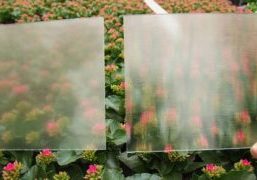
Wageningen University tests water conservation technology in the Middle East
The greenhouse horticulture division of Wageningen University Research Centre is involved in setting up research centres in the field of water conservation in the Middle East. Their goal is to test water conservation technology under local circumstances. Technology that enables plants to be grown without any soil, possibly based on the recirculation of drain water, is a key topic.
Most of the water used in greenhouse horticulture under Middle Eastern conditions is not used to grow plants, but to cool greenhouses using the pad & fan principle of evaporative cooling. This cooling method is quite effective on account of the low humidity outside, but it uses a lot of water. The amount of water needed could be compensated for by leaving less heat in greenhouses. However, as this is primarily heat generated by the sun, this could only be limited slightly without any concessions to production. A possible solution would be to apply specially developed covering materials with spectral properties to reflect part of the solar radiation not used for the photosynthesis process. Additionally, greenhouses could also be cooled mechanically through air conditioning. Obviously, this would require more energy, but it would also result in higher production of a better quality.
Technical and economic feasibility
The research conducted at the centres will focus primarily on the technical and economic feasibility of these innovations in the Middle East. The application of these innovations in practice will also be investigated, in which the necessary expertise will closely examined. ‘The application of high-quality technology without the accompanying expertise would be like selling a Ferrari to someone who has never driven a car,’ explains Jouke Campen, researcher for Greenhouse Climate and Energy at Wageningen UR.
Source/photo: Wageningen University Research Centre.