
monitoring
Robot for scouting plants in greenhouses
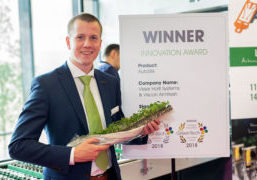
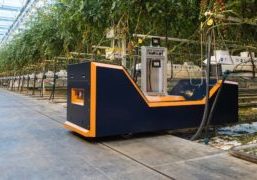
A consortium of three companies, Ecoation, Metazet FormFlex and Micothon, has launched a new robot for scouting plants in greenhouses.
Revolutionary patented sensors register plant diseases and plant production factors before human eyes can discover them. The data generated is automatically displayed on a greenhouse map. This finally makes it possible to steer and protect the plants on an almost individual level, leading to minimal need for crop protection combined with maximum production of “always healthy plants”.
Saber sensor
The robot registers the diseases and development of the plants in greenhouses with technology based on the patented Saber sensor, which detects pests, diseases and deficiencies at an early stage. It can also be equipped with cameras, a gyro sensor and sensors for RH%, temperature, CO2, crop top temperature and a PAR sensor, resulting in almost total plant control.
www.metazet.com
Stand number: 12.107
Related




Big boost in tomato production with exact substrate measurements
“Passion for perfection” – that’s Dutch tomato growers Schenkeveld’s slogan, and not without good reason. Production and quality are already at a very high level. But they can and should be even better, believes crop manager Berry Baruch, who is responsible for the crops at all three of the company’s sites. More focus on the root zone and constant monitoring of conditions in the slab throughout the day and the season make for optimum accessibility and uptake of water and nutrients. This strategy has delivered him a 5% increase in production.
Family-run Schenkeveld Tomaten has been growing tomatoes for almost 80 years. Richard Schenkeveld is the current owner of the company, which has three sites growing cluster tomatoes totalling 30 ha within a radius of three kilometres of each other. The tomatoes at the Schipluiden site and on two-thirds of the Den Hoorn site are lit, enabling Schenkeveld to supply tomatoes all year round. The nursery is a member of the Prominent growers association and sales take place via the Door Partners cooperative, which means that the quality bar is set high.
Irrigation strategy
Baruch takes every opportunity to not only steer the plant above ground via the climate but also below ground via the root environment. As well as relying on the automatic pilot in the climate computer, he likes to keep his own finger on the pulse to ensure that the water content and EC in the slab are kept as constant as possible. “Recently we had a spell of cold weather with a north-easterly wind. When that happens, you have to restrict your ventilation. In those conditions the plant takes up less water despite the amount of light available. You can’t automatically adjust your irrigation to that,” he says.
Baruch has two tools which he uses to manage his irrigation: an Aquabalance weighing scale and, since the current growing season at the Schipluiden site, the wireless GroSens sensor system from substrate suppliers Grodan.
Wireless sensors
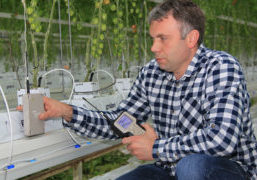
The advantage of the sensor system is that it consists of several wireless sensors which accurately measure the water content, EC and temperature in the slab. A basic set consists of a receiver and three sensors which can be positioned anywhere in the greenhouse. The crop manager: “There are always differences in the greenhouse. I aim for the representative average of the measurements from the three sensors in the control section. Because it is a wireless system, you can easily move them to another slab if a sensor looks like it is deviating from the average, for instance if one of a plant’s four stems is lost. On top of that, we recently added a fourth sensor in the irrigation section at the back of the greenhouse. We use that to check that the measurements in the irrigation section at the back match those in the control section.”
Sensors and weighing scale
The question is why the crop manager needs both tools – wireless sensors as well as a weighing scale – to monitor his growing conditions. “To get the most out of the crop, I measure as much as possible. We start irrigating based on the amount of radiation after sunrise at the time when the crop actively starts to transpire. The EC peaks in the morning and drops away rapidly in the substrate after the first point of drain is reached. By taking more measurements with the wireless sensors I have a better picture of what is happening with the concentration of the nutrient solution and I’m not worried now if it rises by, say, 0.3 mS/cm2 in warm weather.”
Production up by 5%
Gert-Jan Goes, substrate and irrigation advisor at Grodan, adds that with this system, growers will notice if something is wrong one or two days earlier than if they only tracked the amount of drain water and EC. “If a plant isn’t happy, the concentration in the slab increases. As soon as you see that, you can adapt your strategy. By optimising your strategy you can push the boundaries a little further and increase the drip value on more days of the year.”
Baruch drip irrigates with an EC of 3.5 at the beginning of the crop and 3.1 later on. He sees clear advantages in this higher value. “The better the plant grows, the more nutrition it needs. We aim for a highly generative plant with high production, better quality and more flavour.” Goes adds: “By staying on top of things better you avoid EC peaks in the slab. You have to flush out any excess and that uses up more water. And there is less oxygen in the slab. The roots don’t develop as well and that costs you in terms of production and plant health.”
In the last growing season, Baruch’s use of the wireless measuring system enabled him to increase production by 5%. “The plants were potted up on 8 October 2015. We wanted to get the most out of them right up to week 20 2016. We got the extra production in the period in which both the costs (of lighting) and the yields were highest.”
One plant per slab
This increased production is not only the result of extra measurements but is also due to the fact that Baruch is using the Elite system at his Schipluiden site: one plant per 50x10x15 cm slab. “That means plants are not competing with each other in the root zone and makes the plants and stems more uniform. We aim for maximum uniformity in the root zone as well as an even number of stems per unit and an equal distance between the dripper and the drain hole for every plant.”
Goes adds: “Because the wool in these slabs is more capillary at the top, it retains water better there. The water is taken up more easily at the bottom so it is drier there. The balance between water and oxygen in the slab is better and this results in higher, more efficient uptake of water and nutrients. At the end of the day, you can continue to drip irrigate for longer without affecting root quality and generativity. This makes for more vigorous plants and heavier fruit.”
Set daily routine
The crop manager follows a set daily routine: re-saturate, flush, balance, reduce in the afternoon. Optimising the EC in the slab is an important task. He starts his day by re-saturating the slab. Once the point of drain is reached, the flushing stage starts.
The question is how far the EC drops in this phase. If he hasn’t got this under control before noon, something is wrong: the point of drain may have been reached too late, for example, or there may have been insufficient drain in this particular period. He tracks this by means of the wireless sensors. In the afternoon there is a balance between irrigation, uptake and drain, with a stable EC in the slab. He continues irrigating for longer at the end of the day. He also sees this reflected in his measurements. The water content drops more rapidly after the last irrigation; the plant takes up water over a longer period and is active for longer.
Water and fertilisers
An important requirement for all of this is good irrigation water. Schenkeveld Tomaten uses a combination of rainwater and reverse osmosis water, stored in silos and basins covered with floating tarpaulins. The combination of good irrigation water and skilful irrigating produces less drain: 30-35% in the lit period, 35% on sunny days and 25% on dark days. That’s 3-4% less than in the previous year, meaning less drain water to disinfect and less accumulation of minerals or rising sodium figures.
Baruch has to irrigate less to maintain a stable EC in this greenhouse than in the other one. As far as the total amount of irrigation is concerned, there is not much difference. “I continue watering for longer here. The sessions in the afternoon produce less drain but they translate into higher production and better growth. The stable irrigation gives the plants good, healthy roots which contributes to healthy plants and fewer problems with diseases.”
The plants at all three sites are nice and robust. In terms of production, the nurseries are up there at the top. By optimising their irrigation strategy using the wireless sensors and the one-plant-per-slab concept on special slabs, they have been able to go even further.
Summary
At one of its three sites, Schenkeveld Tomaten not only has a weighing gutter but also wireless sensors that measure the EC, water content and temperature in the slab. Crop manager Berry Baruch uses these extra tools to keep the root environment even more stable. This translates into a 5% increase in yield in the lit crop at a time when prices are good.
Text and images: Marleen Arkesteijn.
Related



Remote growing now possible with consistent data collection
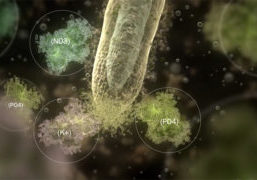
Building a high-tech greenhouse is one thing, but working with it is a whole different ball game. Nurseries in countries with no horticultural tradition often need high-frequency advice. Remote monitoring makes that a whole lot easier. A new system developed in recent years is an interesting option for remote management or benchmarking.
If you want to read this content you need a subscription, or log in when you already have a subscription.
Related


How Dutch Sprouts wants to conquer the world
Henri Hekman was major shareholder of the BLGG Group, the leading laboratory for soil analysis. In 2013 he sold the company to Eurofins. But instead of enjoying his retirement, he chose to start something new. Inspired by his analytical background but with the addition of IT and statistics, he founded Dutch Sprouts.
The choice was easy for him: "Starting something new was simple: I had the knowledge, money and people. So the question was not why, but rather why not? Besides, I wanted to do something for humanity and this was the ideal chance."
Soil samples
Dutch Sprouts offers a number of products, of which products for the analysis of soil samples are the most important ones. Every farmer knows that the composition of the soil is important: the nutrients that are in it decide what can be grown and how much of it. Worldwide the soil composition is mainly determined by chemical analyses. Based on these results, a fertilizer recommendation is made. The analysis of a soil sample can easily cost 60 to 70 euros and is daily practice, at least in most parts of the Western world. However, this is very different in, for example, Africa, Asia or Eastern Europe. Farmers in those parts of the world do not have the right techniques at their disposal nor the financial resources."
"The SoilCares scanner, not bigger than a drill, allows you to take a sample anywhere in the world. The data are sent to our computers via a smartphone."
"Especially for this group, we have found a solution. We have made a link between the digital scan of the ground based on the infrared sensor and the chemical analysis. By taking 1500 samples and analysing and validating the scans, we can now predict which substances are in the soil based on the scan. The scan is, as it were, extrapolated with existing data."
Soil scanner
"It provides a whole new business model. The SoilCares scanner, not bigger than a drill, allows you to take a sample anywhere in the world. The data are sent to our computers via a smartphone. Within seconds the analysis is made and sent back. Payment is done through the local telephone network. No more expensive analyses: just a few dollars. It is real-time and also manageable for poor farmers! Not only an analysis is made, but also an instant fertilizer recommendation tailored to the local availability of raw materials."
"If you translate this concept into marketing terms, mass is the keyword. Many small amounts together eventually lead to profits."
"If you translate this concept into marketing terms, mass is the keyword. Many small amounts together eventually lead to profits. Fortunately, there are a lot of farmers in the world and more poor ones than rich ones. The reason that we are mainly active in developing countries is not only based on social grounds, but simply on commercial considerations."
You must be heavily betting on sales and marketing if you want to conquer the whole world?
"Not really. The key is that this technique is game-changing. We see a production improvement of 50% up to double the output. Believe me, that's not difficult to communicate. We are already being approached by cooperatives and growers from all over the world. Even governments contact us."
Governments?
"Yes, a doubling of the production transcends the interests of individual farmers. Quite apart from the fact that some countries want to be self-supporting, the economic contribution is so significant that the gross national product is affected."
Does every farmer have to buy its own scanner?
"We sell the scanner at cost, approximately 2,000 euros, and that is of course getting cheaper as the sales increase. It is expected that there will be a new market for intermediaries. They measure the soil; the farmer pays them, for example, $ 5 and the intermediary pays us $ 3 per analysis. Larger cooperatives for, amongst others, coffee, sugar and grain, and large farmers will obviously buy their own scanner."
"Technique sells itself: have you ever been contacted by Facebook with the request to open an account?"
Henri continues: "Furthermore, we have also developed a compact laboratory for this group, the Lab-in-a-Box. This compact laboratory measures more accurately than the scanner, and can be placed on a jeep, if desired. We already have 30 orders for the lab-in-a-box, especially from East Africa, as well as Ukraine and the United States. An analysis with the Lab-in-a-box is more complex and takes more time than an analysis with a scanner, for which more support is needed from the Netherlands. We will not open our own offices for the scanners. We will just start from the analogy of the drills and expect the SoilCares scanner to eventually be sold through sites like Amazon and Bol.com. "Technique sells itself: have you ever been contacted by Facebook with the request to open an account?"
Scoutbox
Another innovative product is the Scoutbox, especially designed to identify and count pest insects. This is also based on digital technology and databases: sticky traps hanging in greenhouses to monitor pest insect population are automatically counted and analysed. The sticky trap is placed in the Scoutbox and a digital picture is made."This picture is sent to our computers and a count is made of the insects and the type of insect is determined. The gardener then gets an overview on his computer with the type of insects and how many insects are present in his greenhouse and where. A lot of tomato growers in the Netherlands are already using the Scoutbox. "
"The market demands more: we are now working to develop a database for trips, so the Scoutbox can also recognise and count these trips."
"The market demands more: we are now working to develop a database for trips, so the Scoutbox can also recognise and count them. Trips are tiny bugs that can be found on plants and flowers, and which may cause problems for export."
Why develop? It is exactly the same system, isn't it?
"Yes, but you have to realize that we have to interpret the pictures correctly and that requires a lot of programming. A tiny fly that flies against a sticky trap, sometimes bursts in different pieces. Our software then needs to reconstruct a head, leg or wing to one fly so it does not count them as three flies. IT is our R&D!"
Finally, Mr. Hekman would like to give an advice to the agricultural world: “Manage your business in a more rational way! A farmer might see his cow as Klara 2, I see it as a factory. There is input, output and residues. The point is to optimize this and that is only possible with IT and lots of sensors. Knowledge is power, which is something well known, but it is still unexplored ground in this sector. Even the process in a modern greenhouses can be further optimized."
"Forget what you've learned from your predecessors. Let statistical software find a causal link between all measured variables, because believe me, there is one!"
With thanks to: Exportmagazine.nl. Photo: Dutch Sprouts.