
pest insects
“It works, but you need discipline to succeed”
Thrips are one of the biggest threats chrysanthemum growers face. But this hasn’t put off River Flowers in the central Dutch town of Zaltbommel: they grow one of the most sensitive chrysanthemum varieties using integrated pest management. “It works, but you need discipline to succeed.”
Chrysanthemum ‘Haydar’ grows here in all its glory. When you enter the 3.5 hectare greenhouse, you are confronted with a sea of plants graduating from green at the front of the greenhouse to purple with a white edge at the back. Not many growers are keen to grow this chrysanthemum variety because of the huge threat posed by thrips. In extreme cases these small, thin insects can even mean bankruptcy, but Peter van de Werken of River Flowers in Zaltbommel is up to the challenge. “We have the resources to deal with them and we have a person working full-time on crop protection. It is more labour-intensive, but we can charge more for this plant.”
Fully alert
At the beginning of each plant row is a yellow sticky trap hanging from a pin mounted on the truss. Some traps have more black dots on them than others. CEO assistant Rick van de Werken takes hold of one of the yellow cards and examines it with a magnifying glass. “Look, there’s a thrip.” He points to a dot that is barely visible to the naked eye. “Last week I found two different species.” He shows us a picture on his phone. “We need to be fully alert to keep the pressure as low as possible.”
His uncle agrees: “We base our cultivation decisions on the risk of thrips. Do we want to use the sprinklers? First we check whether that fits in with our pest management strategy. It is a huge threat and difficult to get to grips with, or at least it has been until recently.”
Nematode sprays
Until 2014, the growers fought the pest with chemicals and the predatory mite Cucumeris. “Every year we started off using Cucumeris in the spring, but things would often get out of hand between weeks 35 and 45, so we had to correct with chemicals,” says Teun de Leeuw, the company’s crop protection specialist. “That immediately killed off all the biological life, including the other natural predators. The biological balance got out of kilter and we had to rebuild the biology from scratch. We were always falling behind.”
So he decided to try something new: correcting with Nemasys nematode spray. “I had heard of this before and thought: this will enable the bio to continue to do its job,” he says. The nematodes did the trick and got the number of thrips back under control. Since then, the nursery has hardly ever needed to use chemicals to tackle an outbreak.
Biological balance
“This doesn’t mean we can sit back and relax, though,” Van de Werken adds. “Thrips get into your crop in three ways: through the windows, through the door or from the soil. To minimise the risk in the soil, we only grow one variety of chrysanthemum in each greenhouse. Luckily we don’t have any growers as neighbours, so there is less risk of contamination through the windows. We also carry out intensive chemical thrips control measures on the new cuttings for two weeks. And lastly, Teun is always on the case.”
Teun works on crop protection full-time. He checks the plants and the sticky traps daily. “We sit down with Alliance once a week. I keep an eye on the cost structure, they input their experience, and when the number of thrips rises and the biological balance gets out of kilter, we decide together whether we need to change the strategy.”
Focus on biological control
Nematodes are not the only thing they use to keep the numbers of thrips down. They also use tapes, fungi and turkey feed. According to Piet van Boven, bio-insecticides advisor at BASF, growers are increasingly looking for a biological solution. “Firstly because the list of legally permissible pesticides is getting shorter and shorter, and secondly because pesticides are detrimental to the biological life in the greenhouse. It takes time and energy to build that up again,” he says.
For the last four years he has been recommending Nemasys nematodes. Cage tests have revealed that the effectiveness of these nematodes is around 40-60% in the soil and 60-70% in the crop. Van Boven: “Of course, you can’t translate these results directly to the commercial setting, but they do show a continuous effect. We see nematodes as part of the package of control measures and we get good results in combination with predatory mites.”
Thrips determine cultivation choices
However, it is important to follow the nematode protocol. Among other things, that means leaving the leaves wet for two hours. “Sufficient moisture is vital,” van Boven adds. “We recommend spraying with a normal spray boom. This produces the best nematode distribution and avoids dripping.”
But the chemicals company is also on a learning curve. “We used to think that the best time to apply nematodes was in the dark, at around 4 am. But new insights have revealed that spraying them in the late afternoon can also be very effective.”
For de Leeuw, that means no more getting up at the crack of dawn, although at this time of the year the plants do start the night wet, which increases the risk of rust. “It’s always something to bear in mind, but as mentioned, the thrips determine our cultivation choices,” he says.
Chemicals as a back-up
Discipline is and remains the key to success. Van de Werken and de Leeuw discovered this in September last year, when disaster was narrowly averted. “When it came to harvest time, we suddenly noticed that the flowers in some of the bays ready for harvesting were damaged,” van de Werken says. “We went to look for the cause and found insect-damaged tapes. It turned out that we had had an infestation of mice, attracted by the bran in the tapes. Because the tapes had been eaten, the thrips had had a field day. The whole balance was out of kilter. We bought some cats and tackled the thrips with nematodes and a bit of chemistry. It took more than 15 weeks to restore the balance in the greenhouse. We have learned to be even more alert now. It was a really tense time, because if you don’t get an outbreak like that under control, you might as well shut down. You would simply go bankrupt.”
So it is extremely important to have some chemicals that can still be used, he believes. “As a grower I only feel confident in heading down the biological control path if we can continue to use chemicals as a back-up. If the government allows us some leeway in terms of chemicals, we will be happy to use biological control methods in return. Chemicals are a must when you are experimenting with biological pest management. You have to have something up your sleeve if things go wrong.”
Summary
Netherlands-based River Flowers grows chrysanthemum ‘Haydar’, one of the most sensitive chrysanthemum varieties to thrips, which they control using integrated pest management. They keep numbers down with nematode sprays, but discipline is a must. One employee specialises in crop protection full-time, and the nursery is constantly optimising its methods.
Text and images: Marjolein van Woerkom.
Monitoring system for spider mite damage and yellow sticky traps
Pest monitoring forms the basis of good biological control. Knowledge of the ratio of harmful and beneficial insects is indispensable in determining the necessary control strategy. In the EU PeMaTo-EuroPep project (Pest Management tool for tomato and pepper in Europe), we are developing advanced camera systems and image analysis algorithms for detecting insect pests.
We analysed tomato leaves with spider mite damage with a hyperspectral camera system to investigate which spectral bands contain the most information for distinguishing between healthy and damaged leaves. The results showed that promising classification results can be achieved even when standard colour images are used.
For the upcoming season, a semi-automatic pipe rail trolley has been developed for image and data acquisition in the greenhouse. A deep learning image analysis system that automatically identifies and counts whitefly and bugs on images of yellow sticky traps is also currently under development. The preliminary results are encouraging.


How Dutch Sprouts wants to conquer the world
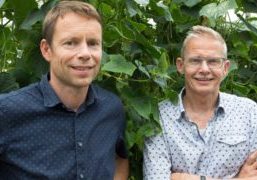
Henri Hekman was major shareholder of the BLGG Group, the leading laboratory for soil analysis. In 2013 he sold the company to Eurofins. But instead of enjoying his retirement, he chose to start something new. Inspired by his analytical background but with the addition of IT and statistics, he founded Dutch Sprouts.
The choice was easy for him: "Starting something new was simple: I had the knowledge, money and people. So the question was not why, but rather why not? Besides, I wanted to do something for humanity and this was the ideal chance."
Soil samples
Dutch Sprouts offers a number of products, of which products for the analysis of soil samples are the most important ones. Every farmer knows that the composition of the soil is important: the nutrients that are in it decide what can be grown and how much of it. Worldwide the soil composition is mainly determined by chemical analyses. Based on these results, a fertilizer recommendation is made. The analysis of a soil sample can easily cost 60 to 70 euros and is daily practice, at least in most parts of the Western world. However, this is very different in, for example, Africa, Asia or Eastern Europe. Farmers in those parts of the world do not have the right techniques at their disposal nor the financial resources."
"The SoilCares scanner, not bigger than a drill, allows you to take a sample anywhere in the world. The data are sent to our computers via a smartphone."
"Especially for this group, we have found a solution. We have made a link between the digital scan of the ground based on the infrared sensor and the chemical analysis. By taking 1500 samples and analysing and validating the scans, we can now predict which substances are in the soil based on the scan. The scan is, as it were, extrapolated with existing data."
Soil scanner
"It provides a whole new business model. The SoilCares scanner, not bigger than a drill, allows you to take a sample anywhere in the world. The data are sent to our computers via a smartphone. Within seconds the analysis is made and sent back. Payment is done through the local telephone network. No more expensive analyses: just a few dollars. It is real-time and also manageable for poor farmers! Not only an analysis is made, but also an instant fertilizer recommendation tailored to the local availability of raw materials."
"If you translate this concept into marketing terms, mass is the keyword. Many small amounts together eventually lead to profits."
"If you translate this concept into marketing terms, mass is the keyword. Many small amounts together eventually lead to profits. Fortunately, there are a lot of farmers in the world and more poor ones than rich ones. The reason that we are mainly active in developing countries is not only based on social grounds, but simply on commercial considerations."
You must be heavily betting on sales and marketing if you want to conquer the whole world?
"Not really. The key is that this technique is game-changing. We see a production improvement of 50% up to double the output. Believe me, that's not difficult to communicate. We are already being approached by cooperatives and growers from all over the world. Even governments contact us."
Governments?
"Yes, a doubling of the production transcends the interests of individual farmers. Quite apart from the fact that some countries want to be self-supporting, the economic contribution is so significant that the gross national product is affected."
Does every farmer have to buy its own scanner?
"We sell the scanner at cost, approximately 2,000 euros, and that is of course getting cheaper as the sales increase. It is expected that there will be a new market for intermediaries. They measure the soil; the farmer pays them, for example, $ 5 and the intermediary pays us $ 3 per analysis. Larger cooperatives for, amongst others, coffee, sugar and grain, and large farmers will obviously buy their own scanner."
"Technique sells itself: have you ever been contacted by Facebook with the request to open an account?"
Henri continues: "Furthermore, we have also developed a compact laboratory for this group, the Lab-in-a-Box. This compact laboratory measures more accurately than the scanner, and can be placed on a jeep, if desired. We already have 30 orders for the lab-in-a-box, especially from East Africa, as well as Ukraine and the United States. An analysis with the Lab-in-a-box is more complex and takes more time than an analysis with a scanner, for which more support is needed from the Netherlands. We will not open our own offices for the scanners. We will just start from the analogy of the drills and expect the SoilCares scanner to eventually be sold through sites like Amazon and Bol.com. "Technique sells itself: have you ever been contacted by Facebook with the request to open an account?"
Scoutbox
Another innovative product is the Scoutbox, especially designed to identify and count pest insects. This is also based on digital technology and databases: sticky traps hanging in greenhouses to monitor pest insect population are automatically counted and analysed. The sticky trap is placed in the Scoutbox and a digital picture is made."This picture is sent to our computers and a count is made of the insects and the type of insect is determined. The gardener then gets an overview on his computer with the type of insects and how many insects are present in his greenhouse and where. A lot of tomato growers in the Netherlands are already using the Scoutbox. "
"The market demands more: we are now working to develop a database for trips, so the Scoutbox can also recognise and count these trips."
"The market demands more: we are now working to develop a database for trips, so the Scoutbox can also recognise and count them. Trips are tiny bugs that can be found on plants and flowers, and which may cause problems for export."
Why develop? It is exactly the same system, isn't it?
"Yes, but you have to realize that we have to interpret the pictures correctly and that requires a lot of programming. A tiny fly that flies against a sticky trap, sometimes bursts in different pieces. Our software then needs to reconstruct a head, leg or wing to one fly so it does not count them as three flies. IT is our R&D!"
Finally, Mr. Hekman would like to give an advice to the agricultural world: “Manage your business in a more rational way! A farmer might see his cow as Klara 2, I see it as a factory. There is input, output and residues. The point is to optimize this and that is only possible with IT and lots of sensors. Knowledge is power, which is something well known, but it is still unexplored ground in this sector. Even the process in a modern greenhouses can be further optimized."
"Forget what you've learned from your predecessors. Let statistical software find a causal link between all measured variables, because believe me, there is one!"
With thanks to: Exportmagazine.nl. Photo: Dutch Sprouts.