pilot
Dutch startup Plant-e tests green electricity derived from grass
Plant-e was commissioned this autumn by the Province of Zuid-Holland and the Delfland Water Board to conduct a pilot in which green electricity is generated by plants growing on the wet grasslands near the N470 provincial motorway in the Netherlands. This is the first time the Dutch startup has tested this method of generating power outside of a laboratory.
Plant-e was acclaimed one the world’s most promising Technology Pioneers by the World Economic Forum last summer, which puts the company in the same league as Google, AirBnB and Twitter. Plant-e director Marjolein Helder: ‘We are very proud of the recognition we received from the World Economic Forum. Of course we already won the confidence of the Province of Zuid-Holland and the Water Board before receiving this international acclaim. The test set-up in Zuid-Holland was a big step for us to ensure that this system will become a full-fledged alternative for generating sustainable energy.’
Plant energy
The technology works as follows: pipes are laid on a plot of grassland, between the roots and the grass. Grass excretes organic material through its roots, which is broken down by micro-organisms in the soil. In this process, electrons are released as a waste product which are then captured in the pipes and harvested as electricity. Following the further development of this technology the energy can be used to power lights incorporated into crash barriers, or other traffic lighting. The pilot was developed to discover how much electricity plants can yield.
Startup
The startup has taken this technology to a higher level than anywhere else in the world. ‘I dare say that we are the only ones in the world to conduct practical tests at this level,’ says Pim de Jager of Plant-e. A big advantage to generating electricity from plant growth is that it all takes place underground and is therefore not visible. The pipes used in the test set-up protruded slightly above the ground, but this will soon no longer be necessary,’ explains De Jager. ‘You can keep using your land as you would normally. Nothing changes, except that it will be producing electricity.’
Currently, electricity derived from plants is not yet able to compete with other methods of sustainable energy generation. Plant-e intends to further develop this pipe system and hopes that the price per kilowatt hour will be comparable to that of solar and wind energy in the next few years to come - and ultimately with that of our current ‘grey’ electricity (electricity from non-renewable sources).
Source: NOS/Province of Zuid-Holland. Photo: Mario Bentvelsen.
‘A robot has to give you a little something extra.’
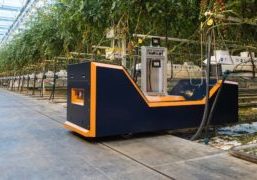
Sweeper was launched at the beginning of 2015. The goal of this project is to develop a harvesting robot for sweet peppers. The robot is being tested at De Tuindershoek, a sweet pepper farm in IJsselmuiden run by two brothers, André en Paul Kaashoek.
What made you decide to join in the development of Sweeper?
‘As a member of the Dutch National Sweet Pepper Committee I was involved in Crops, the predecessor of Sweeper. As Sweeper had to be tested in practice, we proposed our farm as a testing ground. Also, if you are among the first to collaborate on projects like these, you will be able to benefit from innovation grants. That doesn’t mean that funding is our only incentive: all six partners in the project are expected to put a lot of effort into the project.’
What is being researched at your farm?
‘The prototype should be ready in February 2018; we are currently still looking into a number of different aspects. One of these was testing several types of cameras. The goal was to choose the best camera, while also exploring the possibilities of what a camera can capture in terms of data. It may even lead to us cultivating another variety to accommodate the research, for example. That would be quite a drastic change, but like I said, we have very high standards in terms of what we want to accomplish with this project.’
‘Labour is currently our biggest cost item. A robot would help us achieve tremendous savings in this.’
What advantages would a robot have for your farm?
‘Our biggest cost item is labour, for harvesting the green peppers. A robot would help us achieve tremendous savings in this. We would also need fewer seasonal workers. On the other hand, we would need more technical staff for maintenance on the robots. That would mean a big change in the composition of our workforce. Of course, we would have to make sure that the venture is economically viable: a robot has to give you something extra.’
Aren’t you apprehensive about making this investment; by being the first to test a harvesting robot?
‘Nobody is forcing us to join in, or adapt our greenhouses. This is our very own decision. And a decision we will continue to support.’
Are you enjoying your contribution to the development of a robot?
‘Absolutely. It is also very exciting and quite challenging at times.’
Text: Tuinbouwteksten.nl/Mario van Vliet. Photo: Mario Bentvelsen.
Download the complete dossier Robots in Greenhouse Horticulture (13 pages, pdf).
If you want to download this content you need a subscription, or log in when you already have a subscription.