potplants
When each leaf counts, leaf samples can point to plant’s needs
It’s fine for a tomato plant to have a few spots on its leaves. But it’s a different matter when it comes to flowering pot plants. Visible defects detract from the ornamental value and therefore the price of the product. Aspects such as feeding and climate therefore need to be carefully controlled. By taking leaf samples, growers can find out precisely how much of the nutrients they supply actually gets taken up by the plants. They can then optimise their fertilisation based on the data the samples provide.
Yellowing leaf margins, discolouration, speckling or dwarfism – these are just some of the symptoms that indicate an excess or deficiency in the nutrients a Spathiphyllum crop needs. They are all easy to avoid by providing the plants with a constant supply of the right nutrients. But that’s precisely where the trouble lies, because plants’ needs differ depending on the cultivar, the stage of growth, between crops and even between nurseries.
Growers can base their fertilisation strategies on the theory from past research and on their own experience, of course. But it’s only leaf samples that will give them a clear answer to the question “What is actually happening in the plant?”.
Collecting data
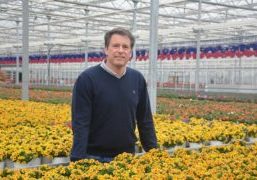
And that’s exactly the reason why Olaf van der Voort, a Spathiphyllum grower and breeder based in Honselersdijk, the Netherlands, has been using leaf samples for as long as he can remember. He has collected a huge amount of data over the years which he uses as a reference framework for his current production and any problems that arise. “Because let’s be honest, every pot plant nursery gets the occasional speckling on a plant. The important thing is how you deal with it. Look, around nine years ago, when we joined the Decorum sales organisation, we decided to only sell plants of the very best quality. So I wanted to know what was causing that speckling and what I could do about it.”
To get to the bottom of this, the nursery takes soil, water and leaf samples at least once a month and compares all the results. “The soil and water samples show the current availability of nutrients and the leaf samples indicate what the plant has done with them over the past few weeks. I want to see numbers and collect as much data as possible. Log, log and log again. That gives you a much better understanding of the plant’s processes and enables you to respond faster to any problems.”
Quality inside and out
Delphy House Plant Consultant Aad van Holsteijn understands this only too well. “If you want good quality foliage and flowers, you must make sure you’ve got your nutrients absolutely right. The nutrient supply – fertilisation – plays an important part in the internal quality of the plant’s cells and therefore of its leaves or flowers. Good quality on the inside is important for growing fast. And growing fast is, in turn, an integral part of good production. In other words, if the quality of every leaf is good, you can grow more quickly and therefore increase your yields. You see big differences between nurseries in this area, particularly in crops grown in shade, such as Phalaenopsis, Spathiphyllum, Bromelia and Zamioculas.”
In a fast-growing shade crop such as Spathiphyllum, an imbalance in fertilisation impacts directly on the purity of the leaves. The main causes of visible defects are boron or manganese toxicity, manganese or magnesium deficiency and an incorrect K:Ca ratio, but also potassium or nitrogen deficiency. Constant monitoring is therefore called for, not only to enable you to grow as quickly as possible but in particular to control the crop better, van der Voort says. “You want to be able to deliver a beautiful product all year round.”
Zinc deficiency
In Van der Voort’s case, that’s a lot of different products. The company supplies pot sizes ranging from 6.5 to 17 cm and bowls from 17 to 23 cm, plants in various heights, as well as sleeves, labels and trays. Van der Voort works with his advisors to constantly push the boundaries – always bearing the controllability of the crop in mind, of course. “Capitalising on these small points for improvement can really make you stand out from the crowd,” the grower says. “And the same applies to fertilisation. By keeping a close eye on the take-up figures in the plant, I can quickly tell whether levels of certain nutrients are too low or too high. When that happens, we can adjust our fertilisation and improve the quality of later leaves.”
During Olaf’s father’s time at the helm of the company, the crop suffered from zinc deficiency. That was what prompted van der Voort to work with van Holsteijn. The advisor: “They had random plants lagging a long way behind in growth, particularly in the winter. In addition, the tips of the leaves had distorted colours instead of being uniformly green. We took leaf samples and discovered that zinc levels were very low. They made adjustments to the nutrient supply and the problem disappeared.” Since then, they have been taking leaf samples regularly at Van der Voort. For example, they take a flower or leaf sample of every growth defect as a basis for possible adjustments to the nutrient supply. “But remember, this grower has specifically opted to have soil, water and leaf samples analysed,” van Holsteijn says. “The combination of all three gives the best picture.”
Set protocol
With so many test results, the grower now has a relatively complete picture of what the nutrient levels should be. But as mentioned earlier, the target values depend on a range of parameters. “And there are more and more to take on board. For example, I have plants under 600 and 1,000 watt lighting and yet I still find that nutritional needs vary between different sections of the greenhouse. I learn something new with every new development. I want to understand it all. There is no constant, so we will keep on taking leaf samples,” the grower says.
This not only helps them avoid defects preventively but also has a curative function, highlighting problems that need dealing with. “It’s important but it doesn’t come cheap. It really is a conscious decision and you do have to take the outcomes seriously. And it has to be implemented properly too, of course. So we have drawn up a protocol for sampling. It’s always the same person who takes the leaf samples, and the leaves mustn’t be too young or too old. I get the results in an Excel spreadsheet. This isn’t ideal, though: at the moment I have to enter all the figures manually. Please could someone write a program that automatically feeds the data into my management software? Data is becoming increasingly important, but you can’t do very much with it without the right ICT tools.”
Fertiliser balance
The leaf samples give growers hard data that they can use to optimise their fertilisation. These figures and insights are becoming increasingly important in pot plant cultivation, not least because of the rapid developments going on in the sector.
Van Holsteijn: “Take recirculation of water flows in house plant crops like Phalaenopsis, Spathiphyllum, Bromelia and Zamioculas. If you want to keep the nutrients in balance, you constantly have to adjust the supply of fresh nutrients. A grower can only monitor the consequences at plant level and avoid a potential imbalance in the nutrient supply by analysing.”
Summary
Growers of pot plants steer for ornamental value and growth rate. An important aspect of this is fertilisation. Leaf samples provide a better picture of the actual uptake of nutrients in the plant itself. By comparing the results against the target values, growers can adapt their fertiliser supply and optimise leaf quality. Target values vary depending on the crop, the species and the growth stage.
Text: Jojanneke Rodenburg.
Images: Studio G.J. Vlekke.
Gerelateerd


“We also need to continuously improve our efficiency through automation”
The Gartneriet PKM nursery was founded by Poul and Marie Madsen north of Odense, Denmark, in 1948. Since then, their son Kristian and their grandson Poul have become the second and third generations of the family to join the company. PKM currently employs a workforce of 165 people plus temporary staff at peak times. It produces 20 million pot plants a year and exports 90% to the European market, primarily to the retail channel. Niels Erik Andersson has been Production Advisor at PKM since 2011.
PKM channels 5% of its annual revenue back into product development to ensure that the company maintains its strong reputation as a supplier of healthy plants. “Product innovation is very important, of course,” comments Andersson. “But we need to compete with the rest of the EU and we can’t do that on quality and reputation alone. Price is an increasingly important factor for our customers, which means we also need to continuously improve our efficiency. Denmark is a high-wage country, so automation is a key way of reducing our costs. Not only that, but it’s hard work in a nursery. Especially in view of the ageing workforce, it makes sense to reduce the physical burden on our employees and let the robots do the heavy stuff.”
That is one reason why the grower’s high-tech greenhouses are highly automated. For example, in the planting department, robots are used to place the individual seedlings of Schlumbergera and Rhipsalidopsis in the sales pot with millimetre accuracy.
Robotisation
Therefore, when CEO Jack Møller was looking for further ways to improve efficiency around three years ago, it made sense to consider automating – and even robotising – other stages of production. “Packing is a particularly labour-intensive process, involving 70-80 employees at peak times, so when Møller saw a WPS automated packing system in action on a trip to the Netherlands, he was keen to explore the possibilities. Development work started in autumn 2016 and the system was then implemented in stages from early 2017 onwards,” recalls Andersson.
The result is a large, automated system combining internal transport, robotised sorting and packing on three of the four packing lines. “The first implementation stage was for picking, sorting and sleeving,” he explains. “We run a just-in-time operation based on agreements with our retail customers to supply the right quantity of plants with the right amount of flowers on the right date. So all our plants have to be sorted and graded based on their developmental stage before packing.”
Customer-specific
In the system, the robot first picks the plants from the bench, eight pots at a time, and places them in small carriers for fast and easy transport during the packing process. Then the plants are graded by a vision system and matched with the orders. If the plant fits into an order, it continues in the packing system. Otherwise it is returned to the greenhouse.
The grading system has another important function, according to Andersson. Retail buyers place their orders – including details of quantity, size, flower-grade quality, labelling, sleeving/wrapping and delivery date – in the central order handling system called ‘DANPOT’. This interfaces directly with the new system, which uses the information in the packing process.
“Each carrier contains a passive RFID tag and, during grading, the tag number is linked with information in the order system. When a plant passes a tag reader at an action point, the system combines the tag number and order information to determine what has to happen next in the process, such as adding a label showing price information or plant-care details.” In that case, the relevant label is printed and automatically attached to the pot. “Next, each plant is sleeved if necessary – either in the own sleeve or a customer-specific one,” he adds. The sleeving system was supplied by Terra International, but WPS – with Bart van Meurs as team lead – arranged for it to be specially modified for the grower. “The final step in the process is to put the plants in the marketing tray. This is done by three robots, and each robot can cope with four different tray types: 6, 8, 10 and 12-hole trays.”
Savings
Once the system is at full speed, the two picking robots will be sending a total of 4,000 plants/hour through to the next stage of the dispatch process. In comparison, the average employee is able to sort and pack 250 plants/hour manually. “Besides the manpower saving, this system has made it easier to introduce shifts so we can benefit from 24-hour efficiency. It has also reduced the amount of overtime and eliminated long days for our employees,” states Andersson.
Another benefit of this integral solution is that it is based on electronic data transfer. Eliminating manual data entry has reduced the chance of mistakes as well as saving time and money.
Complexity
What makes this project so innovative is its complexity. “We’ve set the bar high – we are trying to merge all the activities into a single packing system,” admits Andersson. “Something like sleeving is relatively simple, for example, but robotising the foil-wrapping of the trays has proven to be more challenging because it involves lots of steps: the tray is placed on a platform then a funnel covers the plants, the foil is attached to the tray, the turntable rotates the tray and the funnel, and then the foil is cut before the tray is ejected.”
Flowering plants are very delicate and easily damaged. Plus there are slight differences in the sizes of trays from different suppliers – only at millimetre level, but a couple of millimetres can make a big difference for a robot. “This is being tackled by adjusting the distance parameters in the system. We’re around 95% of the way to full implementation now, so I’m sure it will be resolved soon.” And once it is, the next step could be to automate the quality control stage of the process after sleeving, he adds.
LED pilot
Alongside this project, PKM is working on a pilot to improve energy efficiency through the use of LED lighting. “Our greenhouses are already fitted with double screens, and they are heated based on district heating using residual heat from power plants. So the only way to further reduce our energy bill is to save on electricity costs,” says the production advisor.
“We tried a 100%-LED system seven years ago and achieved around 25% energy savings, but in the winter period the plants produced under LED needed a 3 to 5-day-longer production time compared to high-pressure sodium (HPS) lamps. We are now trialling a hybrid system – 50% HPS and 50% LED – on 3,000 sqm. This combination gives us the full spectrum so we are hoping that we will be able to save energy without affecting the production time or plant quality.”
Summary
Founded in Denmark in 1948, the Gartneriet PKM nursery’s production area today covers 165,000 sqm of 20 m wide-span glass greenhouses (Venlo blocks) and an outdoor area of 40,000 sqm. The nursery has year-round production of crops including Campanula, Schlumbergera, Rhipsalidopsis, Gentian and Helleborus, depending on the season. The high-tech greenhouses include robotic solutions in the planting and packing areas.
Text: Lynn Radford.