process automation
Automate the sticking of cuttings
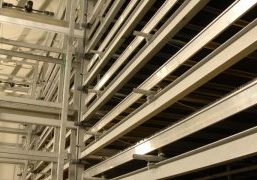
AutoStix is a revolutionary system designed by Viscon to automate the sticking of cuttings using a patented transplanter and innovative biodegradable strips.
AutoStix is an open source system, so it can be used by anyone in the industry. The use of a strip/carrier makes it extremely easy to automate. Ninety percent of vegetative cuttings can now be automatically transplanted. The system provides better quality control of cuttings at the nursery (a visual check is now possible) and unparalleled uniformity in cultivation at the rooting station.
Better rooting
Another advantage is better rooting due to the good, solid soil-root contact designed into the strip. Shorter cultivation cycles are guaranteed as the process is controlled. The strip (cartridge) is biodegradable – a world first in horticulture. There are numerous spin-off innovations based on the this strip (the biodegradable cartridge). The strip is a carrier designed to efficiently handle the plants in many different ways.
www.visser.eu
Stand number: 11.410
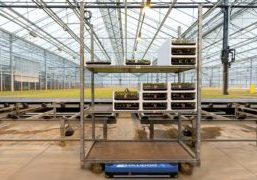
Smart automatic guided vehicle in ultra-low body
In the ornamental industry, mixing and shipping goods on CC trolleys is highly labour-intensive. Growers dislike these trolleys because of their inferior manoeuvrability and limited automation options.
Eurotec has therefore launched Lowpad, an automation system for CC trolleys. It is an AGV (automatic guided vehicle) which fits underneath a CC trolley, lifts it up and travels autonomously with the CC trolley on its “shoulders”. Its wheels are separately driven and steered using Navigator, the on-board control and safety system. No floor infrastructure is required: all you need is a flat floor. It finds its way using an indoor GPS system combined with on-board sensors.
parent software
Lowpads are controlled by Supervisor (parent software) in an integrated system which provides traffic management, creates task and priority management, prevents collisions and plans the most efficient routes. Organizer (WCS) software can be supplied and connected to your current WMS/ERP system.
www.eurotec.nu
Stand number: 11.408
Smart packing line for potted plants
The new smart packing line from WPS consists of five individual modules, all members of the SmartStaff robot family. Modules can be combined based on the grower’s specific needs.
Smart Picking is designed especially for companies with a capacity of more than 2,500 plants per hour. It picks up plants from containers and places them in plant carriers on conveyor belts. The labelling module has a capacity of more than 2,000 plants per hour. Special feature: pots are labelled with in-line printing directly from the OCS software. The third module is for destacking trays and works with a wide range of trays which can all be learned by the OCS software.
Smart Wrapping
Placing plants without damaging them is the speciality of Smart Placing. It has a capacity of more than 1,500 plants per hour. Finally, Smart Wrapping (> 200 trays per hour) wraps trays filled with plants. This module reduces the amount of plastic used in the plant packing process.
www.wps.eu
Stand number: 11.201



'SERCOM automated Vertical Farming long before the hype'
IT company SERCOM from Lisse automated the first companies using multi-layer cultivation five years ago, well before the term Vertical Farming became a hype. At the GreenTech trade fair in Amsterdam, SERCOM will be displaying the latest process control - hardware and software - in this field.
Vertical Farming is the theme of the upcoming GreenTech trade fair in RAI Amsterdam. Vertical Farming is a global trend, and generally leafy vegetables and herbs are cultivated in closed spaces on several layers under LED-lighting. In Japan and America, Vertical Farming is on the rise, and primarily young entrepreneurs are attracted to it.
In America one Vertical Farming company after another is being set up, always in close proximity to large cities. The Association for Vertical Farming (AVF) expects that there will be a Vertical Farm next to every major urban area within 10 years. It is not surprising that multinationals like Philips, Metro, Osram, Toshiba, Microsoft, Panasonic, Fujitsu and GE are interested in it. It is not particularly popular with Dutch growers yet. But multi-layer cultivation is on the rise, especially with young plants (vegetables, potted plants) and tulip farms.
Forced tulips
SERCOM has developed climate systems for several farms in the Netherlands involved in forcing tulips with multi-layer cultivation. One of them is Karel Bolbloemen BV in Bovenkarspel. Since 2011 they have been farming vertically. That makes Karel one of the first tulip companies that started large-scale 'internal expansion' with multi-layer layers in containers with an ebb & flow system. The tulips remain in the dark for the first few days, then fluorescent light is added. SERCOM developed the system for climate control, including the cooling of the climate chambers, the lighting for the multi-layer cultivation and the irrigation of the greenhouse.
In due course, the fluorescent lighting will be replaced by LEDs. Director-owner Bert Karel thinks this will use less energy and allow better control of the plants. Research conducted by Wageningen UR in 2011 revealed that tulips respond differently to different LED-colours. There will also be a new system, in which LED-lighting will be used to improve the quality of the tulips even more and match the production better to peaks in demand. Karel Bolbloemen BV supplies tulips upon demand to supermarkets throughout Europe.
Visit SERCOM at the GreenTech at SERCOM Plaza, hall 11, stand 321.
Photo: KG Systems/Karel Bolbloemen BV.