
resistance
Rootstocks: an extra instrument to achieve production goals
In the past the use of rootstocks represented an important step in the fight against soil-borne diseases. But rootstocks offer many more possibilities: Improved vigour, setting, flower and fruit quality. And more resistance to stress or low temperatures. With respect to saving energy, the latter is an interesting option and is faster to achieve than by breeding.
Grafting allows you to combine the desired properties of the rootstock with those of the graft. When growing in soil, resistance to soil-borne diseases is an important reason to choose a rootstock. As growers have switched to substrates this argument no longer holds true for many crops and the use of grafted plants has decreased. However, time has shown that substrates are not as sterile as at first thought and that persistent soil-borne diseases can occur here too. Therefore resistance to microbial diseases remains a reason to choose a rootstock. Over the course of the time many other reasons have been added.
10% increase in production
Rootstocks are back on the agenda again, first and foremost to boost production. This, for example, is an important reason to seriously consider using a rootstock for roses grown on a substrate. In this case production can rise by some ten per cent. The grafting of tomatoes offers better resistance to different diseases and thus greater security over production. In addition, these grafted plants yield more.
But rootstocks offer many more possibilities. Production at a lower temperature, improved fruit quality, and improved resistance to heat and drought stress. Nevertheless, they are still used very little; the emphasis remains – also in research – on improving yield. But this is changing: The last few years have seen plenty of developments. In an international context, research is being carried out into the mechanisms whereby the rootstock influences the processes that take place above ground and how the genetic mechanisms function.
Greater tolerance to cold
Greater tolerance by fruit vegetables to lower temperatures would be very attractive. It would also allow further energy savings to be made and increase the crop’s resilience. Now, for example, a tomato crop that has encountered a temperature that is far too low (under 12ºC) for some time hardly recovers.
The roots, however, appear to play an important role in tolerance to lower temperatures. Photosynthesis continues as usual when it's cold, but the development of the leaves deteriorates. This is due to the poor absorption of water and nutrients and a disturbed hormone balance. So it makes sense to select species with a root system that functions better under cold conditions. For this it is often necessary to return to the wild varieties. Grafting tomatoes onto Solanum habrochaites is a way to achieve better growth under cold conditions. In cucumbers the fig-leaf gourd (Cucurbita ficifolia) is a good example.
Larger root system
The types of rootstock that are best suited to achieving tolerance to low temperatures appear to have a number of features in common. Quite simply, when it becomes cold they produce a larger root system than rootstocks that are more sensitive. Also, research on the fig leaf gourd shows that uptake of nutrients is better. And, the uptake of phosphate by tomatoes drops considerably at low temperatures but this is not a problem in wild varieties, according to trials.
If a crop of fruit vegetables has had far too much cold the leaves wilt. This clearly points to a water absorption or transport problem. This problem is much less apparent with cold tolerant rootstocks, due primarily to the more extensive root system and the longer roots. In addition, they are more capable of suppressing the formation of free radicals (which affect the cell membranes) during cold stress. Finally, the hormone production is also different. Cold tolerant roots, for example, produce more cytokinins. These hormones stimulate the root meristem and ensure that sufficient assimilates are drawn to the roots.
Heat stress
On the other hand, theoretically, the rootstock should also play a role in the crop’s resistance to heat stress. The formation of the hormone ethylene is partly causing the lagging root growth when it is hot, as well as damage by free radicals. There are undoubtedly differences in ethylene production and free radical formation between the different rootstocks, but research findings so far offer little perspective. However, it has been possible to increase eggplant production by 10% under hot conditions by grafting onto a heat tolerant rootstock.
Fruit quality
Fruit quality can also be influenced by the choice of rootstock. This includes appearance, firmness, taste and healthy ingredients such as vitamins. In general, the external fruit quality (size, colour, shape) improves with greater vigour as a result of the chosen rootstock, so you don't have to select specifically for this.
Firmness is a property that is more complicated. This depends on the shape of the cells, cell turgor, composition of the cell wall and its chemical properties. All these features are influenced by the hormone systems, water and nutrient uptake. Trials have shown that grafting has a positive influence on the firmness of watermelons and cucumbers while courgettes grown on rootstocks were actually softer.
The taste of a fruit is a combination of acids, sugars, volatile substances and other components. Based on international research it is hard to say to what extent this is dependent on the rootstock. There is a more positive picture for the healthy substances, such as vitamins and lycopene. It appears that in watermelon, cucumber and tomato the levels are indeed sometimes determined by the chosen rootstock. But before a grower can start to steer the crop based on this a lot more research is needed.
The conclusion is that rootstocks certainly offer fruit vegetables perspective in the search for more energy-efficient or cold tolerant production. The impact of rootstocks on fruit quality is still a largely unexplored area.
The ultimate rootstock doesn’t exist
If you inoculate a graft with the best above-ground characteristics onto a rootstock with the best under-the-ground characteristics you’ll have the best plant. Right? Unfortunately it’s not that simple.
It all cases it’s about the combination. Characteristics of the graft and the rootstock can reinforce each other but they can also work against each other. In the worst case they can even be incompatible. (see page 46).
Usually trial and error leads to the best combination. For example, some rose rootstocks produce lots of cytokinin. If you graft onto this a variety that has difficulty developing, it has a positive effect. The graft forms more flowers. But if you graft on a variety that easily develops then you’ll have too many flowers. Sweet peppers that have a problem with setting would very much welcome a good rootstock that encourages setting.
Summary
There is renewed interest in rootstocks when growing on substrate, first and foremost to increase production. However, rootstocks offer more possibilities. There certainly provide opportunity to improve cold tolerance and thereby save energy.
Text: Ep Heuvelink (Wageningen University), Dietmar Schwarz (IGZ Grossbeeren) and Tijs Kierkels. Images: Henk Bouwman and Eric van Houten.
Related


Time for resistance
It’s always an exciting time when the first flowers appear in the new crop. We proudly put them in a vase at home so that we can continue to enjoy them after work. But after three years, you can’t drum up the same amount of enthusiasm for every variety. Sometimes I look forward to the next change of crop and sometimes I’m even quite pleased if a variety goes out the door never to return.
That came to mind last week as I was doing the rounds of the Dutch plant breeders. Lots of new species are introduced every year but only a few ever turn out to be real winners. It does seem as if breeders keep on producing more and more of the same thing, and the new ones often don’t even seem to be much of an improvement on the previous versions. Later on you discover that the flowers are very prone to mildew, they aren’t particularly productive, or they are too susceptible to pests and diseases, causing high losses. Every species has a nice little sign describing their performance but they say nothing about how sensitive the plants are. Surely there’s a better way?
If breeders could provide a little more information up front, it would make it much easier to choose the right plants. I also think that highlighting this information would shift the focus more towards breeding resistant crops, which is something that’s urgently needed. If it’s possible to produce a burger from a 3D printer, surely it’s possible to produce a young plant that’s resistant to pests and diseases?
This has particular potential in the current market, in which there is a lot of demand for clean, sustainably produced products. Some vegetable crops already come with information about how sensitive the variety is to diseases like mildew, for example. So the first step has already been taken, and it would be a nice challenge for gerbera breeders to follow this example. Who will be the first? I’m looking forward to visiting the show greenhouses of breeders like Dümmen Orange, Florist and Schreurs this year and seeing neat little signs stating what form of resistance all these wonderful blooming gerberas have.
Marius Mans
Gerbera grower in the Netherlands



‘With good bacteria and fungi you can win the war in the slab’
Plants are just like people. The fitter they are, the more resistant they are to diseases. But how do you create such a fit crop? According to the experts it begins at the roots, the heart of the plant. In recent years more attention has been paid to strengthening the root environment. Good bacteria and fungi in the slab help the plant itself to fight disease. This makes chemical products completely or partly superfluous. Tomato grower Geert Koot of Gebr. Koot, of Poeldijk, the Netherlands, became open to ‘another way of thinking’ with positive results.
The horticultural sector and research institutes both agree that crop protection in horticulture needs to change. Resilience and resistance of the crop have become the magic words. Already in 2010 researchers explained, in the Dutch journal Onder Glas, that due to the narrower range of chemical substances available and higher demands regarding residues, a different mindset was necessary. Even then a robust root environment was mentioned as the area receiving the least attention. Fortunately during the last four years producers and suppliers have not stood still.
For example, grower Koot, of Poeldijk, has been implementing the Fytopro system by Biopol Natural. Last year the supplier, a specialist in natural pest and disease control, introduced this system to promote strong and healthy growth. It consists of three parts: microorganisms; organic materials; and training.
Beneficial bacteria and fungi
Advisor Mark Hoogendoorn explains exactly what the system comprises. “Traditionally, we believed that the environment in the slab should be sterile. Now we are moving away from that. Instead of being reactive we are acting proactively. The multi-species products Hansebac and Hansespor form the basis for our system. We build-up a preventative wall of good microorganisms that help the plant to fight against unwanted fungi and bacteria and improve the uptake of nutritional elements. The plant feels so much better.”
The first product contains a bacterium – a strain of Bacillus subtilis – and various Trichoderma-fungi. The beneficial bacteria and fungi compete in the slab for space and food with harmful types. The second product includes Glomus intraradices, an endomycorrhizal fungus that grows very quickly on the roots of the plant and promotes optimal growth. The products also contain amino acids and vitamins which provide nutrients for the fungi and bacteria.
More hair roots
Geert Koot is unable to say exactly how the products work. But they do have a positive effect he discovered last season and again this season. He grows cluster tomatoes in the mid sector and sells them via the distribution centre belonging to the growers group, Prominent, to German customers. Last season he applied the system to 1.8 ha of his 4.7 ha in total.
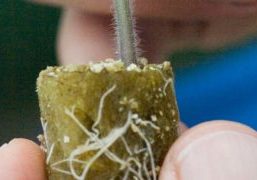
“In this 1.8 hectare greenhouse the weight of the tomatoes always lagged somewhat behind the rest. I applied Hansespor twice – once in the propagation phase and once at the beginning of the cultivation phase – and applied Hansebac five times, according to the recommendations. Last year for the first time the tomatoes in this greenhouse were similar in size.” In particular, the development of the hair roots in May and June was, according to the grower, especially good. That resulted in better uptake of nutritional elements.
In the end, the weight of the fruit was 5% higher than previously. “In addition, in that greenhouse I had less trouble from white fly because the leaves were thicker. Therefore, I could cut out three of the sprayings. All in all, it meant the cost of this approach was good. It amounts to between 16.5 and 20 euro cent per square meter.”
No chemical products
Due to last year’s good results the tomato grower decided to treat all tomatoes in this way this year. The results are similar: more root hairs, stronger plants and less pests and diseases. If the latter is a result of the system is not clear. “This year colleagues are likewise experiencing little incidence of mildew, aphids and white fly, despite the mild winter. I haven’t needed to use any chemical control but that’s the same for everyone.”
If Koot will also achieve a higher fruit weight this year is difficult to say. “I am now growing a new variety that produces heavier fruits. Actually this is not so handy for me because the middle segment goes up to 125 gram. I still don’t know what I’m going to do next year.”
The grower adds that opting for the Fytopro-system does require a slightly different way of growing. “Because the plant develops stronger roots, I’ve been giving more water. Also, I have to be careful with hydrogen peroxide which I use to clean the pipes. If I’ve applied the natural product than I can’t clean with that for two weeks. Otherwise the beneficial bacteria and fungi would suffer.”
Heavier cucumbers
Jaco den Bakker, Dutch cucumber grower, of Brielle, has had similar positive experiences with the system. His reason for choosing this resilient type of production is simple. “In principle, nature has a solution for every problem. That’s why this sort of natural substance appeals to me.” The grower produces two high wire crops per year and applies both products twice on the first crop.
“I applied the products to my entire nursery of 2.5 hectare. My impression is that more root hairs develop in the slab. Yield across the board is higher than last year, by about 10%. I can’t say if I can attribute this entire rise to these products. We did have an early and nice spring. But I do think that the extra root hairs lead to a stronger crop and that translates into heavier cucumbers. It just makes it easier for the plant and therefore it grows better.”
Bio stimulants
Other specialists in the natural control of pests and diseases also have products in their assortment that strengthen the root environment. For the last three years Koppert has been offering, under the umbrella Natugro, products such as bio stimulants, natural nutrients and plant improvers. Jan Rodenrijs, responsible for ‘special products’ says, “We start by strengthening the existing root environment. We stimulate the beneficial bacteria and fungi that are already present. In this way they can win the war over the harmful micro-organisms in the slab.”
Also Fortafol, a bio stimulant containing humic- and fulvic acids, which the company has been selling since 2014, belongs in this list. “Think of it as a vitamin shot for the plant. It builds up resistance which helps it to combat diseases.”
Natural balance in the slab
Both Rodenrijs and Hoogendoorn think there’s a lot to gain by developing resilient cultivation. Rodenrijs: “It is becoming increasingly important to grow residue free. A strong root environment helps in that respect. The roots were a forgotten zone but they actually form the heart of the plant. Strengthening the organisms around the root ensures that the mineralisation process is better, nutrients can be better absorbed and the plant builds up natural immunity substances.”
Hoogendoorn also sees opportunities. “It is another way of thinking, whereby we create a natural balance in the slab. We know there is constant communication between the plant, the roots and the microorganisms. We are now discovering exactly how this interplay works. There is still a lot to do.”
Summary
A strong and healthy crop begins with a strong root environment. Various suppliers are launching natural products that introduce beneficial fungi and bacteria into the slab or indeed strengthen their presence. These seem to produce a stronger plant that is more resilient to diseases.
Text: Karin van Hoogstraten. Photos: Studio G.J. Vlekke