Rijk Zwaan
Potential for greenhouses to make sustainable leap in the tropics
Thanks to a united effort, an educational greenhouse project has been set up in the east African country of Rwanda. Its aim is to allow businesses, knowledge centres and governments to learn about greenhouse design, cultivation and marketing. It is a process of trial and error yet necessary now that the demand for quality products from Africa is clearly growing.
The interest in greenhouse production is growing worldwide. It is a way to make a big leap in sustainable production as greenhouse cultivation requires significantly less water, fertilisers and crop protection substances per hectare or per kilo of product than open field cultivation. In addition, a crop grown under glass or plastic is protected from extreme weather conditions so the growing conditions and product quality are safeguarded.
Hardly any history
This is true in both rich and poor countries. In a country in which agriculture and horticulture has undergone limited development it is a challenge to achieve a greenhouse design that is suitable for the local conditions as well as create an effective cultivation and marketing structure. Under the so-called Smart Adaptive Sustainable Horticulture, or Smart Horticulture for short, Dutch companies are working with local partners in Africa. In South Africa this involves mid- to high-tech greenhouses and in Rwanda low-tech greenhouses.
“This is the most suitable for Rwanda. There is some covered cultivation, set up from out of Kenya, but there is hardly any history of greenhouse horticulture and no supporting industry,” says Anne Elings, of Wageningen University & Research. He is involved in the project as trainer and researcher. “The level of knowledge is also very low. This is typical of many countries that are just beginning with greenhouse horticulture. The technology itself is not the most difficult; a greenhouse can be designed for all conditions. The challenge is to get the crop growing and in particular to maintain it. This requires training in skills and competences in order to apply the technology effectively and efficiently."
Good lesson
The horticultural company Rwanda Best Company, owned by Jean-Claude Ruzibiza, carries some of the risk. The specially designed greenhouse has been constructed on his property, 50 km north of the capital Kigali. Smart is meant to improve the food supply through covered cultivation, but it is also a learning project.
“Such a pilot is an investment for Dutch businesses as it costs money, even with a subsidy, but in the long run it should pay off. They see clear opportunities. The industry looks beyond this country; they learn from the greenhouse design and what it entails for other African countries," says Elings.
Weak link
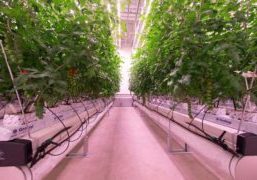
Ruzibiza’s plastic greenhouse is equipped with ridge ventilation and insect mesh. The greenhouse climate is not actively regulated, but because the greenhouse is situated at a relatively cool, high altitude that it not a problem. The crop – currently high wire tomatoes, and soon sweet peppers as well – are in pots filled with rice hulls.
“We decided on substrate production instead of soil cultivation because large parts of Africa are contaminated with bacterial wilt. Cultivating in pots requires a technological step with many consequences; watering and fertilisation are more accurate,” he says. Each pot is supplied via drip irrigation. The irrigation is computer controlled; that is possible because the power supply in Rwanda is relatively stable. Crop protection, managed by Koppert Biological Systems, is still completely chemical because there is currently a ban on the import of natural predators. This will change soon, opening up more possibilities.
“The grower is very well supported and that is also necessary,” says Elings. “You see here in practice how difficult it is when people have to come from very far away. In a tropical country the disease pressure is extreme and therefore it is essential to comply with hygiene regulations. The advice is simple: always disinfect boots, wear a protective coat and enter the greenhouse through a lock. But people are the weak link in the system.”
Local crop advisor
The greenhouse was completed in the summer of 2015. The first tomato crop had to be broken off early due to teething problems in the nutrient supply and crop protection straregy. A lot was learned. The grower took the professional decision to start the second crop with a clean slate. The current crop, planted in March, is so far going very well. “Designing a suitable greenhouse for the local circumstances is actually the easiest step. This is still the case. Explaining cultivation measures such as pruning and plant balance is difficult when there is little basic knowledge. The funding runs out after 12 months and the support will have to be phased out. It would be nice if an experienced Dutch grower in such a country, was available to give advice every week. That would make a big difference. But when more greenhouses are built perhaps the growers can help each other out,” he says.
The knowledge transfer takes place at eight similar horticultural nurseries in the region. A local crop advisor has also been hired who supervisors the grower and follows the training himself. In this way the knowledge transfer stays in the region.
Stable supply
The driving force behind the development of greenhouse horticulture is the demand for fresh and reliable vegetables. As well as the very many poor people in Rwanda there is also a growing middle class that is prepared to pay for good quality products. In addition, there are hotels, restaurants and, for example airlines, with a clear demand. “It is currently a process of trial and error. But in the longer term, such developments are necessary to meet the needs of the consumers. The middle class wants products that look good and that are grown with few chemicals. The latter is becoming increasingly important. And if you want to spray less, you certainly need greenhouses," says the researcher.
Apart from the production certainty, preserving the quality in the sales chain also needs a boost. Traditional open field tomatoes are often already overripe at the time they are sold. To differentiate from this Rwanda Best needs to handle the fruit as little as possible and put it directly into the right containers. “But the boxes cost money and may not be returned. Cooling also costs money. A stable supply of good quality produce is currently the primary focus before considering other matters such as sales under a brand name,” he says.
Market demand
LEI Wageningen University & Research has therefore also conducted a chain analysis in order to clarify the current situation and to identify bottlenecks. The researchers have made recommendations that will reduce the post-harvest losses (up to 40%).
The project clearly arouses interest in Rwanda. “The result is a big increase in interest in greenhouses. This is an interesting aspect for participating horticultural suppliers. In many African countries local and international companies are supplying greenhouses in which a lot can be improved. Market demand therefore exists. There must be opportunities for a good Dutch product that is accompanied by support and knowledge transfer, especially as governments increasingly encourage covered cultivation due to water shortages. Many teething problems have to be overcome, but if the Netherlands positions itself well, there are opportunities."
Partners working together
Within the project Smart Horticulture Rwanda, business, knowledge centres and governments are working together. Dutch companies are united in Holland Horti International. The companies participating in Rwanda are Bosman Van Zaal, Hoogendoorn, Rijk Zwaan and Koppert. The knowledge centres are Wageningen University & Research, LEI Wageningen University & Research, TNO and BoP Innovation Centre. The local consultant Green Pathways is also involved. The project is financed by businesses and the program FDOV (Facility for sustainable entrepreneurship and food security) of the Dutch Ministry of Foreign Affairs.
Summary
Dutch companies and knowledge centres are involved in the greenhouse project Smart Horticulture Rwanda. It stimulates interest in greenhouse cultivation and serves as a learning project. Greenhouse cultivation can improve the food supply in Africa and meet the growing demand for quality products.
Text: Tijs Kierkels. Images: Wageningen University & Research and Wilma Slegers.
Vertical farming is definitely the future, the only question is where and when
On 14 October 2016, InnovationQuarter organised a meeting at Koppert Biological Systems with the theme ‘Vertical Farming, in or out?’. More than 90 representatives from the sector listened to speakers such as Martien Penning (Hillenraad), Arnold van Liempt (Philips) and Jasper den Besten (HAS) talk about the opportunities, threats, benefits, costs, opportunities and challenges of vertical farming. Rien Panneman from Staay Food Group announced that a large construction for a vertical farm project in Dronten was all underway.
Martien Penning from Hillenraad gave a presentation on whether vertical farming (VF) can become horticulture’s ‘KODAK Moment’. His answer was yes. He substantiated this with an analysis of the most recent developments in the US and Asia, where dozens of VF initiatives have been rolled out. The big question was: When will VF perform as well as or better than conventional farming in greenhouses? Cost, quality, food safety and delivery speed are all key criteria here. His conclusion was not whether VF is feasible, but where and when.
Arnold Liempt from Philips Horticulture LED Solutions gave an overview of the many international vertical farming projects currently underway or being implemented. His presentation also made it clear that many there are many different models of vertical farming; from vegetable gardens under glass to cleanroom factories. An example was shown of an in-store farm with LED lighting at Metro Group in Berlin. VF in the Netherlands is still limited to research centres (Brightbox, Grow Wise Centre and PlantLab), and the propagation of seedlings, such as at lettuce grower Deliscious.
Feasibility
Jasper den Besten of HAS University of Applied Sciences talked about which technological developments vertical farming might accelerate. He proposed that conventional greenhouses would remain important for growing vertical crops such as tomatoes, cucumbers, peppers and aubergines, while greenhouses with intermediate LED light could be seen as ‘The New Cultivation’. Just like Martien Penning, Den Besten noted that many technologies such as LEDs, sensors and robots are rapidly decreasing in price, and that this will accelerate the financial viability of VF projects, even though the cost of lettuce and herbs from VF is still considerably higher (2 to 8 Euros per kg) than those from a conventional greenhouse. On the other hand, VF projects can be better controlled in terms of colour, flavour and substances in plants. For example, the brix category of strawberries can be improved.
Ruud Kaarsemaker from Groen Agro Control discussed how nutrients could be used to control substances in plants. He said that the maximum possible returns are defined by the objectives, which might be dry matter content, substances in the produce, potassium or nitrate content, absence of residues or shelf life. The variety selection, cropping system (e.g. NFT) and recording analyses of nutrients can be used to achieve the desired objectives.
Vertical Pharming
‘Alternative Thinker' Peter Jens sees VF as an opportunity to grow medicines, and therefore prefers the term ‘vertical pharming’. According to Peter Jens, we have to look at consumers differently in order to decide if VF is a beneficial cultivation system.
After the presentations, it was the turn of those working in the field, represented by Priva, Vitro Plus, Rijk Zwaan, Certhon, Plantlab and Staay Food Group. The expectation of a number of experts was that vertical farming will soon be offering plenty of opportunities for some crops and segments (the luxury segment and specialty shops and restaurants). Many flower crops and vertical crops such as tomatoes are unsuitable at the moment, but breeding and other growing techniques may eventually offer opportunities. VF definitely offers perspectives for special segments and niches in the market, but it is not yet able to compete with conventional cultivation.
Staay Food Group
To everyone's surprise, Rien Panneman from Staay Food Group announced that a large construction for a vertical farm project in Dronten for the cultivation of lettuces to supply large supermarket chains was underway. The project involves cooperation with various partners (Philips, Rijk Zwaan) and knowledge institutions (HAS, Wageningen UR). This farm will be up and running no later than June 2017, which means that VF will soon be a reality in the Netherlands. Growing in climate cells is seen as clean and food safe, something which consumers are willing to pay more for.
Anne-Claire van Altvorst from InnovationQuarter looks back on a successful day, “Many insights were presented from various quarters, as well as opportunities in many market segments. The openness we were able to create with each other was an essential element for ensuring the positive atmosphere. It was a fantastic day, and looks like it will be repeated. What is true, especially after the eye-opener from the Staay Food Group, is that vertical farming is 'in'."
Text/photos: Mario Bentvelsen.