
robots
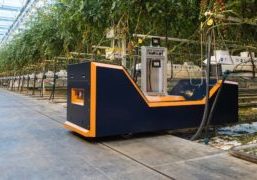
Priva deleafing robot co-created with growers
Chances are big that the Priva Deleafing Robot will be the winner of the 2016 GreenTech Innovation Award. It is the first robot in the world today to offer an economically viable alternative for the manual removal of leaves in tomato plants.
Crop handling comprises a significant chunk of the labour costs associated with the cultivation of crops such tomatoes, cucumbers and sweet peppers. Robots offer an interesting perspective to reducing these costs and enhancing the manageability and predictability of business operations. In collaboration with a group of Dutch tomato growers, Priva has developed a robot that removes leaves from tomato plants completely independently and in an economically viable manner. It is always difficult to find workers for this labour-intensive and unpleasant task.
Many demonstration projects have been launched in the past few decades. However, none of these have led to economically viable products. This can generally be attributed to the fact that the performance exhibited by robots was never able to stand up to that of human workers in terms of speed and quality. A great deal of attention has been given to practical applicability in the development of this robot. The close involvement of a large group of growers has proven to be essential: only they can properly assess the usefulness of the robot.
Vision technology
The robot must be able to identify plants and leaves, for which cameras and smart calculation technology (vision technology) are deployed. Because no two plants are identical and the lighting conditions under which the robot operates is subject to constant change, state-of-the-art vision technology was developed. When the robot identifies a leaf, it removes it with a cutting module mounted onto its arm. This cutter must be as compact as possible to allow it to easily move through the plants, and additionally designed to effectively withstand contamination and the damaging effects of the acidic juices exuded by the tomato plant.
‘Thanks to the application of vision technology, the robot can quickly and accurately identify the position of the leaves and its speed of operation is currently at an economically viable level,’ confirms Ronald Zeelen, Manager for Innovation & Research at Priva. Of course, the robot can’t work at the same speed of an experienced human, but compensates this by being able to work 24 hours a day.
The second GreenTech Innovation Award for the most innovative product or solution will be presented during the opening of the GreenTech in Amsterdam on 14 June 2016. Category awards will be presented in three categories: production, equipment and automation solutions. One of these three winners will be chosen overall winner.
Click here for a list of all nominees for the 2016 GreenTech Innovation Award.
Photo: Priva.
‘A robot has to give you a little something extra.’
Sweeper was launched at the beginning of 2015. The goal of this project is to develop a harvesting robot for sweet peppers. The robot is being tested at De Tuindershoek, a sweet pepper farm in IJsselmuiden run by two brothers, André en Paul Kaashoek.
What made you decide to join in the development of Sweeper?
‘As a member of the Dutch National Sweet Pepper Committee I was involved in Crops, the predecessor of Sweeper. As Sweeper had to be tested in practice, we proposed our farm as a testing ground. Also, if you are among the first to collaborate on projects like these, you will be able to benefit from innovation grants. That doesn’t mean that funding is our only incentive: all six partners in the project are expected to put a lot of effort into the project.’
What is being researched at your farm?
‘The prototype should be ready in February 2018; we are currently still looking into a number of different aspects. One of these was testing several types of cameras. The goal was to choose the best camera, while also exploring the possibilities of what a camera can capture in terms of data. It may even lead to us cultivating another variety to accommodate the research, for example. That would be quite a drastic change, but like I said, we have very high standards in terms of what we want to accomplish with this project.’
‘Labour is currently our biggest cost item. A robot would help us achieve tremendous savings in this.’
What advantages would a robot have for your farm?
‘Our biggest cost item is labour, for harvesting the green peppers. A robot would help us achieve tremendous savings in this. We would also need fewer seasonal workers. On the other hand, we would need more technical staff for maintenance on the robots. That would mean a big change in the composition of our workforce. Of course, we would have to make sure that the venture is economically viable: a robot has to give you something extra.’
Aren’t you apprehensive about making this investment; by being the first to test a harvesting robot?
‘Nobody is forcing us to join in, or adapt our greenhouses. This is our very own decision. And a decision we will continue to support.’
Are you enjoying your contribution to the development of a robot?
‘Absolutely. It is also very exciting and quite challenging at times.’
Text: Tuinbouwteksten.nl/Mario van Vliet. Photo: Mario Bentvelsen.
Download the complete dossier Robots in Greenhouse Horticulture (13 pages, pdf).
If you want to download this content you need a subscription, or log in when you already have a subscription.
Related





‘Fewer neck and shoulder complaints and always a uniform quality.’
Leo van den Harg, of the potted rose nursery in Vierpolders that bears his name, bought a Rombomatic ten years ago: a combination of four robots that takes cuttings from roses and subsequently roots them. ‘In the spring, we use it 7 days a week, 24 hours a day.’
What prompted you to buy this robot?
‘We were on the brink of an expansion, which would mean having to take as many as 400,000 cuttings a week for several weeks at a time. People can easily develop neck and shoulder complaints from this. Also: you can explain precisely to people how you want them to take certain cuttings, and root them, but people will always be people, if you know what I mean. If you use a robot you can be assured of a uniform quality.’
How long does it take for the investment of a robot to pay itself back?
‘Thanks to the robot I need fewer workers to take the cuttings and root them. Still, the reduction in personnel costs did not enable me to earn back my investment immediately. However, after a few expansions our investment in the Rombomatic was amply paid back. The Rombomatic also relieves my workers from heavy manual labour: all they have to do is put the cuttings in position. The only equipment they need to do this comfortably is a good chair.’
Does a robot always perform its duties?
‘Absolutely. In spring we use it 7 days a week, 24 hours a day. Three years ago we had four robots replaced. By that time we had rooted 125 million cuttings. That’s 125 million movements! We began to get an increasing number of malfunctions due to wear and tear. Of course, that wasn’t a huge problem: if one robot was out of operation, the other three can continue working. However, the capacity of the Rombomatic then drops to 80%. A big bonus was that the robots were replaced by new ones that work 10% faster.’
Do you use any other robots in addition to the ones that clip and root cuttings?
‘We make use of a packaging robot, but I wouldn’t really call that a genuine robot. That is more a question of automating repetitive movements. The same applies to the robots that pick up and move plants. Besides that, we don’t have any other duties here that could be performed by a robot.’
Text: Tuinbouwteksten.nl/Mario van Vliet. Photo: Mario Bentvelsen.
Download the complete dossier Robots in Greenhouse Horticulture (13 pages, pdf).
If you want to download this content you need a subscription, or log in when you already have a subscription.
Related
‘An integrated robot doesn’t need to be more expensive than a conventional machine.’
‘We won’t even begin to consider developing a solution if the pay-back time is longer than three and a half years,’ says Piet Oomen, director and owner of the ISO Group in Gameren. This company was established in 2009 for the development of machines that has robots integrated in them. Since then, the ISO Group has developed fully-automated robots for numerous crops. ‘An integrated robot doesn’t need to be more expensive than a conventional machine.’
What prompted you to start developing robot applications in horticulture?
‘The year 2009 saw a substantial crisis in the horticulture industry. We noticed that at our machine plant as well. One of the horticulture firms near us rooted millions of cuttings every year. One day, we put our heads together and developed an automated rooting tool for plant cuttings. That was the beginning, and it had an enormous impact on our company. We were soon able to incorporate the combination of vision technology and robotics into a wide variety of applications.’
How is your company working on the development or robot applications?
‘We apply robot applications and vision technology to automated tools for clipping and rooting plant cuttings, grading machines, transplanters and grafting equipment. Working in collaboration with our partners in the field of vision technology, we continually aim to raise the bar even higher. This means: training robots to “see” better, in combination with the accurate and failure-free processing of materials. We are now able to process increasingly smaller or more complex cuttings and are attaining ever higher levels of precision in grading. Thanks to our and Wageningen University and Research Centre’s concerted efforts in the field of 3D vision, we are now able to process the vines of potted roses faster than ever before, and monitor the growth process of such plants with greater precision, too.’
What is the average pay-back time for an ‘average’ robot application?
‘An investment in one of our robot applications will earn itself back between two and three and a half years. This is quite short, actually. However, it is more difficult to get financing for long-term investments. This is why we won’t even consider developing a robot application with a pay-back time longer than that. An integrated robot doesn’t need to be more expensive than a conventional machine. The investment in a robot is usually earned back within a short space of time due to the lower price, simple operation and even lower maintenance costs.’
What is your vision of the future for robots in horticulture?
‘We will continue to make improvements in terms of quality and speed. I have high hopes with regard to phenotyping: the ability to predict quality-related results based on external plant traits. This is highly useful not only in grading plants, but in selecting seeds as well. And my own agenda remains: to continue to remain ahead of the competition with cheap labour. One of our customers decided, for instance, to relocate to Africa, where labour was cheaper. He recently returned to the Netherlands and started using automatic rooting equipment for plant cuttings. A robot application not only saves labour, the uniform level of quality it can produce is just as important. A robot will root all cuttings at precisely the same depth, for example. Robots never do anything in a random way.’
Text: Tuinbouwteksten.nl/Mario van Vliet | Photo: Mario Bentvelsen.
Download the complete dossier Robots in Greenhouse Horticulture (13 pages, pdf).
If you want to download this content you need a subscription, or log in when you already have a subscription.
Related
‘The introduction of robots requires industrial thinking.’
Millions of products are grown in the horticulture industry, of which none resembles the other. Not only that, growers tend to harvest their crops at varying stages of ripeness. These are difficult circumstances for the development of a robot, confirms Erik Wekking, sales manager of Irmato, a firm that develops a lot of robots for horticultural applications. ‘It is nevertheless a fact that robots will be making their breakthrough soon.’
What made you decide to produce robots?
‘Irmato took over Jentjes Machinetechniek in 2013. This firm had been been approached at the end of the nineties by a number of growers of potted roses to develop a robot to clip cuttings. At that time, Jentjes was developing robots for industrial applications. The difference between the manufacturing and the horticulture industry is that in the manufacturing industry your products are identical; from the first to the millionth. That’s completely different in horticulture. No two cuttings are alike. Additionally, human intellect plays a big part. The eyes tell the hands what to do.’
Is that what is preventing the large-scale introduction of robots in horticulture?
‘That is part of the reason. In horticulture there are lots of different crops, which are additionally grown according to a vast number of different methods; and within this vast variety of crops types there are also many different varieties. This requires specific robot applications with corresponding new software for such tasks as identifying a flower or fruit, determining where to make a cut, or identifying ripeness. Ripeness is, however, a subjective quality. Growers decide when to harvest their fruits and vegetables according to market demands. Another factor that is complex for a robot is colour. Imagine how difficult it is for a robot to identify a green sweet pepper amidst all the green foliage of a row of sweet pepper plants! Additionally, the horticulture industry produces a lot of seasonal products. It’s much easier to earn back an investment on a product that can be sold all year round.’
What is needed for robots to become a success in horticulture?
‘First of all, it would be helpful if growers would adapt their cultivation methods. They could enable robots to approach both sides of a plant, for instance. Breeding also plays a big part in this: the plants themselves could be adapted to make them easier to be harvested by a robot. All of this is would involve some drastic changes. It is a question of embracing an industrial way of thinking. The cultivation of decorative plants, as well as the cultivation of vegetables, has achieved considerable progress in this. However, growers will not change their cultivation methods until the benefits of robot technology have been proved. The development of technology and new cultivation methods will have to go hand in hand.’
Will this breakthrough ever occur?
‘Of course. The drop in government funding and the economic crisis threw quite a spanner in the spokes: growers no longer received grants. There are, however, some demonstrable successes, like the robots that clip rose cuttings that have been around since 2002. And in 2008 we were able to demonstrate that it was possible to automatically harvest cut roses, but at that point the country was on the verge of economic collapse. Growers stopped receiving funding for the development of initiatives like that.
‘We should also join forces on a representative scale to ensure that testing can be carried out in practice before widely applying automation. Pilot projects such as the Sweeper project should be facilitated to curb disappointment among the first users of the ensuing products and who have made projects like this possible. These days, a grower with a good business case has a good chance of getting private or government funding. At the same time, robotics are becoming less expensive and new technology is constantly being developed. It is inevitable that there is a breakthrough ahead with respect to robots.’
Text: Tuinbouwteksten.nl/Mario van Vliet | Photo: Mario Bentvelsen.
Download the complete dossier Robots in Greenhouse Horticulture (13 pages, pdf).
If you want to read this content you need a subscription, or log in when you already have a subscription.
Related
Waiting for the horticulture robot
Robots appear to be the best solution to combat the rising cost of labour. After all, they can work 24 hours a day, without uttering a single complaint. So, what is keeping the entire horticulture industry from embracing the robot? Are they too expensive, has the technology not yet been developed to a high enough level, or are humans simply better workers in the horticulture industry?
The first robots have been spotted in the horticulture industry. Even better: there are plant growers with entire ‘streets’ of thirty robots whose job is to take and root cuttings. Still, most of the work being carried out in this industry involves manual labour. But aren’t robots cheaper as well as better than humans? Or, in other words: what’s preventing the large-scale introduction of the horticulture robot?
Big chances for success
The robots we are most familiar with are those used in the car manufacturing industry. In the horticulture industry robots are also very welcome alternative, with big chances of success. According to a whitepaper on robotisation (Dutch only) by a team of researchers from Wageningen University and Research Centre (WUR), this is mainly because work in the horticulture industry is often monotonous and physically demanding, and the sector subsequently attracts increasingly fewer workers. The nature of the work is, however, not the only factor. Robots perform their work with a more consistent level of reliability than people, say the researchers. ‘Thanks to modern sensors robots are able to pick, grade and inspect food products with increasingly greater precision.’
Why the agricultural sector has had to wait so patiently for the large-scale introduction of robots can be easily explained. ‘Circumstances in this sector are, by the nature, subject to constant fluctuation: a bell pepper will never be suspended at exactly the same spot for two days in a row, and no two udders are identical.’ Developments are, however, coming along rapidly. It is inevitable that the robot will soon be making a breakthrough in the horticulture industry, say the researchers. ‘The sector will be facing a gigantic challenge worldwide in 2050: having to feed nine billion hungry mouths. Without the extensive application of robots in food production we do not expect the industry to be capable of meeting this challenge.’
Tomato packaging line
Nevertheless, there are plenty of developments being launched, albeit it fits and starts. In the kick-off to the 1996 Dutch Mushroom Days the presentation of a grand total of three robots was announced. In the end, only one robot was actually presented at the fair; the other two never left the testing area - and that one robot was demonstrated for only a limited number of hours during the fair in Grubbenvorst due to technical problems. Now, almost a decade later, there are still no commercial harvesting robots for mushrooms.
Researcher Rick van de Zedde of WUR knows more examples of horticulture robots that failed to make it to the market. This can seldom be attributed to technology or the quality of the robot, but is more often than not related to a lack of confidence among suppliers and growers. ‘You may be able to develop the most amazing robot in the world, but you need to find someone willing to dig into his pockets to pay for the first one.’
The European Union found it time for a breakthrough. Politicians and policy-makers felt Europe would lag behind in terms of competitive power if not more robots were to be developed. This is why the EU is putting a lot of money into the development of robots. WUR and several of its partners are currently applying an EU grant to design a new, fully automatic tomato packaging line: the PicknPack.
The bar is quite high in the development of the PicknPack project, says Van de Zedde. ‘We will be testing the line on vine tomatoes. This has made it a complex project: a vine tomato is a composite product, after all. Any other fresh product would have been easier.’ The project is currently at a halfway mark. The line is being constructed in Wageningen and will be demonstrated to the public in 2016. PicknPack will be able to grade vine tomatoes (based on camera images), and pick up move and package bunches of vine tomatoes.
Attempts to promote the development of the robot for the horticulture industry aren’t limited to the European Union; several years ago the Japanese government funded the development of a horticulture robot, too. This strawberry-picking robot was able to harvest 60 per cent of the red strawberries, at a rate of only 9 seconds apiece. The Spanish Agrobot has been equipped with several picking arms, further increasing its productivity.
Harvesting robots
The EU aims to ensure that more and better robots are developed. However, this does not mean that there are no horticulturists already making use of robots. Rose grower Leo van der Harg purchased the Rombomatic a decade ago to clip cuttings from rose stems and subsequently plant (or root) them. The robot was designed by the firm of Jentjens, which was taken over by Irmato in 2013. This company was also closely involved in the Crops Project , a project that focused on the development of harvesting robots for various types of crops, such as apples and sweet peppers.
The Crops Project was a good starting point for the further development of harvesting robots, according to WUR researcher Jan Bontsema. Crops showed that greenhouses will need to be organised differently to facilitate the successful implementation of robots. Robots, for example, see crops only from one side. They therefore tend to overlook fruits that are hidden or even partly concealed behind leaves. This means that they would have to be able to approach a crop from both sides. Greenhouses will need to be prepared for this.
Such aspects are taken along for consideration in the follow-up to Crops: Sweeper. This research project was launched at the beginning of 2015 and receives European funding. ‘The Sweeper project explicitly takes the crop into consideration,’ continues Bontsema, the project’s leader. ‘This is why it is so important that growers are also involved in the development of Sweeper.’ A study will be conducted at the De Tuindershoek sweet pepper farm in IJsselmuiden during the next few years to discover how a greenhouse should be reorganised to make Sweeper a success.
The harvesting robot itself will also be subject to redevelopment. Bontsema provides an example: ‘In the Crops Project, sweet peppers are harvested using two ‘fingers’ and a pair of scissors. The robot therefore needs to know exactly where the stem is located, a task which it doesn’t always perform successfully. Sweeper is currently testing a ring to capture the sweet pepper. This ring will make it much easier for the robot to find the stem.’ The Sweeper robot should be ready to market in a few years. Bontsema: ‘Our goal is to build a fully operational robot within the next three years. The next step will then be for our partners to bring it to the market.’
Labour planning
The crux of the matter is: will such a robot be a financially attractive alternative for growers? This is quite a difficult question. Van der Harg: ‘Thanks to this robot, I need fewer people to make and transplant the cuttings.’ Saving on labour costs is, of course, the foremost argument in favour of buying a robot. For this purpose Wageningen UR developed MARVIN™, a robot that can inspect and grade 19,000 tomato cuttings per hour, thus replacing a work force of 27. Besides MARVIN™, the Enschede-based firm of Demcon recently announced a new harvesting robot. The newspaper header read ‘Asparagus robot at DEMCON Enschede does the work of ten people’
Van de Zedde says that it is still only in a few cases that the investment costs of a robot can actually be earned back by cutting labour costs. ‘That will only be possible if your product is available for longer than just a season, and if the robot can work for 24 hours a day. An apple-harvesting machine, for example, can only be deployed for a few weeks every year. An investment in a robot like that will only be profitable if it can perform other tasks for the remainder of the year.’ This is precisely what makes the idea behind the Sweeper robot: it can perform its tasks on almost a year-round basis.
Business model
What is at least as important is the uniform quality of work performed by a robot. After all, if you tell a robot to cut roses 70 cm in length, it will keep on cutting 70 cm roses until there are none left, night and day. When you tell a person to perform the same task their enthusiasm for the task is bound to wane after some time. However, there are tasks that a human can execute far better than any robot. Van de Zedde: ‘People are very sensitive to deviations. This is why so much of the labour carried out in the horticulture industry is manual: people are very good at that.’ Piet Oomen of the ISO Group: ‘One of customers decided at one point to outsource his production to Africa, where labour is much cheaper. However, he recently returned to the Netherlands and has started using robots.
Additionally, a robot enables you to take an entirely new approach to growing fruit and vegetables. A mobile cultivation system with the deployment of a robot would be a very sensible idea, for instance: after all, a robot that has to continually move about from plant to plant (instead of the other way around) is, of course, much more susceptible to malfunctions than a stationary one.
Also, using robots will allow for a different business model. Van de Zedde refers to the Japanese market, where strawberries are sold as if the were bonbons: completely uniform in size and ripeness, and sold in posh packaging, Japanese Grade A strawberries can easily be harvested by robots. Those robots do not have to harvest 100% of the strawberries that match the Japanese criteria; whatever remains on the plant can be picked by people and will be marketed through other channels.
Plant phenotyping
Opportunities abound. And there will be even more in the future. Van de Zedde has high hopes for plant phenotyping, for example: the assessment of the quality of a crop or product, based on its external traits for selection. Wageningen University and Research Centre is currently conducting a study into its possible applications, e.g. to monitor quality in the chain.
It is self-evident that many of the current developments feature the tomato as their test crop: it is a popular vegetable fruit that is produced by a relatively large number of growers. It also comes as no surprise that a relatively large amount of research is conducted on field produce. Thousands of hectares in Europe are dedicated to the cultivation of broccoli, for instance. A broccoli-harvesting robot would therefore also have reasonable chances of success.
Van de Zedde proposes that the successful implementation of robots in the horticulture industry depends on a handful of entrepeneurs: are they willing to rearrange their greenhouses in such a way to make the deployment of robots a profitable venture? Large-scale growers will be the first to consider a robot. ‘If you are a front-runner in a particular industry, your chances of profitability following the introduction of new technology will be greater. The ones to introduce new technology to the market will therefore always be its pioneers. I expect it to take another five to ten years before robots become the standard in the horticulture industry.’
Text: Tuinbouwteksten.nl/Mario van Vliet | Photos: Wageningen UR/Mario Bentvelsen.
Download the complete dossier Robots in Greenhouse Horticulture (13 pages, pdf).
If you want to read this content you need a subscription, or log in when you already have a subscription.