
rooftop greenhouse
Smart greenhouse roof materials with reversible optical filters
The Smart Materials project is investigating the next generation of smart, adaptable materials that will soon be available for use in greenhouses around the world.
These greenhouse roof materials are designed to use resources such as energy as efficiently as possible, while increasing the quality and yields of horticultural products. The project is being funded by various research organisations, the Dutch Ministry of Economic Affairs and a number of commercial partners. The smart greenhouse roof materials should enable the amount and quality of sunlight in the greenhouse to be optimised for every crop and climate zone in the world, even during the day.
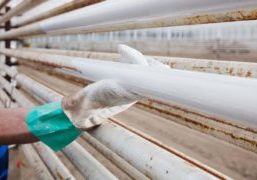
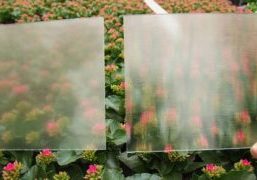
Our greenhouse roof experts use greenhouse climate and crop growth models to investigate the potential of these smart roof materials with switchable filters. The optical properties of the greenhouse roof can be changed by applying an electrical current to the material, for example. This means that a smart greenhouse roof can be used to immediately adjust the amount of penetrating sunlight to what the crop needs.
Related


Growing vegetables in an urban environment
Apart from Vertical Farming, there are numerous hybrid cultivation initiatives taking place in and on buildings, also known as Urban Farming and Rooftop Farming. Even restaurants, supermarkets and offices are experimenting with growing fruit and vegetables in cities.
Vertical Farming is, of course, not suitable for crops that grow in an upwards direction, such as tomatoes and cucumbers. This problem was solved in Jackson (Wyoming) with the construction of an impressive building incorporating huge amounts of glass, designed by Larssen Ltd.: a very expensive building costing 3.7 million dollars, partly due to its earthquake-proof construction. Three stories of the building are dedicated to LED-illuminated Vertical Farming, with two stories reserved for herbs and leafy vegetables and the third for tomatoes. The 3,800 m2 surface area is sufficient for a production of 45,000 kg a year. The building is intended to bridge the awareness gap between horticulture and the city’s inhabitants and also provides space for education. The vegetables can be seen growing from behind a glass wall. The project received financial support through crowdfunding and the municipality is the owner of the building.
Restaurants and supermarkets
InFarm is directed at growing vegetables in big cities; in and by restaurants and the retail industry. ‘We are the new farmers and the city is our company.’ In his mind’s eye, the founder of InFarm is seeing supermarkets with multi-tier cultivation for leafy vegetables above the shelves. You simply can’t buy fresher food with fewer food miles than this! InFarm developed the Kräutergarten for the Berlin-based Metro wholesaler, just as Mirai did in Japan: a multi-tier LED-illuminated greenhouse in the supermarket. The crops grown consists primarily of herbs (basil in particular) and leafy vegetables grown on a shallow layer of water (hydroponics).
You simply can’t buy fresher food with fewer food miles than this!
InFarm also operates the UFcontainerfarm in Berlin: a container with a small greenhouse on top. Tilapia fish are bred in the container. The water from the fish is pumped up to the greenhouse, where it is used to water the plants after it has been purified. This concept is also used in London, where it is called a GrowUp Box.
Above and below ground
An outsider in Urban Farming is SkyGreens. This Singapore-based initiative grows vegetables on trays suspended in gutters. These gutters circulate vertically by means of two A-shaped pillars nine metres tall. The circulatory movement enables each plant to obtain the same amount of sunlight. The company has 1,000 of these vertical towers with 20 gutters each and produces 800 kg of vegetables a day, including Chinese cabbage, spinach and other leafy vegetables.
The London-based Farmdrop initiative produces herbs underground, in former bomb shelters.
Another outsider, but of an entirely different calibre, is the Pasona office building in Tokyo, where a myriad of plants and vegetables are grown on and in the building, which also features a dedicated Vertical Farming division. The vegetables grown here are intended for the company restaurant. In conference rooms, workspaces - in fact, all over the building - you will see tomatoes growing all the way up to the ceiling, or sweet peppers and eggplants, broccoli, lemons and even passion fruit. A total of 200 varieties of vegetables, fruit and even rice are grown here! The staff is free to pick whatever they want. The company employs a permanent staff of ten people to keep the vegetables in tip-top condition. Not everything is grown efficiently, but the project was never intended to achieve a high production rate; the concept was developed to engender awareness for food provision.
The London-based Farmdrop initiative produces herbs underground, in former bomb shelters: 30 metres below the surface. It took Farmdrop two years to conquer all the challenges of underground cultivation.
Rooftop greenhouse
Where Vertical Farming appears to be booming, there is less interest among the inhabitants of big cities for rooftop cultivation - in greenhouses, at any rate. Few people practice greenhouse horticulture on rooftops, but when it is, this is mainly in the USA.
According to GothamGreens, urban farming is all about re-establishing the connection between people and the food they eat, educating young people and nurturing the soul.
A firm called GothamGreens operates a series of rooftop greenhouses, in which leafy vegetables are grown in gutters, in New York and Chicago. The first 1400 m2 rooftop greenhouse was built in 2011, and the total surface area of GothamGreens has since risen to 16,000 m2 distributed across four sites. The biggest measures 7,000 m2 and is built on the roof of a bowling alley. According to GothamGreens, urban farming is all about re-establishing the connection between people and the food they eat, about educating young people and nurturing the soul. ‘Urban Farming will never become a primary source of food, but its impact is lasting.’ A head of lettuce grown here costs around $4 at Whole Foods, almost twice as much as conventional lettuce grown in the field and $1 more than organic lettuce.
Bright Farms also aimed to dedicate itself to rooftop cultivation, but it was forced to give up its plans due to the difficulties it encountered with permit applications and the costs, which were 20% higher in comparison to an 8.5 million dollar greenhouse built just outside of the city.
The Hague
The Swiss Urban Farms initiative in Basel built a 250 m2 rooftop greenhouse as a pilot in 2013. Three years later, in May 2016, the UF De Schilde rooftop greenhouse opened its doors in The Hague, the Netherlands. As opposed to the rooftop greenhouses in the USA, which are all on one or two-storey buildings, this greenhouse is situated on top of building six storeys tall. Greenhouse builder Van der Valk Kleijn designed an extra-sturdy greenhouse with double glazing incorporated into the walls and roof. The project’s financiers are SVn (Stimulation Fund for Public Housing) and private investors. The greenhouse collaborates with Rijk Zwaan, Koppert Biological Systems and Priva.
UF hopes to cater to 900 families who can order fresh fish and vegetables via a subscription, as well as to restaurants.
The 1,200 m2 greenhouse is the biggest rooftop greenhouse in Europe. The farm grows lettuce, micro-greens and tomatoes. The floor underneath the greenhouse is rented from the municipality of The Hague to farm fish, whose waste products are subsequently used as nutrients for the plants. Visitors can watch the cultivation process from behind a glass wall. UF hopes to cater to 900 families who can order fresh fish and vegetables via a subscription, as well as to restaurants: 500 tilapia fish a week and 50 tons of vegetables a year. UF expects the venture to be a success, mainly because consumers are enthusiastic about initiatives engaged in the local production of food.
Priva developed the necessary control technology for the project, which required an extraordinary degree of innovation taking into account all the regulations that apply to fish farming (e.g. temperature and oxygen content) and irrigation (including fertilising, temperature and electrical conductivity) for the various greenhouse sections in which lettuce, tomatoes and leafy vegetables are grown. On top of that, Priva also developed the systems for CO2 and climate control.
Canada
Lufa Farms in operates a 3,000 m2 rooftop greenhouse in Montreal (Canada) and one in Laval measuring 4,000 m2. Both were built by the Montoni Group and Kubo. The greenhouses are capable of withstanding large amounts of snow.
Verticrop combines a rooftop greenhouse with Vertical Farming, with cultivation on horizontally circulating plates in twelve tiers in a greenhouse on top of a parking garage in Vancouver (Canada). As the plates rotate slowly, all plants obtain the same amount of light and are watered and harvested at a particular point. However, the company has since gone bankrupt. The investment in both the rooftop greenhouse and a complete new cultivation system was probably too high. Additionally, crops grown using this system tend not to grow as profusely due to the limited amount of daylight they receive.
Horticulture 3.0?
An interesting point for consideration is the extent to which the higher costs of a rooftop greenhouse are balanced against the presumed higher quality, freshness and local distribution. Or will the multi-tier cultivation of fruit, vegetables and fish under fully controlled conditions pave the way for Horticulture 3.0, with its smaller CO2 footprint, retention of local employment and higher diversity in supply as its social driving forces? In the meantime, restaurants, supermarkets and offices are all experimenting with growing their own vegetables, and urban consumers have discovered the art of growing their own food as a meaningful and pleasurable pastime.
Locally grown, super-fresh and demonstrably sustainable could very well become the new standard of reference.
The consequences are, however, very limited for the Dutch horticulture industry, which has traditionally always focused on the export of primarily herbs and leafy vegetables to other European countries. This does not detract from the fact that the industry should consider expanding its focus area to feeding mega-cities rather than ‘shifting around’ products from one location to another, as the CEO of Hoogendoorn, Martin van Gogh, recently suggested during the Greenport Annual Event. Locally grown, super-fresh and demonstrably sustainable could very well become the new standard of reference.
Text: Tuinbouwteksten.nl/Theo Brakeboer. Photo: UrbanFarmers/Martijn Zegwaard.
Download the complete Vertical Farming files, including the pros and cons of vertical farming (16 pages, pdf).
If you want to download this content you need a subscription, or log in when you already have a subscription.
Related



Urban Farm UF002 De Schilde open to the public on 20 May
The biggest commercial urban farm in Europe will open its doors to the public on 20 May. UF002 De Schilde, the official name of the urban farm, was developed for the sustainable production of fish and vegetables in The Hague and surroundings. Urban Farmers promises to deliver high-quality food with a high nutrient content, bursting with taste.
Starting in May, the urban farm will not only be delivering its first products to local restaurants, such as Het Gouden Kalf and Mochi, but also to visitors, albeit on a smaller scale. All products will be available for consumers in Fresh Weekly Baskets, which can be picked up at special pick-up points in The Hague from August onwards. Consumers are invited to place pre-orders for this service via the website. 'Not only will you get sustainable urban-grown fish, but also local, freshly-picked produce on your plate,' says Urban Farmers' Paul Driest. Prices will be comparable to - or just a little higher than - those conventionally charged for organic products. The initiators of the project expect to produce 50,000 kilos of tomatoes, lettuce and microgreens, as well as 20,000 kilos of Tilapia fish, every year.
Rooftop terrace
The 1,300 m² greenhouse was built by Van der Valk.Kleijn BV. This wasn't the firm's first project to be built at a great height: Van der Valk.Kleijn BV already has two similar projects to its name, explains project leader Willem Kleijn. The first was a 3,500 m2 rooftop greenhouse for Vida Verde in Honselersdijk in 2008; the second the 250 m2 Urban Farmers rooftop farm in Basel in 2013.
Exceptionally strict safety requirements applied to both the construction and the frame itself. The glass panes of the façade are anchored with screws, for which a special profile was developed. The 2 x 3 mm glass panes covering the façade are made out of two layers: a layer of tempered glass on the interior with a thickness of 16 mm for extra strength, and a 4 mm-thick layer on the exterior. Taking into account a section size of 7.5 x 7.5 metres, a Venlo cover was built with three ridges and a roof sloping at 22 degrees. The gutters were reinforced with heavy-duty aluminium U profiles to withstand gusts of wind at a height of 34 metres.
The space&matter architecture firm ensured that the façades were finished with white slats and that the greenhouse was visually separated from the office building at its base be means of a wing. After all, aesthetics are important, too!
The greenhouse will feature an Agrolux HPS lighting system and a screening system supplied by Steetec installaties BV. A roll-down façade will separate the tomato from the leaf vegetable section. The natural gas-fuelled heating systems for both the fish farm and the greenhouse were installed by Verkade Klimaat BV. The harvested products are transported using a greenhouse lift.
Aquaponic system
The residual water from the fish farm will be discharged to the greenhouse, where the fertilising agents derived from this water will be used to feed the plants. Bacteria are also grown to support this process: they transform the ammonia produced by the fish into useful substances. Even the CO2 emitted by the fish is used as fertiliser for the vegetable plants. A Priva computer, normally applied in building automation, will control all the various systems, explains Ruud Hulleman of Priva. The return water from the greenhouse will have to be made suitable for reuse in the fish farm to create a closed circuit identical to the system used by Urban Farmers in Basel. The fish farm was designed and built by Fleuren & Nooijen.
According to Urban Farmers, the greenhouse will need 90% less water thanks to the aquaponic system. The products are all grown without any chemical crop protection agents or antibiotics. The fish are well taken care of, given high-quality feed and processed in an animal-friendly manner.
Transparency and experience
Part of the greenhouse has been reserved as a visitor centre. The spectacular view of The Hague from the top floor is a bonus. The complex on the sixth floor will house a visitor and conference centre with a mobile kitchen and a glass wall, through which the fish farm on the other side can be observed. Transparency and experience are the key values of this building. This is, however, not the project's main focus area, explains General Director Marc Dumo: 'We want people to know where there food comes from. That is the basic principle behind the Urban Farmers Project. However, we mustn't forget that this is a commercial project. Our investors expect a return on their investment.'
Text/photos: Mario Bentvelsen.
Wageningen UR for Greenhouse Horticulture’s Veggie Palace wins design award
Wageningen UR Greenhouse Horticulture and its partners won a design award for its Vegetable Palace in West Flanders: an ambitious building for research and demonstrations in the field of vegetable cultivation. ‘This constitutes an unprecedented development in urban rooftop gardening,’ says Jan Willem de Vries van Wageningen UR. ‘It will be the biggest in Europe, for which we will be happy to make available all our expertise.’
A team of designers from the Greenhouse Horticulture division of Wageningen University Research Centre, Van Bergen Kolpa Architecten, Meta, Smiemans and Tractebel Engineers jointly produced the innovative designs for the Vegetable Palace: a genuine landmark for ‘The Green Hub’ on the Roeselare ring road. The building will be built on the roof of REO Veiling, Belgian’s fruit and vegetable auction and the food logistics heart of West Flanders. The Vegetable Palace is constructed from glass and steel, an airy greenhouse frame that rests on the concrete pillar of the auction building. The project, with its innovative design, is to be an example for urban food production, the intensive use of space, circular energy and water consumption and sustainability in greenhouse horticulture.
Landmark
The 9,500 m2 building will house high-tech research facilities for the cultivation of fruit and green leafy vegetables, surrounded by an educational routing for the general public. The cultivation of tomatoes and lettuce, as well as pepper and strawberries can be experienced hands-on in four different climate zones. The entrance, with an imposing staircase, leads to the Urban Farming Square with visitor facilities at the heart of the building. The ‘Façade Greenhouse’ at the ring road will feature a special greenhouse that will focus on innovation in vertical farming and that will be twice as high as conventional greenhouses. Rainwater will be collected at the foot of this ‘Façade Greenhouse’ with a reed filter for the purification of waste water.
Construction of the greenhouse is scheduled to start in early 2017, and it is expected to open its doors to growers, researchers and the general public at the beginning of 2018.
Source: Wageningen UR Glastuinbouw. Photo: Van Bergen Kolpa Architecten.