
smart ventilation
Strong tomato crop with less gas in 2SaveEnergy greenhouse
In a Cappricia crop in the 2SaveEnergy Greenhouse, we are seeing how far we can go with limited ventilation. Among other things, an average 24-hour temperature of 21.4ºC was achieved in April.
The crop tolerated this for quite a while, but in early May we had to start providing more ventilation. But venting more during the day means that less CO2 and moisture are retained in the greenhouse. In the 2SaveEnergy greenhouse, we have also been trying to save as much energy as possible without affecting the strength of the crop. That has worked well so far. Up to April, we were using 5 m3/m2 (planting date: 5 January) plus 10 kWh electricity for the heat pump.
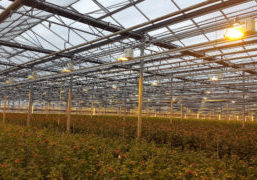
This greenhouse has a double glass roof with an F-clean film and is also equipped with a double aluminium screen and a transparent (Luxous) screen. To limit outgoing radiation, the screen is closed quite early at the end of the day, at around sunset. In winter and spring we don’t generally vent off heat towards the evening. During dehumidification, we recover both the sensible and latent heat from the air and we also use the heat from the heat pump for heating the greenhouse air.
Related



Consortium is working on a green wall for active air purification
During the Innovation Expo, taking place on April 14th in Amsterdam, a consortium of horticultural businesses will show a prototype of a green wall that produces clean air. An important part of this project is the high-tech sensor ASML, which can accurately measure so-called volatile organic compounds.
The fact that plants provide healthy air by cleaning the air of harmful substances was already demonstrated by NASA in 1989. But is it also possible to guarantee the air quality to the users of buildings? That is the key question in the project 'Schone lucht garantie' (Clean air guarantee), an innovation program of the Dutch Horticulture Innovation Foundation SIGN.
Broad consortium
The program is supported by a consortium consisting of Royal FloraHolland, Waterdrinker, Into Green, Van der Tol,Priva, Nieuwkoop Europe BV, and SIGN in alliance with the Ministry of Economic Affairs. Organic Architects was asked by the horticultural consortium to build a prototype of a green wall with a ventilation system, which sends the air actively along the green wall. The higher the concentration of harmful substances, the higher the ventilation speed.
Evidence
In order to investigate the effect, the researchers put a high concentration of volatile compounds in a room. The actively ventilated green wall was able to degrade the contaminants: methane and urea were halved within three hours, alkanes and cyclic hydrocarbons after 9.5 hours. The baseline measurement showed that without the green wall the contamination remained stable at a high level. This demonstrates that the degradation was caused by the green wall with increased ventilation.
Business concept
In the second phase of this project industrial designers will start to develop a universal ventilation system which, in combination with a variety of existing green wall systems, can contribute to a healthy living and working environment. This system will form the basis for a business concept to provide 'clean air guarantee' to building managers.
Source/photo: SIGN.