
Sweeper project
First demonstration of new sweet pepper harvesting robot in the greenhouse
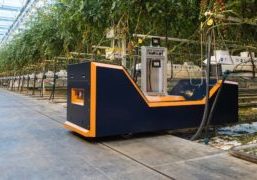
The Sweeper consortium was invited to hold the first live demonstration of its new sweet pepper harvesting robot at the De Tuindershoek greenhouse horticulture firm in IJsselmuiden. The so-called ‘Sweeper robot’ is the world’s first harvesting robot for sweet peppers to be demonstrated in a commercial greenhouse. An audience of over 40 interested parties watched the harvesting robot pick its first commercially-grown sweet peppers.
The Sweeper robot was designed to harvest sweet peppers in a cultivation system based on single plant stalks in a row, a crop without clusters and in little foliage near the fruits.
Commercial use
In earlier test set-ups in a commercial greenhouse with a V-type double-row cultivation system the harvesting robot achieved a harvesting percentage of 62%. Based on these test results, the Sweeper consortium expects to be able to bring the commercial sweet pepper harvesting robot to the market in about four or five years.
Further research required
Until then, further research will be needed to enable the robots to work faster and achieve a higher success percentage. Additionally, commercially viable cultivation systems must be developed that are more suitable to the robotic harvesting of crops. The test and research results are not only suitable for the automatic harvesting of sweet peppers; the data can also be used to robotise the harvesting of other crops.
International research partnership
Sweeper is a partnership between Wageningen University & Research (WUR), sweet pepper farm De Tuindershoek BV, the Umea University in Sweden, the Ben-Gurion University in Israel, the Research Station for Vegetable Cultivation and Bogaerts Greenhouse Logistics in Belgium. The study receives financial support from the EU’s Horizon 2020 programme and is also funded by the Dutch Horticulture and Propagation Materials Top Sector.
Successor of CROPS
The Sweeper robot is the successor of CROPS (Clever Robots for Crops), an EU project launched by WUR, in which WUR and the other participants developed a robot that can make a distinction between a sweet pepper plant’s fruit, leaves, stalks and main stems. As a result, the robot can harvest sweet peppers without damaging the fruit, leaves, stalks or stems.
Source and photo: www.sweeper-robot.eu. Video: Wageningen UR greenhouse horticulture.
Related
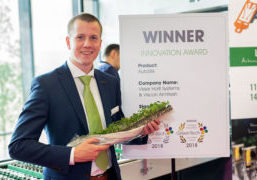




‘A robot has to give you a little something extra.’
Sweeper was launched at the beginning of 2015. The goal of this project is to develop a harvesting robot for sweet peppers. The robot is being tested at De Tuindershoek, a sweet pepper farm in IJsselmuiden run by two brothers, André en Paul Kaashoek.
What made you decide to join in the development of Sweeper?
‘As a member of the Dutch National Sweet Pepper Committee I was involved in Crops, the predecessor of Sweeper. As Sweeper had to be tested in practice, we proposed our farm as a testing ground. Also, if you are among the first to collaborate on projects like these, you will be able to benefit from innovation grants. That doesn’t mean that funding is our only incentive: all six partners in the project are expected to put a lot of effort into the project.’
What is being researched at your farm?
‘The prototype should be ready in February 2018; we are currently still looking into a number of different aspects. One of these was testing several types of cameras. The goal was to choose the best camera, while also exploring the possibilities of what a camera can capture in terms of data. It may even lead to us cultivating another variety to accommodate the research, for example. That would be quite a drastic change, but like I said, we have very high standards in terms of what we want to accomplish with this project.’
‘Labour is currently our biggest cost item. A robot would help us achieve tremendous savings in this.’
What advantages would a robot have for your farm?
‘Our biggest cost item is labour, for harvesting the green peppers. A robot would help us achieve tremendous savings in this. We would also need fewer seasonal workers. On the other hand, we would need more technical staff for maintenance on the robots. That would mean a big change in the composition of our workforce. Of course, we would have to make sure that the venture is economically viable: a robot has to give you something extra.’
Aren’t you apprehensive about making this investment; by being the first to test a harvesting robot?
‘Nobody is forcing us to join in, or adapt our greenhouses. This is our very own decision. And a decision we will continue to support.’
Are you enjoying your contribution to the development of a robot?
‘Absolutely. It is also very exciting and quite challenging at times.’
Text: Tuinbouwteksten.nl/Mario van Vliet. Photo: Mario Bentvelsen.
Download the complete dossier Robots in Greenhouse Horticulture (13 pages, pdf).
If you want to download this content you need a subscription, or log in when you already have a subscription.