
sweet pepper
Biobest develops new weapon in the war against aphids
Combating aphids with biological crop protection agents is everything but easy. This is why Biobest is involved in relentless research into new ways to get rid of aphids. The result? The hoverfly, Sphaerophoria rueppelli, is being deployed in the battle.
Many commercial crops are plagued by a plethora of aphid varieties that can create a tremendous amount of damage. A lot of preventive pest control strategies have already been explored. Many of these focus on the use of parasitoids. Although these are quite effective, they still aren’t effective enough to be truly reliable. According to Biobest, the biggest problem is that every parasitoid attacks only a limited number of hosts.
The latest weapon in the war against aphids, Sphaerophoria rueppelli, is a native species that is very common throughout Europe and in numerous Mediterranean countries. Its larvae are highly efficient predators of various ahipd vaieties, including Macrosiphum euphorbiae. Not only do hoverflies feast on aphids, they also consider whiteflies, thrips, and spider mites to be a delicacy. ‘Sphaerophoria rueppellii will go actively in search and fly long distances to detect even the first signs of an aphid colony,’ explains Yann Jacques, Product Manager for Macrobials at Biobest. ‘The Sphaerophoria System is therefore also a preventative system. It is a perfect complement to our existing range of parasitoids and predators.’
Biology
Adult hoverflies are virtually harmless, as they feed only on pollen and nectar. It’s the larvae, however, that are the leading players in the war against aphids. Adult females prefer to lay their oval-shaped greyish white eggs in large colonies of aphids, to ensure that their offspring will have plenty of nourishment. Each female can lay up to 20 eggs a day, and up to 400 eggs in all. The green larvae that are hatched can consume an average of 200 aphids during their larval stage, which lasts nine days at a temperature of 25°C. They will also feed on other pests, such as whiteflies, thrips, and spider mites. ‘What’s so interesting about this system is that the hoverflies can be deployed concurrently with aphid parasitoids. Hoverfly larvae will devour only the non-parasitised aphids. By deploying both, the number of aphids will be reduced even more dramatically,’ concludes Jacques. S. rueppellii is highly efficient when deployed in sweet pepper crops, but it looks as if this system will also promote aphid control substantially in other vegetable, fruit and decorative plant crops.
Source/photo: Biobest.
‘A robot has to give you a little something extra.’
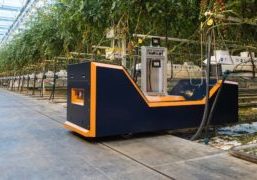
Sweeper was launched at the beginning of 2015. The goal of this project is to develop a harvesting robot for sweet peppers. The robot is being tested at De Tuindershoek, a sweet pepper farm in IJsselmuiden run by two brothers, André en Paul Kaashoek.
What made you decide to join in the development of Sweeper?
‘As a member of the Dutch National Sweet Pepper Committee I was involved in Crops, the predecessor of Sweeper. As Sweeper had to be tested in practice, we proposed our farm as a testing ground. Also, if you are among the first to collaborate on projects like these, you will be able to benefit from innovation grants. That doesn’t mean that funding is our only incentive: all six partners in the project are expected to put a lot of effort into the project.’
What is being researched at your farm?
‘The prototype should be ready in February 2018; we are currently still looking into a number of different aspects. One of these was testing several types of cameras. The goal was to choose the best camera, while also exploring the possibilities of what a camera can capture in terms of data. It may even lead to us cultivating another variety to accommodate the research, for example. That would be quite a drastic change, but like I said, we have very high standards in terms of what we want to accomplish with this project.’
‘Labour is currently our biggest cost item. A robot would help us achieve tremendous savings in this.’
What advantages would a robot have for your farm?
‘Our biggest cost item is labour, for harvesting the green peppers. A robot would help us achieve tremendous savings in this. We would also need fewer seasonal workers. On the other hand, we would need more technical staff for maintenance on the robots. That would mean a big change in the composition of our workforce. Of course, we would have to make sure that the venture is economically viable: a robot has to give you something extra.’
Aren’t you apprehensive about making this investment; by being the first to test a harvesting robot?
‘Nobody is forcing us to join in, or adapt our greenhouses. This is our very own decision. And a decision we will continue to support.’
Are you enjoying your contribution to the development of a robot?
‘Absolutely. It is also very exciting and quite challenging at times.’
Text: Tuinbouwteksten.nl/Mario van Vliet. Photo: Mario Bentvelsen.
Download the complete dossier Robots in Greenhouse Horticulture (13 pages, pdf).
If you want to download this content you need a subscription, or log in when you already have a subscription.
Related




‘De-leafing curbs energy loss’
Evaporation - and therefore energy loss - can be limited by removing excess foliage. This principle is, however, applied to only a few crop varieties. Professor Marcelis sees oppurtunities for sweet peppers, tomatoes, aubergines and roses.
‘Sweet peppers do not need their lower leaves for production, for example. These leaves do not contribute to photosynthesis, while they continue to evaporate moisture. Without this evaporation you could save energy. This is why you should remove the lower foliage in late summer or early autumn. Dutch growers, however, believe that this will take too much work. Their answer to the research proposal we submitted was "We’re not going to do that", because they did not expect it to yield any substantial profits. In cases like these there is no point in conducting a study to assess the production increase resulting from de-leafing, or whether or not de-leafing has a beneficial effect on susceptibility to disease due to the improved air circulation around the plant. Aubergines are another crop that would benefit from de-leafing in late summer or early autumn.
‘De-leafing sweet peppers is relatively easy: you simply tear the leaves off. You can easily estimate the results achieved in a calculation model. However, due to the immediate rejection by the horticulture industry this study was never given a chance to prove the benefits of de-leafing.
‘Tomato growers, on the other hand, have embraced de-leafing as a useful practice. Research is now being conducted into the amount of foliage that is genuinely needed by a plant. Plants produce too much foliage in winter, in any case. We are conducting in-depth research into this.
‘When growing tomatoes, you remove the leaf at the head of the plant before it has fully formed. The plant will then no longer need to spend any energy on the development of that leaf. This is already being done in practice, but the process could be improved. Research is currently being conducted on this by Wageningen UR Greenhouse Horticulture in Bleiswijk, but I am not directly involved in this project.
‘We have not yet reached any definite conclusions with regard to how much foliage is desirable. I am convinced that de-leafing would also be useful in the cultivation of roses. Roses waste a lot of energy on unnecessary foliage. If all the sugars now seeping into bent branches would be made available for production, you could probably harvest many more branches. We have to come up with a smart solution for that. I am certain that far too much energy is being lost.’
The emergence of LEDs, climate control and a growing insight into plant physiology allow crops to be grown in greenhouses all over the world. Does greenhouse horticulture in the Netherlands have a future?
‘There are actually many advantages to greenhouse horticulture in the Netherlands. Summers aren’t so hot. There could be more light in winter, but there are other greenhouse horticulture areas - such as in the United States - where winters are much colder. Many regions have to cope with regularly extreme weather conditions. No, greenhouse horticulture certainly has enough advantages.
‘It is, however, a fact that horticultural developments are taking place at an accelerated pace all over the world. The Netherlands is a front-runner with respect to efficiency. If you wish to retain that leading edge you will, however, have to continually come up with smarter solutions with regard to efficient cultivation, marketing, quality and vitamin and nutrient content. Innovation is essential to horticulture.’
Leo F.M. Marcelis (Elst Gld, 1963) studied horticulture at Wageningen University, where he obtained his PhD in 1994. He was a professor by special appointment of Crop Production in Low-Energy Greenhouses at Wageningen University until 2013 and team leader at Wageningen UR Greenhouse Horticulture. On 1 December 2013 Prof. Dr Leo Marcelis was appointed Professor of Horticulture and Product Physiology at Wageningen University.
Download the complete interview with prof. dr. ir. Leo Marcelis about diffuse glass, LED-lighting, urban farming, de-leafing and the effects on plants, energy consumption and cultivation strategy (login required).
Source/photo: Tuinbouwteksten.nl/Theo Brakeboer.