transpiration
Intensive screening promotes transpiration from the top
Reducing energy consumption in greenhouses is associated with higher humidity levels. Many growers are concerned that this could make the crop less active, impacting on transpiration from the top in particular. Last year, a Dutch research project was launched with the specific aim of measuring that. The conclusion: rather than a reason for concern, intensive screening is actually a way of improving the crop.
The “Transpiration from the Top” study took place at the Wageningen University & Research greenhouses in Bleiswijk, the Netherlands. Over two months, greenhouse climate and energy researcher Feije de Zwart tested a measurement method in a mature tomato crop and evaluated the quality of the technique. “We looked at the extent to which we could specifically measure transpiration at the top of a crop using a thermal imaging camera. And it worked. But this method requires an extremely accurate camera and a lot of attention. So for the time being, although this camera is excellent in the lab, it is not really suitable for use in the commercial setting.”
Measurement system
Low-energy cultivation not only requires better greenhouse insulation, but it also means the crop has to be grown in higher humidity levels. Growers tend to use their screens more often and don’t often open gaps in them. This increases the humidity in the greenhouse. “One of the reasons why growers are reluctant to accept this situation is that they are concerned the crop may not transpire enough,” de Zwart says. “After all, the more humid the air in the greenhouse, the lower the difference in vapour pressure between the crop and the greenhouse air, and the less the crop will transpire. They are most concerned about the top of the plant.”
These concerns stem from the fact that inadequate transpiration can affect nutrient transport to growing tips. He adds: “To measure is to know, so we developed a measurement system that can accurately determine transpiration at the top. A sensor of this kind could put growers’ minds at ease and could result in wider acceptance of higher humidity levels, particularly in vegetable cultivation.”
Camera plus artificial leaf
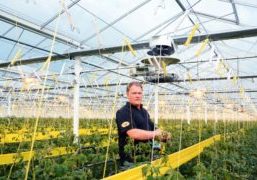
To test the system, the researchers installed a thermal camera above the crop. Besides the leaves on the crop itself, there were always two artificial leaves in the camera’s line of sight. One of these artificial leaves was fitted with a PT-100 temperature sensor to check the temperature registered by the camera. With this setup they were able to compare the temperature of a leaf at the top of the plant with that of an artificial leaf that was not transpiring, in the same conditions. The lower the temperature of the real leaf compared with the non-transpiring one, the greater the transpiration.
De Zwart again: “In fact, we noticed that the temperature of the real leaf fell quite a bit below that of the artificial leaf at night and that the temperature difference increased as the humidity level dropped. The best thing was that the behaviour of the real leaves was very much in line with our expectations based on our calculations. When we took another close look at the calculations, we noticed that the reduction in radiated heat loss brought about by screening really does increase the temperature at the top of the crop quite significantly. And this in turn leads to higher levels of transpiration at the top.”
De Zwart’s conclusion is therefore that transpiration at the top of the plant simply continues when screens are used, even if humidity is higher. “Intensive screening can limit transpiration from the crop as a whole but, conversely, stimulates it from the top of the crop.”
Vertical differences in the crop
These results could perhaps explain why good yields were achieved in all those practical trials with Next Generation Growing, despite the expectation that the high humidity would cause problems. De Zwart again: “If you look at water uptake, for example by comparing the amount irrigated and the drain, or by using a weighing gutter, you can barely see the effect of screening at all. But if you look at the increase in temperature in the crop, then you can see that closing the screen increases the temperature at the top, while often lowering it slightly further down in the canopy. This is because the use of the screen means less heating is needed further down.”
In any case, the temperature gradient across the crop drops, making transpiration more even throughout the crop. “That last factor, the evenness, had never really occurred to me,” he adds. “So rather than being a reason for concern, intensive screening is actually a way of improving the crop. This realisation is essentially the most important outcome of our research. It is such interesting information that it has been added to the Radiation Monitor.”
Radiation monitor
Growers and other interested parties who attended the Next Generation Growing course in the Netherlands will already be familiar with the Radiation Monitor. This online simulation model calculates the effects of screening and greenhouse covering materials on energy consumption and vertical temperature distribution.
De Zwart used the same model to establish the expected difference in temperature between a transpiring and a non-transpiring leaf. However, the data obtained from the project mentioned above demonstrated that the original calculation method was too inaccurate. Following improvements, the program now calculates transpiration at each layer of the crop.
The basis for this is that the difference in vapour pressure between the greenhouse air and the leaves plays a bigger role in driving transpiration than the local leaf temperature. The program can be used via the greenhouse horticulture models website.
“Impractical” method
De Zwart is slightly less enthusiastic about the results of the original project setup. “The measuring equipment was quite tricky to set up. We didn’t have a problem collecting images with a thermal camera, but focusing the lens was difficult. The plant was growing, so we had to constantly refocus the lens. Also, you have to use artificial leaves. We now know that a tomato leaf transpiring at the normal rate at the top of the plant is around 0.4°C cooler at night than a non-transpiring leaf in the same place.”
If this measurement method is used to distinguish normally transpiring leaves from leaves transpiring at a lower rate, the temperature differences measured should be in the magnitude of 0.2°C. These are such small differences that you would need to know exactly how warm a non-transpiring leaf would be in that position. That is why you need artificial leaves and a very accurate camera. He adds: “Actually, you do wonder whether the information you get is really worthwhile. After all, we now know that transpiration at the top of the plant simply continues when screens are used intensively, even if the air humidity is higher.”
Summary
Low-energy cultivation means a lot of screening hours and higher humidity in the greenhouse. Research shows that although higher humidity causes transpiration to decrease, the use of screens does not affect transpiration from the top of the plant. The project used a thermal camera and artificial leaves. The setup worked and, besides providing figures for the top of the crop, it also highlighted the vertical temperature distribution in the crop. The data was integrated into the online Radiation Monitor.
Text: Jojanneke Rodenburg.
Images: Wageningen University & Research and Jan van Staalduinen.
Related



Slowing down crop transpiration cuts energy consumption
The focus of energy savings usually lies in technology. But the crop itself offers numerous opportunities to economise on energy consumption. Many research results are still waiting to be translated into practice.
Significant differences in energy consumption per square metre or per kilo of product regularly exist between nurseries with similar greenhouses and the same crop. These can be attributed to different views on production among the growers. One grower likes to play it safe, the other looks more into the possibilities of the plant. Within the scope of The Next Generation Growing other ways to deal with the characteristics of the crop is gaining more attention. Previous research results form the basis for this.
Transpiration
Transpiration is the driving force behind essential processes such as mineral uptake, transport in the plant, maintaining cell tension and development of fruits. But the plant exaggerates: In the greenhouse it often transpires much too much. This 'luxury' transpiration brings an excess of moisture into the air, which then needs to be removed. And draining off moisture always costs energy. It would be very advantageous to be able to slow down transpiration. Various studies have shown that it can be reduced by 30 to 35% in tomatoes without any cost to production.
Less minimum heat
Yet in practise, growers are still reluctant to slow down the transpiration. They want an ‘active crop’ and are afraid that root growth will lag behind. But ‘active’ means that the crop fully assimilates; this can also be done with less transpiration. And you can stimulate root growth better with a lower greenhouse temperature.
Over the last few years commercial growers have been assessing much more critically the use of the minimum heating pipe to reduce air humidity. Actually, raising the temperature encourages the crop to transpire even more. And then the windows have to be opened to lower the air humidity.
One step further than economical use of the minimum pipe is dehumidification with external air in combination with more screening. Then you control the air humidity independently of the window position. But this of course requires extra technology.
Picking leaves
A very effective means to drastically reduce crop transpiration is to pick leaves on a major scale. With a leaf area index (LAI = m2 leaf surface area per m2 ground) of 3 to 4 you already have sufficient light interception. Any number above that means you have a superfluous amount of leaf in the greenhouse.
It’s normal to pick the leaves of tomato plants but it would also be a good idea for sweet peppers too. The lower leaves only transpire and don’t contribute any more to photosynthesis. Picking could also be an option for different ornamental crops. Of course you need to consider whether the extra labour outweighs the energy savings.
Temperature
In practise there are many fixed views about the necessary temperature gradient during the day. Tomato production is definitely a crop that is very dependent on the temperature strategy. But some of these opinions lead to very high energy consumption. If you heat before sunrise, when the outside temperature is at its lowest point, it costs a lot of gas. If you want to achieve a sharp drop in temperature at the end of the day, and therefore open the windows, all the heat that you’ve just put in is simply lost.
Retain the heat
The question therefore is whether the temperature gradient during the day needs to be so precise. To find out, a study compared three regimes: Heat up quickly in the morning and cool down quickly in the evening; heat up and cool down slowly; and a middle road in which the house was heated slowly and cooled down quickly. The researchers followed the crop for an entire season, critically observed by a growers group. What happened? Looking at the crop you couldn’t tell which treatment had taken place and yield hardly differed. However, the steady strategy did save energy.
For the growers group it was a question of ‘seeing is believing’. They applied the regime to their own nurseries. Seen from a plant perspective the results were not surprising: The plant responds sooner to the mean 24-hour temperature than to a specific gradient during the day. So as a grower of fruit vegetables you can easily heat the house adapted to the amount of light and keep the heat in at the end of the day. You achieve the same 24-hour temperature with less energy.
Cooling
Another point is that at the end of the day leaves and fruit cool off at different speeds. The leaf temperature follows the greenhouse temperature; the fruit temperature lingers behind. The effect of this could be that the fruit attracts more assimilates. The differences are so small, that it’s hardly noticeable. Research has shown no differences in fruit weight between the different cooling strategies.
In pot plants, where the shape of the total crop is important, phenomena like DIF (the difference between day and night temperatures) and DROP (a sudden drop in temperature) can indeed affect the elongation or the compactness. Then it’s worth having a temperature regime during the day.
Light and lighting
If you look at light from an energy point of view, you arrive at two questions: How do you best utilise the natural light and when does it pay to use assimilation lighting? The answer to the first question was always: Ensure that the greenhouse has the highest light transmittance possible. Based on the research over recent years we can now add: Diffuse light almost always pays off. This light penetrates much deeper into the crop, the horizontal distribution of light is more uniform and both result in more assimilation.
The answer to the second question requires some more explanation. With respect to temperature, the plant responds to the average over the day, or over a few days. The latter forms the basis for temperature integration. With light however, there is an immediate response. At the same time, there are reasons why the plant, despite a lot of light, assimilates very little, for example, because the stomata are closed for one reason or another. It is therefore very useful to know the reason why. Then you know when the assimilation lights have an effect.
Photosynthesis
A grower can already determine the photosynthetic activity himself with instruments such as the Plantivity, but these measure just a very small piece of leaf. New methods are being developed that measure the photosynthesis (actually the fluorescence) of a square metre of leaf surface area.
A better understanding of photosynthesis can save energy because then the grower can adjust the lighting and CO2-dosing according to the activity of the crop.
Summary
A different growing strategy is a potential key to saving energy. An important part of this is to slow down transpiration. Furthermore, the precise temperature gradient over the course of the day is often not that important. The plant responds more to the average for the day (or several days). This response also offers a basis for saving energy. Finally, better utilisation of natural and assimilation light is possible.
Text and images: Ep Heuvelink (Wageningen University), Anja Dieleman (Wageningen UR Greenhouse Horticulture) and Tijs Kierkels.
Related



Transpiration is driver behind cooling and uptake and transport of nutrients
The plant can’t function without transpiration. But sometimes it can be somewhat less. Also less than is commonly used commercially. There are plenty of ways to slow down or encourage transpiration which will be discussed in this article.
If you want to read this content you need a subscription, or log in when you already have a subscription.