Winterlight Greenhouse
Winterlight greenhouse on track
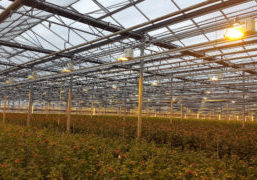
With the second crop in the Winterlight greenhouse at the Energy Innovation and Demo Centre (IDC) in Bleiswijk (NL) coming to an end, it’s time to draw some initial conclusions. The predominant feature of the greenhouse is its extremely high light transmittance.
Growers don’t only stand to gain from this in the winter but in the dark autumn months too: the 10%-plus light gain the designers were aiming for has turned out to be a reality. This not only means that all the partners involved in the project did a fantastic job, but also that the models used in the design process, such as RAYPRO, have proved their worth.
Results
On the crop side, the two high-power crops we grew also yielded good results, despite the thrips problems we had in the first crop. With a few growing weeks to go, the tally is currently 268 cucumbers with an average fruit weight of 407 grams, bringing the total yield to more than 109 kg/m2. We are pleased with the outcome on the energy front, too. In this greenhouse, which is single glazed and has two high-transparency screens and a dehumidifier with heat recovery, we used less than 20 m3/m2 gas between the end of December and mid-November. But this did mean that we had to buy in around 13 kg of CO2.
Related



Good cucumber yields in innovative Winterlight greenhouse
Last year the focus in the Dutch 2SaveEnergy greenhouse was on high-wire cucumbers. Over two production cycles, Wageningen University & Research investigated whether it was possible to grow a crop that could intercept and use winter light to the full. This trial was a preliminary study in advance of upcoming trials in the Winterlight greenhouse, a design that lets in 10% more light in the winter.
The crop in the innovative greenhouse was very successful, say crop researchers Jan Janse and Frank Kempkes. It was cleared at the end of November and the total yield is estimated at 110 kg, with 260 cucumbers. “And all with minimal energy input,” Janse says. “We used around 17.5 m3 of gas over the entire year. That once again puts us well below the average for the sector.” Yet again, this new greenhouse proves what it is capable of. The concept clearly demonstrates that Next Generation Growing can be made even more energy-efficient without affecting production or quality.
Steering the crop
This high-insulating greenhouse at the Energy Innovation and Demonstration Centre in Bleiswijk features clear glass and a permanent, high light transmitting, diffuse layer of plastic film parallel to the glass. The greenhouse is fitted with a dehumidifier unit with outdoor air entering via ducts under the gutter.
The researchers planted the cucumber variety Hi-Jack in the greenhouse on 29 December 2015. The crop was steered by varying the row width and plant density and by thinning out the fruits, the optimum having been modelled in advance. Over two production cycles the team intensively monitored light interception, cultivation (crop, production and quality) and energy consumption.
Different row widths
Janse: “We decided to start with a plant density of 1.67 plants/m and three different row widths: 1.4, 1.6 and 1.8 m. Among other things, we wanted the trial to tell us which row width would produce the best crop, would be best for light utilisation and would be easiest to work in. After all, you have to be able to move through the cucumbers on the high-wire trolley without damaging the plants too much. Each setup consisted of three ‘carousels’ (growing gutters). Regular crop observations were carried out on one carousel in each setup.”
To record the observations, Kempkes took photographs from a fixed position above the crop at the same time once a week. Using an image processing program, the researchers were then able to track the development of the crop and the projected leaf surface area to get an idea of the amount of light being intercepted. Kempkes: “If you can see a lot of the floor or the gutter on the photos, light interception is not as good as it could be.”
45% less gas
At the end of January last year, the plants were doubled by pinching out. “At one point we had a crop with highly generative growth and small leaves, but we still harvested a lot of cucumbers from it. Over six weeks (weeks 15-20) the crop produced as many as ten cucumbers per week, or 4.5 kg/m2. So clearly the plants were using their assimilates very efficiently.”
According to Janse, even the two growers on the supervisory committee were looking enviously at the crop. “The plants were strong and production was high – better than in a commercial greenhouse, in fact. We still have some work to do to find out the exact reasons for this. It may be partly down to good crop care. What was also striking was the temperature achieved: it averaged 1ºC higher than in a commercial greenhouse. This meant that the cucumbers got going very quickly. Over the entire period, the development time was around 14 days at an average greenhouse temperature of 21.4ºC. The row widths of 1.4 and 1.8 m yielded the highest production. In addition, gas and pure CO2consumption worked out at 12.7 m3and 4.5 kg/m2 respectively. This represents savings on gas consumption of around 45% compared with commercial greenhouses.”
Later second planting
The team set up a new crop in mid-July. This time they used Hi-Power with a plant density of 2.25 plants/m2, again with the same three row widths. In the period with the most light, there was therefore a gap of three weeks between the end of the first crop and the start of the second one. “We deliberately planted it slightly later because we wanted to test the crop in the dark period as far as possible. After all, this was a preliminary trial for the Winterlight greenhouse. By the end of October we had already harvested almost 100 cucumbers from this second crop, with an average fruit weight of around 420 grams. The crop finished off well and we achieved excellent overall production of good quality cucumbers.”
This time too, the row widths of 1.4 and 1.8 m yielded the best results. So the objective was fulfilled. An excellent crop can indeed be achieved with a relatively small leaf surface area, in other words small leaves, a characteristic of the variety. Because the rows were oriented east-west and care had been taken to distribute the wires evenly, the crop clearly intercepted enough light and a good proportion of the assimilates went to the fruits. There was barely any fruit abortion. Smaller leaves also mean less transpiration, which saves energy in cold periods.
Winterlight greenhouse
The research into an efficient Winterlight crop was brought to a successful conclusion. On to phase two: in late December 2016 a new high-wire crop was planted in the Winterlight greenhouse, this time with a row width of 1.8 m. Kempkes: “Both 1.4 and 1.8 produced good results but there was more plant damage with 1.4 m spacing.” The scientist, who also manages the Winterlight greenhouse project, is expecting a lot from the follow-on trial. “The Winterlight greenhouse was handed over recently and is really very nice.”
The entire structure is painted with a white powder coating with an increased reflection factor of 90%. The glass used is SmartGlass, a new type of diffuse glass in panes measuring 300 x 167 cm. Light transmission remains constant even if the glass is wet or covered in condensation. The integrated ISO++ screen system is fitted in a W shape for optimum light transmission when the screen is closed. In addition, the greenhouse is fitted with a new, highly transparent screen cloth with even better light transmission.
The greenhouse is equipped with an Air in Control climate system. The expectation was that the greenhouse would let in at least 10% more light. “Initial measurements have indicated that this light gain has in fact been achieved. The next crop will prove whether we can achieve a 10% rise in production too.”
Cutting energy consumption
In the meantime, the 2SaveEnergy greenhouse has been adapted for a new research project entitled “A strong crop with little gas”. The assumption is that it should be possible to go yet another step further in reducing energy consumption. Janse: “We will be trying this out with a dehydration system that recovers heat using a heat pump. This will enable us to not only recover tangible but also latent heat. There will also be three movable screens in the greenhouse and some adjustments will be made to the control strategy for the tomato crop.”
Both the 2SaveEnergy greenhouse and the Winterlight greenhouse are financed by the Greenhouse as a Source of Energy programme, the innovation and action programme of LTO Glaskracht Nederland and the Dutch Ministry of Economic Affairs.
Summary
A high-wire cucumber crop was grown in the high-insulating 2SaveEnergy greenhouse last year. The aim of the project was to optimise a vegetable crop by making use of the available scarce winter light. Over two cycles the researchers intensively monitored light interception, cultivation (crop, production and quality) and energy consumption. The crop performed well and the trial clearly demonstrates that both energy savings and higher production are achievable.
Text: Jojanneke Rodenburg. Images: Studio G.J. Vlekke.
Related


Full HortiContact Tour programme announced
The HortiContact Tour organisation has released its full tour schedule. On Tuesday 14 and Wednesday 15 February 2017, the two-day excursion will visit multiple nurseries and research centres, and introduce international growers to the latest developments in Dutch horticulture. The programme includes a Practical Day, and a Seminar & Exhibition Day.
On the first HortiContact Tour day (14 February 2017), participants will be visiting several growing and research facilities. The excursion will leave from Rotterdam at 8:00 hours. The first stop will be at 8:30 hours, at tomato grower Jami’s in Bleiswijk, followed by a visit to the Wageningen University & Research (greenhouse department) and the Delphy Improvement Centre at 10:30 hours. Both knowledge institutes will walk tour members through the latest developments and growing experiments.
Next Generation Growing
After lunch, the group will head for De Lier-based chrysanthemum grower Arcadia at 13:30 hours. The company opened a new greenhouse in 2015. They are Next Generation Growing and plant health pioneers. The last visit of the day will bring the group to Sion Orchids at 16:00 hours, also in De Lier. The company is renowned as an innovative producer of young Phalaenopsis plants. Sion Orchids is active internationally, on multiple continents. The day concludes with a diner.
Seminar & Exhibition Day
The second day will centre around Gorinchem, 35 kilometres from Rotterdam. At HortiContact’s exhibition premises, researchers from Wageningen University & Research will give captivating presentations: Ep Heuvelink will present on the fascinating botany world (9:00 hours), while Frank Kempkes will introduce HortiContact Tour participants to the Winterlight greenhouse; the university’s new greenhouse construction project (at 10:30 hours). A complimentary lunch concludes the morning programme.
From 13:00 hours, participants may visit the HortiContact exhibition. With an average of 450 to 500 exhibitors, it is one of the biggest and most-valued meeting platforms for Dutch Horticulture. The day will be concluded with a standing dinner reception.
Free participation
The HortiContact Tour is being arranged through a cooperation of the HortiContact exhibition organisation (hosted from Tuesday 14 until Thursday 16 February 2017 at Evenementenhal Gorinchem), Uniglobe Westland Business Travel, and In Greenhouses magazine. Through support from multiple sponsors, participation in the HortiContact Tour is free of charge. Growers from abroad will need to arrange their own travelling and hotel stays. Participants can, however, make use of the organisation’s hotel and airport transfer arrangement.
More information/signing up
Do you know growers within your international business network who might be interested in this tour? Then please refer them to the following website for more information, or for signing up: www.horticontacttour.nl.
Related



First cucumbers harvested in Winter Light Greenhouse
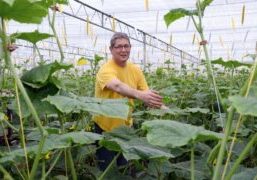
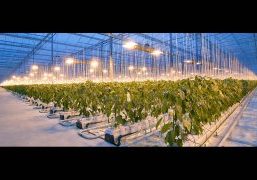
Recently, harvesting of cucumbers started in the new Winter Light Greenhouse at the Greenhouse Horticultural Department of Wageningen University and Research Centre in Bleiswijk.
The High-Power (Nunhems/Bayer) cucumber variety was planted on 19 September. Thanks to the good weather, the crop matured rapidly in this light greenhouse, so the first examples could already be harvested on 11 October. These first fruits were remarkably long; at the start of the harvest, fruits tend to be short. The growers who visited this test site every two weeks noticed that the plants were strong, with good ovaries and large leaves at the base. Although the greenhouse transmits more than 10% extra light in comparison with a standard greenhouse, light is still a limiting factor in this period. With the acquired knowledge, a second crop was planted immediately after Christmas.
Greenhouse concept
The Winter Light Greenhouse is a new greenhouse concept which, in combination with a new type of screen system, new screen cloth and light-diffusing glass, improves light transmission by more than 10%. The entire newly-designed greenhouse structure is provided with a white powder coating, which offers an increased reflection factor of 90%. The greenhouse is glazed with SmartGlass, a new type of diffusion glass with large panels. Even if the glass is wet or covered in condensation, light transmission remains constant. The integrated Iso++ screen system is mounted in a W-shape for optimal light transmission when the screen is closed, and features a new Ludvig Svensson screen with even better light transmission. The new greenhouse design is also fitted with an Air in Control climate system.
The Winter Light Greenhouse was developed by a consortium of BOM Group, Ludvig Svensson, Bayer Crop Science and Glascom Tuinbouw, in collaboration with Wageningen UR. The project was also assisted by the Greenhouse as Energy Source (Kas als Energiebron) programme, LTO Glaskracht’s innovation and action programme, and the Dutch Ministry of Economic Affairs.
Source/Photos: BOM Group.
Winter light greenhouse at research centre ready for cucumber trial
The winter light greenhouse aims to enhance light transmission by more than 10% during the European winter. In September a trial greenhouse of 500 m2 was prepared at a site at Wageningen University & Research in Bleiswijk, the Netherlands. Among other things it includes a special light transmitting cloth and diffuse, hydrophilic glass. “We’ve pinched a few per cent from everywhere. Our goal is to maximise the amount of light in the greenhouse between October and March.”
Even on a grey July day you had to squint your eyes when walking into the trial greenhouse during the construction work. In that respect it seems mission is accomplished. “Even the people working here say it is very light,” says project leader Frank Kempkes, researcher at Wageningen University & Research. He's been working on this project since 2014.
Cooperation
Kempkes organised the building together with a consortium of companies: Glascom Tuinbouw and DA Glass provided the glass; Ludvig Svensson the screen material; Bayer CropScience the most suitable cucumber variety; and Bom Group was responsible for the greenhouse and screen construction. The latter company was a logical part of the project, says its CEO Mike Vermeij. “Our company is always focused on innovation. We work closely with Wageningen University & Research on several projects. In this project too, we wanted to test our practical capability with their theoretical knowledge. Together we achieve more.”
Kempkes explains the reason for this project: “Nearly everywhere in the world natural light is the limiting factor for growth and production for part of the year. In the winter the prices are at their best. Therefore, we are searching for the ideal winter light greenhouse and a greenhouse that is also more energy efficient, because it uses more, free, solar energy."
Calculations in preliminary phase
In order to design the right greenhouse, in 2014 and 2015 researchers in Bleiswijk first looked at all the parameters. In consultation with the greenhouse designer and suppliers nine designs finally emerged. Further calculations were made using an optical simulation model created by researcher Gert-Jan Swinkels. This resulted in a greenhouse design that on paper provided 12% extra light. How? It was achieved by a combination of factors: The greenhouse construction and equipment; the glass; the screen; the screen installation; and the variety.
Larger glass panes
Starting with the greenhouse construction, it is situated east-west. This is better than a north-south position during the winter. “That is slightly less favourable in the summer but then the light is not a limiting factor. In the end you gain that back in the winter,” says the project leader.
The roof is still the ‘normal’ symmetrical Venlo roof, 5.60 m wide with extra large glass panes of 3.00 x 1.67 m. The researcher explains how this evolved. “Based purely on theory an asymmetrical saw tooth roof seemed better for the winter light greenhouse. But in practise there were disadvantages. Therefore we still went for a symmetrical roof.”
The large glass panes also caused headaches. “The disadvantage of larger glass is that it bends more. Then you need wider rods, but they intercept the light. Therefore we chose thicker glass of 5 mm instead of 4 mm. That absorbs slightly more light, but the effect is less great than wider rods."
Regarding the greenhouse construction, the upright Twinlight columns are not solid, but have a smarter, leaner, yet sturdy construction. In addition, all gutters, rods, trusses and columns are covered in a white powder coating with a reflection factor of 90%, a big improvement on out-dated aluminium that has a factor of less than 60%. “That results in just a few tenths of a percentage, but we do everything we can to achieve more light," says the researcher.
Diffuse and hydrophilic glass
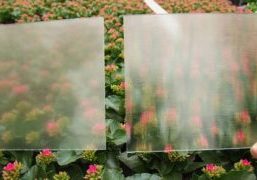
The biggest gain comes from the light transmission through the diffuse glass. Compared with clear float glass – the current standard-horticultural glass – the SmartGlass used yields more than 7% extra light. A whole process was involved in its selection. First of all, researchers established that after taking measurements diffuse glass was a better choice for the crop than clear glass, even in winter. The hemispheric transmission – a weighted average of incident light taken from all angles – of this glass is more than 90% (perpendicular 96%), while that of standard glass is 84% (perpendicular 91%).
Usually diffuse glass is structured glass. In this case it is etched glass, the speciality of glass manufacturer DA Glass. Measurements showed that both types of glass performed well, as long as the glass is hydrophilic (water attractant). “Condensation always occurs on the glass in winter. If droplets form it is at the expense of light transmission. When a water film forms the transmission remains virtually the same or even increases. The type of glass produced by this supplier causes a water film to form and there is hardly any loss in light transmission,” explains the project leader.
Actually, Kempkes expects to see many more innovations in glass. “Solar panels are covered with glass. This market is growing fast so there’s a demand for improvements and therefore it continues to develop. The horticulture sector could piggyback on this.”
Better basic material for cloth
In addition to the clever construction and SmartGlass, the winter light greenhouse prototype is fitted with screens by Ludvig Svensson. These lead to at least a 4% gain in light compared with the manufacturer’s 'standard' energy screen. The greatest gain is achieved by having a better starting material. “The screen is more transparent. After testing many samples we eventually ended up with this material,” says Kempkes. Because the H2NO-technique has been applied to this energy screen the screen remains transparent even when wet from adherent condensation.
In addition to this alternative material the fitting is also special; it’s not horizontal, but forms a W-shape. “This was the screen supplier’s idea. Just like the W-shape is better for optimum light transmission through the roof, it’s the same for the screen.”
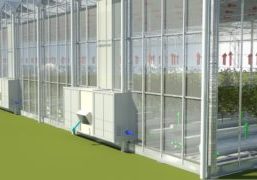
Another novelty is the Iso++ screen installation, in which two screens are about 6 cm apart. The cavity space is therefore small, so the air virtually stands still and as a result forms a good insulating layer. This is not so important for the light transmission, but it is important for the energy efficiency of the greenhouse. That also applies to the innovative dehumidifier with heat recovery, the Air in Control system by Bom Group. “We have also further optimised the forced ventilation in the greenhouse by using this system,” says Mike Vermeij.
Variety with small leaves
According to theory all these components add up to 12% extra light. The researchers are now going to accurately measure if this extra light transmission is realised in practise. The first autumn crop of cucumbers was planted at the beginning of September and will be tested. Similarly, the first winter crop of cucumbers - what the trial is really about - will be planted at the end of December.
“Together with Bayer we decided to plant Hi-Jack, a variety for a high wire winter crop. It produces smaller leaves, so that the light can better penetrate the crop. We've also tested which planting distance is best for light penetration. In this greenhouse we choose 1.86 metres in one trellis and 1.77 m in the other," says Kempkes. How the crop develops in the winter light greenhouse will be closely followed.
Summary
A winter light greenhouse has been built at the Innovation- and Demo Centre for Energy in Bleiswijk, the Netherlands. The greenhouse and screen construction, the equipment, glass and screen have been designed to optimise light transmission in the winter. The researchers, together with the participating companies, are striving for 10% extra light between October and March. A winter crop of cucumbers will be planted at the end of December. The autumn crop has already been planted.
Text: Karin van Hoogstraten
Images: Leo Duijvestijn
Bom Group introduces Winterlight Greenhouse concept: 10% more light
BOM Group will present a completely new greenhouse concept at the Greentech: the Winterlight Greenhouse. This concept, in combination with a new type of screen system by Svensson and light-diffusing glass, yields 10% more light.
The Winterlight Greenhouse, with all its installations, systems and products is currently built on the site of Wageningen UR Greenhouse Horticulture in Bleiswijk and will measure 500 m2. This coming winter the greenhouse concept will be tested with a new cultivation method for a cucumber crop, focusing on the winter period. Crop trials are conducted with the cucumber variety Hi-Jack. This variety is especially suitable for winter cultivation because of its leaf shape and direction.
Reflection factor
The newly designed greenhouse structure is fully powder coated in white with an increased reflection factor of 90%. The greenhouse is glazed with SmartGlass, a new type of diffuse glass, sized 300 x 167 cm. Even if the glass is wet or condensed, the light transmittance does not decrease. The integrated Iso++ screen system is installed in a W-shape for optimal light transmission in closed position and is equipped with a new high transparent screen fabric of Ludvig Svensson with an even better light transmission. The new greenhouse concept is also equipped with an Air in Control climate system (overpressure air).
Consortium
The Winterlight Greenhouse was developed in collaboration with Wageningen UR, Svensson, Bayer Crop Science and Glascom Horticulture. The project has been made possible by the program Kas als Energiebron, the innovation and action program of LTO Glaskracht and the Ministry of Economic Affairs.
BOM Group will present the new greenhouse concept at the GreenTech, hall 8, stand 108.